FBI drops a bombshell: Investigating Trump-Russia ties during election campaign

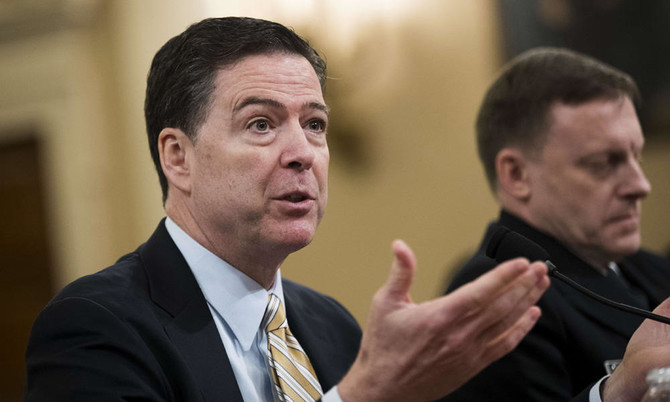
James Comey, director of the US Federal Bureau of Investigation (FBI), and Michael Rogers, director of the National Security Agency, testify Monday on Capitol Hill during a House Permanent Select Committee on Intelligence hearing concerning Russian meddling in the 2016 US election. (Drew Angerer/Getty Images/AFP)
Updated 20 March 2017
Follow

FBI drops a bombshell: Investigating Trump-Russia ties during election campaign

WASHINGTON: FBI Director James Comey sent US politicians scrambling yesterday after an unusual hearing in Congress, uncovering an official intelligence investigation into alleged Russian meddling in the presidential election and into potential ties to Donald Trump’s campaign.
Comey, testifying alongside National Security Agency (NSA) Director Mike Rogers, openly contradicted Trump’s allegations of being the victim of wiretapping by his predecessor Barack Obama. “I have no information that supports those tweets,” Comey said.

Extended probe
The more-than-five-hour hearing at the House Intelligence Committee sent shockwaves across Washington yesterday.
Comey for the first time announced that the FBI is conducting an investigation into alleged Russian efforts to interfere in the 2016 US election.
“I have been authorized by the Department of Justice to confirm that the FBI, as part of our counterintelligence mission, is investigating the Russian government’s efforts to interfere in the 2016 presidential election,” Comey told the committee.
He went a step further, saying: “It includes investigating the nature of any links between individuals associated with the Trump campaign and the Russian government, and whether there was any coordination between the campaign and Russia’s efforts... and whether any crimes were committed.”
This is a significant and unusual announcement to be made by the head of the FBI, said James Miller, managing editor of The Interpreter, a publication that focuses on Russia.
“Prior to Comey’s testimony, we only knew that there was an ongoing investigation because of articles published by the Washington Post, New York Times and others that relied on leaks and unnamed sources,” Miller told Arab News. Now “we know those leaks may have been telling the truth.”
Also of significance was Comey’s refusal to comment on or deny statements that there was no collusion between the Trump campaign and the Russian government during the election.
Comey identified three goals for Russian meddling in the election: “Undermine US democracy, help him (Trump) and hurt her (Hillary Clinton).” These goals were confirmed by the FBI “at least by December.”
Miller said if the FBI investigation obtains evidence that the “Trump campaign had direct or indirect ties to the Kremlin, or that Trump himself was compromised because he was being blackmailed by the Russian government,” it would constitute “a massive national security threat.”
Miller added: “We could be talking treason if some of these allegations are true. While we still have no proof that the allegations are true, we know the FBI has been investigating these claims since at least last summer.”

NSA and FBI: No wiretapping
Asked about Trump’s tweets two weeks ago that Obama wiretapped him, Comey said he has “no information that supports those tweets,” adding that both the FBI and the Justice Department “have looked” internally and could not confirm it.
Miller said those statements, and that the FBI, the Justice Department and the NSA “are now on record saying there’s no substance whatsoever to Trump’s claims that Obama ordered a wiretapping of Trump Tower, or that British intelligence was spying on Trump,” imply that he “lied about our former president and about our most important ally for political reasons.”
Politically, this will “diminish trust with US allies, and raise questions if the president is going to publicly throw them under the bus for political gain,” Miller added.
Perhaps the biggest political wedge between Trump and the heads of US intelligence was how each viewed Russia. Asked by the committee if Russia “was our adversary,” both Comey and Rogers said: “Yes.”
In terms of policies, Miller said: “The interests of the Putin regime and the US government almost never align.”
Hence “the US should be highly suspicious and alarmed when a president, with ties to the Kremlin, is excited about working with (Vladimir) Putin while at the FBI has his campaign under investigation.”


Mexican army kills leader of powerful Jalisco New Generation Cartel during operation to capture him

Updated 5 sec ago
Follow

Mexican army kills leader of powerful Jalisco New Generation Cartel during operation to capture him

  • The killing of the powerful drug lord set off several hours of roadblocks with burning vehicles in Jalisco and other states

MEXICO CITY: The Mexican army killed the leader of the Jalisco New Generation Cartel, Nemesio Rubén Oseguera Cervantes, “El Mencho, ” on Sunday, decapitating what had become Mexico’s most powerful cartel and giving the government its biggest prize yet to show the Trump administration its efforts.
Oseguera Cervantes was wounded in an operation to capture him Sunday in Tapalpa, Jalisco about a two-hour drive southwest of Guadalajara and he died while being flown to Mexico City, the Defense Department said in a statement. The state is the base of the cartel known for trafficking huge quantities of fentanyl and other drugs to the United States.
During the operation, troops came under fire and killed four people at the location. Three more people, including Oseguera Cervantes, were wounded and later died, the statement said. Two others were arrested and armored vehicles, rocket launchers and other arms were seized. Three members of the armed forces were wounded and receiving medical treatment.
Roadblocks and burning vehicles
The killing of the powerful drug lord set off several hours of roadblocks with burning vehicles in Jalisco and other states. Such tactics are commonly used by the cartels to block military operations. Jalisco canceled school in the state for Monday.
Videos circulating on social media showed plumes of smoke billowing over the tourist city of Puerto Vallarta in Jalisco, and people sprinting through the airport of the state’s capital in panic. On Sunday afternoon, Air Canada announced it was suspending flights to Puerto Vallarta “due to an ongoing security situation” and advised customers not to go to their airport.
In Guadalajara, the state capital, burning vehicles blocked roads. Mexico’s second-largest city is scheduled to host matches during this summer’s soccer World Cup.
The US State Department warned US citizens in Jalisco, Tamaulipas, Michoacan, Guerrero and Nuevo Leon states to remain in safe places due to the ongoing security operations. Canada’s embassy in Mexico warned its citizens in Puerto Vallarta to shelter in place and generally to keep a low profile in Jalisco.
Jalisco Gov. Pablo Lemus told residents to stay at home and suspended public transportation.
US had offered up to $15 million for his capture
The US State Department had offered a reward of up to $15 million for information leading to the arrest of El Mencho. The Jalisco New Generation Cartel, known as CJNG, is one of the most powerful and fastest growing criminal organizations in Mexico and was born in 2009.
In February, the Trump administration designated the cartel as a foreign terrorist organization.
Mexican President Claudia Sheinbaum, like her predecessor, has criticized the “kingpin” strategy of previous administrations that took out cartel leaders only to trigger explosions of violence as cartels fractured. While she has remained popular in Mexico, security is a persistent concern and since US President Donald Trump took office a year ago, she has been under tremendous pressure to show results against drug trafficking.
Known as aggressive cartel
The Jalisco cartel has been one of the most aggressive cartels in its attacks on the military — including on helicopters — and is a pioneer in launching explosives from drones and installing mines. In 2020, it carried out a spectacular assassination attempt with grenades and high-powered rifles in the heart of Mexico City against the then head of the capital’s police force and now federal security secretary.
The DEA considers the cartel to be as powerful as the Sinaloa cartel, one of Mexico’s most infamous criminal groups, with a presence in all 50 US states. It is one of the main suppliers of cocaine to the US market and, like the Sinaloa cartel, earns billions from the production of fentanyl and methamphetamines. Sinaloa, however, has been weakened by infighting after the loss of its leaders Ismael “El Mayo” Zambada and Joaquín “El Chapo” Guzmán, both in US custody.
Oseguera Cervantes, 59, was originally from Aguililla in the neighboring state of Michoacan. He had been significantly involved in drug trafficking activities since the 1990s. When he was younger, he migrated to the US where he was convicted of conspiracy to distribute heroin in the US District Court for the Northern District of California in 1994 and served nearly three years in prison.
Following his release from custody, Oseguera Cervantes returned to Mexico and reengaged in drug trafficking activity with drug lord Ignacio Coronel Villarreal, alias “Nacho Coronel.” After Villarreal’s death, Oseguera Cervantes and Erik Valencia Salazar, alias “El 85”, created the Jalisco New Generation Cartel around 2007.
Initially, they worked for the Sinaloa Cartel, but eventually split and for years the two cartels have battled for territory across Mexico.
Indicted several times in the United States
Since 2017, Oseguera Cervantes has been indicted several times in the United States District Court for the District of Columbia.
The most recent superseding indictment, filed on April 5, 2022, charges Oseguera Cervantes with conspiracy and distribution of controlled substances (methamphetamine, cocaine, and fentanyl) for the purpose of illegal importation into the United States and use of firearms during and in connection with drug trafficking offenses. Oseguera Cervantes is also charged under the Drug Kingpin Enforcement Act for directing a continuing criminal enterprise.
Last year, people searching for missing relatives founds piles of shoes and other clothing, as well as bone fragments at what authorities later said was a Jalisco cartel recruitment and training site.