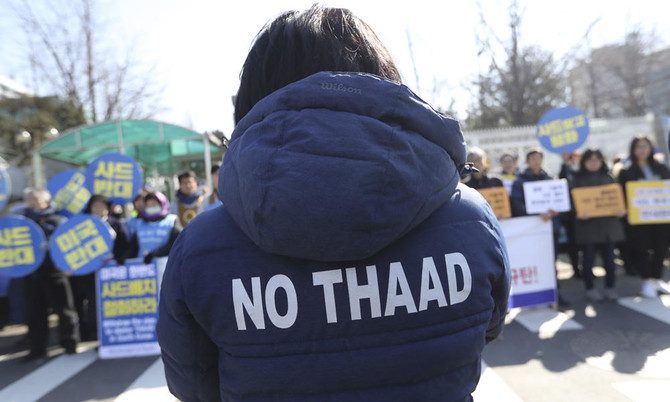
S. Koreans protest against US missile defense system

A protester wearing a jacket with "No THAAD" letters, participates during a rally to oppose the plan to deploy the Terminal High-Altitude Area Defense system, or THAAD, in front of the Defense Ministry in Seoul, South Korea on March 7, 2017. (AP Photo/Lee Jin-man)
Updated 18 March 2017
Follow

S. Koreans protest against US missile defense system

SEONGJU, South Korea: Hundreds of South Koreans protested Saturday against the deployment of a US missile defense system, a day after the visiting US Secretary of State reiterated that its installation would go ahead.
Rex Tillerson said in Seoul Friday that the United States and South Korea would “proceed with the installation” of the system, known as Terminal High Altitude Area Defense (THAAD).
Residents of Seongju county — where the system will be deployed — say it poses health and environmental hazards and argue that its presence could make them a priority target for North Korea.
About 2,000 residents of Seongju and a neighboring county, 275 kilometers (170 miles) southeast of Seoul, rallied with banners reading: “No THAAD but peace.”
Some 2,000 riot police were mobilized to maintain order at the march and stop protesters reaching the installation site.
Washington and Seoul say the system is for purely defensive purposes, but China fears it could undermine its own nuclear deterrent and has reacted with fury, imposing a series of measures seen as economic retaliation on the South.
North Korea has a long-standing ambition to become a nuclear power and has conducted several atomic tests in defiance of the international community and UN sanctions.
Earlier this month, Pyongyang test fired a salvo of missiles that fell in waters off Japan.
On his visit to Seoul, Tillerson — who is now in Beijing — held talks on North Korea’s missile and nuclear threats with foreign minister Yun Byung-Se and acting Prime Minister Hwang Kyo-Ahn.
“It’s my expectation that the new government in South Korea will continue to be supportive of the THAAD system, because it is directed solely at the defense” of the country, Tillery told journalists after the meeting.


Britain needs to step up defense spending faster, says Starmer

Britain's Prime Minister Keir Starmer takes part in a panel discussion in Munich, Germany. (AP file photo)
Updated 5 sec ago
Follow

Britain needs to step up defense spending faster, says Starmer

  • Britain’s budget watchdog, the Office for Budget Responsibility, said last year that raising defense spending to 3 percent of the GDP would cost an additional £17.3 billion a year ($24 billion) in 2029-30

LONDON: Britain should step up and accelerate its ​defense spending, Prime Minister Keir Starmer said on Monday, following a report that the government was considering bringing forward its target to spend 3 percent of economic output on defense.
Britain, which has warned of the risks posed by Russia, said in February 2025 that it would lift annual defense spending to 2.5 percent of the GDP by 2027 and aim for 3 percent in the next Parliament, which is expected to begin after an ‌election due in ‌2029.
The BBC reported that the government was ​now ‌exploring ways to ​reach the 3 percent target by 2029. It said no decision had been taken but the government recognized current plans would not cover rising defense costs.

HIGHLIGHT

The BBC reported that the government is ​now ‌exploring ways to ​reach the 3 percent target by 2029.

Asked whether he would bring the target forward to 2029, Starmer echoed comments he made at the Munich Security Conference, where he said Europe had united to support Ukraine with the supply of weapons and munitions and to strengthen military readiness.
“We need to step up. That means on ‌defense spending, we need to go faster,” ‌Starmer told reporters on Monday. “We’ve obviously made commitments ​already in relation to that, but ‌it goes beyond just how much you spend.”
Latest NATO estimates show ‌that Britain spent 2.3 percent of the GDP on defense in 2024, above the alliance’s 2 percent guideline. But like other European countries, it has faced US pressure to spend more to protect the continent. Struggling with high debt and spending commitments, the government last ‌year cut its international aid budget to fund the hike in defense spending to 2.5 percent of GDP but is yet to publish an investment plan with spending priorities, something that has frustrated the defense industry.
Britain’s budget watchdog, the Office for Budget Responsibility, said last year that raising defense spending to 3 percent of the GDP would cost an additional £17.3 billion a year ($24 billion) in 2029-30.
Finance Minister Rachel Reeves has struggled to stay on track with her plans to repair the public finances. The BBC said the Finance Ministry was believed to be cautious about the new defense spending proposals.
A government spokesperson said Britain was “delivering ​the largest sustained increase in defense ​spending since the Cold War.”