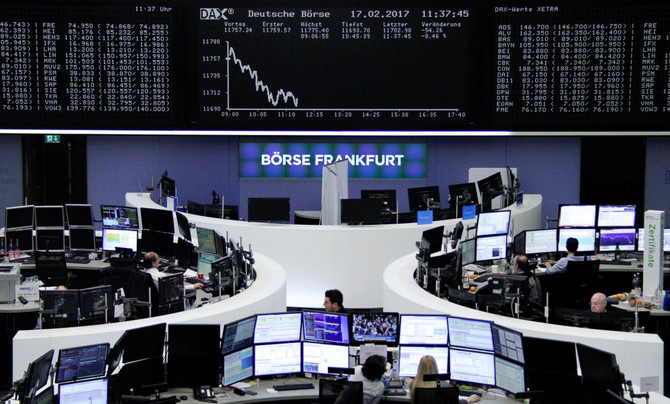
Germany vows legal action if Trump taxes imports

Germany says that its products are simply better and that the US should focus on producing more competitive manufacturers. (Reuters)
Updated 17 March 2017
Follow

Germany vows legal action if Trump taxes imports

BADEN-BADEN: Germany could take the US to court if Washington goes ahead with plans to tax imports, Economy Minister Brigitte Zypries said Friday.

“I am betting partly on reason and partly on the courts” to prevent a damaging trade war, Zypries told Deutschlandfunk public radio.
The minister’s combative stance comes ahead of Merkel’s first meeting with Trump in Washington and a gathering of G-20 finance ministers in Baden-Baden, western Germany, set to be dominated by the US president’s “America First” policy.
Trump has targeted the German luxury carmaker BMW by name with threats of a 35 percent border levy if it goes ahead with construction of a plant in Mexico.
If a US border tax was found to breach World Trade Organization (WTO) rules, “it would not be the first time that Mr. Trump has failed before the courts,” Zypries said, in a jab at repeated rejections by US judges of executive orders banning immigration from majority-Muslim countries.
In 2016, the US was Germany’s biggest export customer, importing €107 billion of goods while selling back just €58 billion of goods.
Trump’s pledge to bring manufacturing jobs back to American shores has led the president and his advisers to attack major exporting nations like Germany and China, accusing them of manipulating their currencies to make their goods less expensive.
But Germany says that its products are simply better and that the US should focus on producing more competitive manufacturers.
When Trump complained that he saw more Mercedes in New York than Chryslers in Germany, Vice-Chancellor Sigmar Gabriel retorted that “the US will have to build better cars.”
Zypries acknowledged that Germany’s trade surplus was a “problem” but said that Berlin was acting to reduce it — and that for now, “the Americans need our machines and industrial plants.”
Alongside cars, capital goods like machine tools are one of Germany’s biggest manufacturing sectors.
Zypries predicted that Trump’s advisers would warn him that “the Americans would be cutting off their nose to spite their face if they slap such taxes on imports.”
Amid the heightened rhetoric, she acknowledged that “a lot is at stake,” calling for clarity and “creating a reliable base” for relations to reduce the “poisonous” uncertainty clouding the economic outlook.


Saudi Arabia’s cultural sector is a new economic engine between Riyadh and Paris, says ambassador

Updated 25 January 2026
Follow

Saudi Arabia’s cultural sector is a new economic engine between Riyadh and Paris, says ambassador

RIYADH: Culture has become a fundamental pillar in bilateral relations between France and Saudi Arabia, according to the French Ambassador to the Kingdom, Patrick Maisonnave.

Maisonnave noted its connection to the entertainment and tourism sectors, which makes it a new engine for economic cooperation between Riyadh and Paris.

He told Al-Eqtisadiah during the opening ceremony of La Fabrique in the Jax district of Diriyah that cultural cooperation with Saudi Arabia is an important element for its attractiveness in the coming decades.

La Fabrique is a space dedicated to artistic creativity and cultural exchange, launched as part of a partnership between the Riyadh Art program and the French Institute in Riyadh. 

Running from Jan. 22 until Feb 14, the initiative will provide an open workspace that allows artists to develop and work on their ideas within a collaborative framework.

Launching La Fabrique as a space dedicated to artistic creativity

The ambassador highlighted that the transformation journey in the Kingdom under Vision 2030 has contributed to the emergence of a new generation of young artists and creators, alongside a growing desire in Saudi society to connect with culture and to embrace what is happening globally. 

He affirmed that the relationship between the two countries is “profound, even cultural par excellence,” with interest from the Saudi side in French culture, matched by increasing interest from the French public and cultural institutions unfolding in the Kingdom.

Latest estimates indicate that the culture-based economy represents about 2.3 percent of France’s gross domestic product, equivalent to more than 90 billion euros ($106.4 billion) in annual revenues, according to government data. The sector directly employs more than 600,000 people, making it one of the largest job-creating sectors in the fields of creativity, publishing, cinema, and visual arts.

Saudi Arabia benefiting from French experience in the cultural field

Maisonnave explained that France possesses established cultural institutions, while Saudi Arabia is building a strong cultural sector, which opens the door for cooperation opportunities.

This comes as an extension of the signing of 10 major cultural agreements a year ago between French and Saudi institutions, aiming to enhance cooperation and transfer French expertise and knowledge to contribute to the development of the cultural system in the Kingdom.

He added that experiences like La Fabrique provide an opportunity to meet the new generation of Saudi creators, who have expressed interest in connecting with French institutions and artists in Paris and France.

La Fabrique encompasses a space for multiple contemporary artistic practices, including performance arts, digital and interactive arts, photography, music, and cinema, while providing the public with an opportunity to witness the stages of producing artistic works and interact with the creative process.