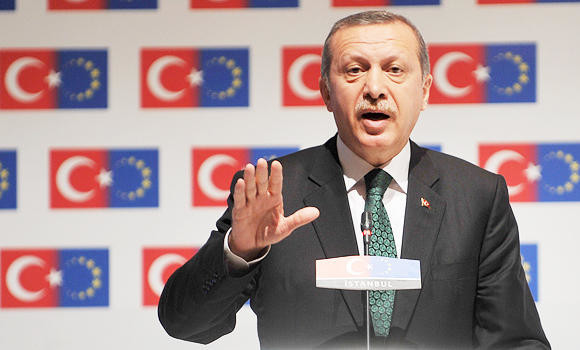
ISTANBUL: Turkey’s president Thursday accused the EU’s top court of starting a “crusade” against Islam after a ruling allowing European companies to ban employees from wearing religious or political symbols including the Islamic headscarf.
“The European Union’s court, The European Court of Justice, my esteemed brothers, have started a crusade struggle against the (Muslim) crescent,” Recep Tayyip Erdogan said in a televised speech,
“Where is freedom of religion?” he said, referring to the court ruling this week.
“Shame on your European Union acquis!” Erdogan said, referring to EU law. “Shame on your values. Shame on your law and justice!”
“Europe is swiftly rolling back to the days before World War II,” he added.
The European Court of Justice said it does not constitute “direct discrimination” if a firm has an internal rule banning the wearing of “any political, philosophical or religious sign.”
Turkey last month said it was lifting a historic ban on female officers wearing the Islamic headscarf in the country’s officially secular armed forces, the last institution where the wearing of the garment was forbidden.
Meanwhile, Erdogan told the Dutch prime minister he had lost Turkey as a friend, despite Mark Rutte’s victory over the far-right in parliamentary elections.
“Hey Rutte! You may have emerged as the number one party in the election but you must know that you have lost Turkey as your friend,” Erdogan said in a televised speech, amid a diplomatic crisis with The Hague due to the blocking of campaign rallies by Turkish ministers.
Turkish Foreign Minister Mevlut Cavusoglu earlier said there was “no difference” between the ruling Dutch liberals and the “fascist” anti-immigration politician Geert Wilders.
Cavusoglu also predicted that “religious wars” will start in Europe due to the rise of the far right.
Turkey and Europe have been locked in a diplomatic spat after The Netherlands and Germany blocked Turkish ministers from holding campaign rallies to secure a “yes” vote in next month’s referendum on expanding Erdogan’s powers.
Erdogan ridiculed Rutte who Turkish officials said had told Prime Minister Binali Yildirim that the two sides could iron out their differences over dinner. “He says ‘we can have dinner with the prime minister after the election.’ There is no such prime minister. You have lost Turkey,” said Erdogan.
The French and German leaders condemned Erdogan’s “unacceptable” remarks accusing Germany and the Netherlands of acting like “Nazis.”
Francois Hollande and Angela Merkel “consider comparisons with Nazism and aggressive statements against Germany and other member states unacceptable,” they said in a joint statement after speaking by telephone, the French president’s office said.
While Erdogan has repeatedly accused the countries of acting like “Nazis,” the EU has warned Ankara to show moderation in its language.


Erdogan accuses EU of launching anti-Islam ‘crusade’
Erdogan accuses EU of launching anti-Islam ‘crusade’




Sudan now has highest number of people in need ‘anywhere in the world,’ UN warns
- Spokesperson Stephane Dujarric presses states to provide urgent financial support to help meet humanitarian needs that have reached ‘extraordinary levels’
- 34m people expected to need aid this year; UN response plan calls for $2.9bn of funding to provide food, nutrition, clean water, health and protection services, and education
NEW YORK CITY: The UN on Friday pressed member states to provide urgent financial support to help stave off further suffering in war-torn Sudan, where nearly 34 million people are now expected to need assistance this year — the highest number anywhere in the world.
Spokesperson Stephane Dujarric said that despite the “extraordinary humanitarian needs,” operations remain perilously underfunded and aid workers face mounting risks.
The UN’s 2026 Humanitarian Response Plan for Sudan calls for $2.9 billion of funding to provide more than 20 million people with life-saving food, nutrition, clean water, health and protection services, and education. But funding lags behind needs, complicating efforts to scale up deliveries of aid.
The civil war between rival military factions in the country, which will enter its fourth year in April, is driving several overlapping emergencies, including acute food insecurity and outbreaks of disease.
According to the UN’s World Food Programme, more than 21 million people in Sudan face high levels of acute hunger, and famine conditions have been confirmed, or are feared to be present, in several regions.
Humanitarian workers continue to face “grave danger,” Dujarric said. In recent months, 92 of them, mostly Sudanese, have been killed, injured, kidnapped or detained, he added, and more than 65 attacks on healthcare providers and patients have been recorded.
Aid groups also warn that conflict-related obstacles, including blockades, drone strikes, and sporadic access restrictions, continue to hamper distribution efforts.
The UN has highlighted the fact that amid the growing displacement of people in North Darfur and North Kordofan, where hundreds of thousands of civilians have been uprooted, water and sanitation services are collapsing in affected areas.
The humanitarian crisis is compounded by regional spillover. Neighboring Chad has closed its border with Sudan amid security concerns, complicating the cross-border flow of aid and threatening already fragile refugee-support systems.
Dujarric warned that without increased donor support and improved access, the skills and commitment of aid workers will not be enough to keep pace with spiraling needs.
“Delivering aid at this scale requires flexible funding and guaranteed humanitarian access, so that workers can reach people in need and they can reach them safely and rapidly and without any obstruction,” he said.


