JEDDAH: Some WhatsApp users in Saudi Arabia on Wednesday expressed their delight at being able to make phone calls through the app, a feature that was previously not working.
Others, however, failed to see what the fuss was about as the popular communication app’s calling function was unresponsive as ever.
The Communications and Information Technology Commission, the agency that regulates telecoms in Saudi Arabia, released a statement saying that it would “like to clarify that it did not direct/order to block nor return such a feature” to service, and that it was following up on the issue with Internet service providers.
Some users told Arab News they could make calls without problem: “Yes it is working good but it’s very surprising,” one said via social media.
For other people, however, the service was allowing them to place calls, but the call dropped after the recipient tried to answer.
Several users said the feature wasn’t functioning, with one in the Kingdom posting that it is “not working at all.”
An Arabic hashtag on Twitter about the app’s calling facility was trending on Wednesday. One person tweeted: “Do we have to pay to make a call? Why can’t we enjoy the free service,” while another posted “I don’t really care for phone calls why is everyone bothered!”
The calling feature was welcomed last year when it was made available on users’ devices, even though WhatsApp had said it would not be available in all countries “due to local laws and regulations.”
Many WhatsApp users complained that the only way to call someone via WhatsApp is to be connected to the same wi-fi network. “I tried to use this feature, but it didn’t work. It only works if you and recipient are on the same wi-fi, which is stupid,” Indian Careem driver Kheder told Arab News.
Meanwhile, Fatima Ahmed, housewife, successfully received a video call from her husband shortly after reading the viral hashtag on Twitter. “It worked with us. Not only a voice call, but we used the video calling feature,” Fatima said. “I was really thrilled to hear the news and immediately told my sister residing in the UAE that we can use this calling feature anytime, however, unfortunately, the call didn’t go through when we tried it.” Fatima suggested that it is due to the different wi-fi network.


WhatsApp calling working in Saudi Arabia…or is it?

WhatsApp calling working in Saudi Arabia…or is it?



Pioneering electric bus service takes to the road in Makkah
- The bus rapid transit project, a system designed to have higher capacity and reliability than conventional bus services, is said to be the first of its kind in the Kingdom
- The vehicles operate in dedicated bus lanes within a network that includes two main bus stations and 11 stops along the route connecting them
MAKKAH: A pioneering electric bus service took to the road in Makkah this week.
Electromin, the developer and operator of the service in partnership with Umm Al-Qura for Development and Construction, said it is expected to serve more than 125 million passengers over the next 15 years, while cutting carbon dioxide emissions by more than 31,500 tonnes compared with traditional vehicles.
The bus rapid transit project, a system designed to have higher capacity and reliability than conventional bus services, is said to be one of the first of its kind in the Kingdom. It was inaugurated on Wednesday by Amr Al-Dabbagh, chairperson of Al-Dabbagh Group; Samir Nawar, managing director of Petromin; and Yasser Abu Ateeq, CEO of Umm Al-Qura.
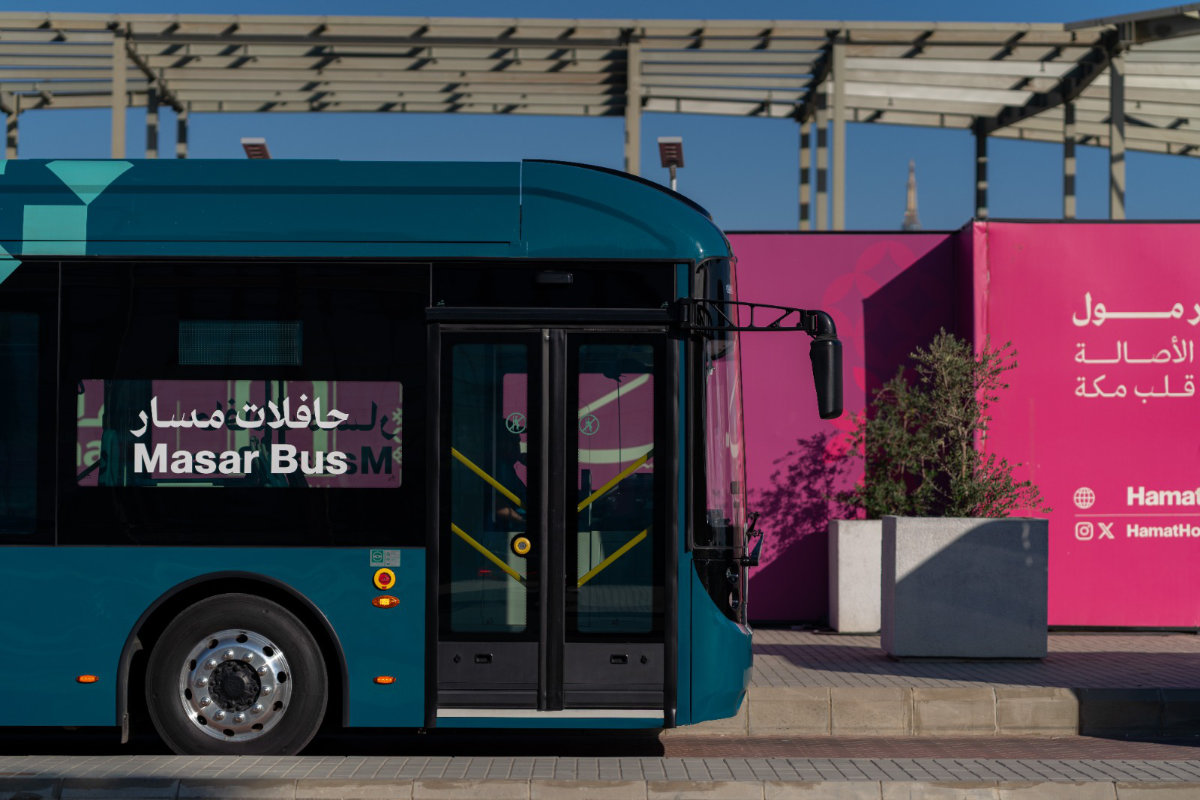
Electromin, a subsidiary of Petromin specializing in energy and mobility solutions, said the new service, which forms part of the Masar Destination mixed-use real estate development project in Makkah, is one the first transport networks of its kind in the country, and represents a significant shift toward a cleaner, more efficient urban transport model.
It operates in dedicated bus lanes, connecting key hubs within Masar and providing safe, reliable and environmentally friendly transportation for residents and visitors, the company added. The network includes two main bus stations and 11 stops along the route connecting them. It has been designed to serve more than 5 million visitors and pilgrims annually, and to be easily accessible to all users.
Operators say the service is designed as a foundation for Makkah’s future transportation system, through its integration with the broader Masar project, which includes pedestrian walkways, more than 5,000 parking spaces, metro services and other urban infrastructure.


