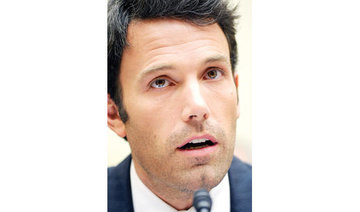
Ben Affleck says he’s undergone treatment for alcoholism

Ben Affleck arrives at the world premiere of “The Accountant” at the TCL Chinese Theatre in Los Angeles. (AP)
Updated 15 March 2017
Follow

Ben Affleck says he’s undergone treatment for alcoholism

LOS ANGELES: Hollywood star Ben Affleck announced on Facebook that he has undergone treatment to combat alcoholism, as he acknowledged his ongoing struggle with the condition.
The Oscar-winning actor and director cited his children as a major motivation to pursue treatment, in order to “live life to the fullest and be the best father I can be.”
“I have completed treatment for alcohol addiction,” Affleck wrote in a Facebook post late Tuesday. “This was the first of many steps being taken toward a positive recovery.”
The actor then turned to his family.
“I want my kids to know there is no shame in getting help when you need it, and to be a source of strength for anyone out there who needs help but is afraid to take the first step,” he wrote.
“I’m lucky to have the love of my family and friends, including my co-parent, Jen, who has supported me and cared for our kids as I’ve done the work I set out to do.”
Once one-half of Hollywood’s famed “Bennifer” married couple, Affleck and his now-estranged wife Jennifer Garner announced plans to divorce in June 2015, one day after their 10-year wedding anniversary.
Affleck, 44, has Oscars for writing and producing. He directed critical and commercial hits “The Town,” “Gone Girl” and “Argo,” which won the best picture award at the Oscars in 2013.
His younger brother Casey this year took home a best acting Oscar for his starring role in the melancholy Hollywood hit “Manchester by the Sea.”
Garner is known for her breakout work in the spy drama “Alias” on television, and for various roles on the big screen, including a well-received turn in the 2004 hit movie “13 Going on 30.”


Three-year heatwave bleached half the planet’s coral reefs: study

Updated 10 February 2026
Follow

Three-year heatwave bleached half the planet’s coral reefs: study

PARIS: A study published on Tuesday showed that more than half of the world’s coral reefs were bleached between 2014-2017 — a record-setting episode now being eclipsed by another series of devastating heatwaves.
The analysis concluded that 51 percent of the world’s reefs endured moderate or worse bleaching while 15 percent experienced significant mortality over the three-year period known as the “Third Global Bleaching Event.”
It was “by far the most severe and widespread coral bleaching event on record,” said Sean Connolly, one the study’s authors and a senior scientist at the Panama-based Smithsonian Tropical Research Institute.
“And yet, reefs are currently experiencing an even more severe Fourth Event, which started in early 2023,” Connolly said in a statement.
When the sea overheats, corals eject the microscopic algae that provides their distinct color and food source.
Unless ocean temperatures return to more tolerable levels, bleached corals are unable to recover and eventually die of starvation.
“Our findings demonstrate that the impacts of ocean warming on coral reefs are accelerating, with the near certainty that ongoing warming will cause large-scale, possibly irreversible, degradation of these essential ecosystems,” said the study in the journal Nature Communications.
An international team of scientists analyzed data from more than 15,000 in-water and aerial surveys of reefs around the world over the 2014-2017 period.
They combined the data with satellite-based heat stress measurements and used statistical models to estimate how much bleaching occurred around the world.

No time to recover

The two previous global bleaching events, in 1998 and 2010, had lasted one year.
“2014-17 was the first record of a global coral bleaching event lasting much beyond a single year,” the study said.
“Ocean warming is increasing the frequency, extent, and severity of tropical-coral bleaching and mortality.”
Australia’s Great Barrier Reef, for instance, saw peak heat stress increase each year between 2014 and 2017.
“We are seeing that reefs don’t have time to recover properly before the next bleaching event occurs,” said Scott Heron, professor of physics at James Cook University in Australia.
A major scientific report last year warned that the world’s tropical coral reefs have likely reached a “tipping point” — a shift that could trigger massive and often permanent changes in the natural world.
The global scientific consensus is that most coral reefs would perish at warming of 1.5C above preindustrial levels — the ambitious, long-term limit countries agreed to pursue under the 2015 Paris climate accord.
Global temperatures exceeded 1.5C on average between 2023-2025, the European Union’s climate monitoring service, Copernicus, said last month.
“We are only just beginning to analyze bleaching and mortality observations from the current bleaching event,” Connolly told AFP.
“However the overall level of heat stress was extraordinarily high, especially in 2023-2024, comparable to or higher than what was observed in 2014-2017, at least in some regions,” he said.
He said the Pacific coastline of Panama experienced “dramatically worse heat stress than they had ever experienced before, and we observed considerable coral mortality.”