

Syrian opposition to stay away from Astana talks

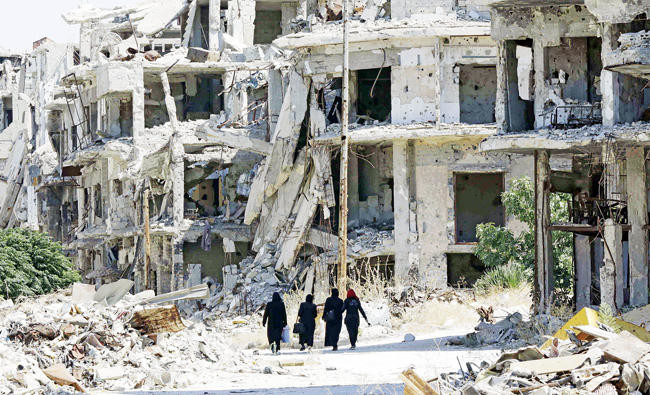
Syrian women walk between destroyed buildings in the regime-held Jouret Al-Shiah neighborhood of Homs. (AFP)
Updated 14 March 2017
Follow

Syrian opposition to stay away from Astana talks

BEIRUT: Syrian opposition factions will not attend a new round of negotiations with regime figures in the Kazakh capital, an opposition delegation spokesman told AFP on Monday.
“Opposition groups have decided not to participate in Astana,” said Osama Abu Zeid, adding that one reason for the boycott was “unfulfilled pledges related to the cessation of hostilities.”
The third round of talks in Astana, sponsored by regime ally Russia and opposition backer Turkey, is scheduled to begin on Tuesday.
The Astana track has aimed to reinforce a fragile cease-fire deal brokered by Moscow and Ankara in December.
“We decided not to participate in Astana because the reinforcement of the cease-fire was not implemented,” said Ahmad Othman, commander of the Ankara-backed Sultan Murad opposition group.
“The regime and the militias are continuing to bomb, displace and besiege,” he told AFP, and opposition groups had informed the talks’ sponsors of their decision.
Syrian state television on Monday reported that the regime delegation, headed by Bashar Al-Jaafari, Syria’s representative to the UN, had arrived in the Kazakh capital.
A fresh round of negotiations in Switzerland is set to begin on March 23 and will focus on governance, the constitution, elections, counter-terrorism and possibly reconstruction, according to UN envoy Staffan de Mistura.
Sergei Lavrov, Russian foreign minister, discussed the Astana meeting with his Turkish counterpart, Mevlut Cavusoglu, according Lavrov’s office.
Meanwhile, the regime and the opposition said they had agreed a Russian-supervised deal to complete the evacuation of fighters and civilians from the last opposition-held part of Homs city.
The new agreement aims to finalize implementation of a “reconciliation deal” that has already seen several phases of opposition evacuation from the Waer district, but which had stalled in recent months.
State news agency SANA said opposition and their families wishing to leave Waer would begin evacuating from Saturday, and the process would last no longer than two months.
A summary of the agreement shared by the opposition National Coalition said that those evacuating Waer would go to opposition-held north Homs province, Jarabulus in Aleppo province or Idlib province.
It also said a military contingent of 60-100 Russian troops would deploy in Waer to monitor the deal’s implementation and the safety of remaining residents and returning civilians.
Opposition fighters backed by Turkish forces have taken some towns near northern Syria’s Manbij, Recep Tayyip Erdogan, Turkish president, said.
The Turkey-backed Free Syrian Army fighters have been advancing toward Manbij after clearing Daesh from Al-Bab. 


’No one to back us’: Arab bus drivers in Israel grapple with racist attacks

Updated 4 sec ago
Follow

’No one to back us’: Arab bus drivers in Israel grapple with racist attacks

  • “People began running toward me and shouting at me, ‘Arab, Arab!’” recalled Khatib, a Palestinian from east Jerusalem

JERUSALEM: What began as an ordinary shift for Jerusalem bus driver Fakhri Khatib ended hours later in tragedy.
A chaotic spiral of events, symptomatic of a surge in racist violence targeting Arab bus drivers in Israel, led to the death of a teenager, Khatib’s arrest and calls for him to be charged with aggravated murder.
His case is an extreme one, but it sheds light on a trend bus drivers have been grappling with for years, with a union counting scores of assaults in Jerusalem alone and advocates lamenting what they describe as an anaemic police response.
One evening in early January, Khatib found his bus surrounded as he drove near the route of a protest by Israel’s ultra-Orthodox Jewish community.
“People began running toward me and shouting at me, ‘Arab, Arab!’” recalled Khatib, a Palestinian from east Jerusalem.
“They were cursing at me and spitting on me, I became very afraid,” he told AFP.
Khatib said he called the police, fearing for his life after seeing soaring numbers of attacks against bus drivers in recent months.
But when no police arrived after a few minutes, Khatib decided to drive off to escape the crowd, unaware that 14-year-old Yosef Eisenthal was holding onto his front bumper.
The Jewish teenager was killed in the incident and Khatib arrested.
Police initially sought charges of aggravated murder but later downgraded them to negligent homicide.
Khatib was released from house arrest in mid-January and is awaiting the final charge.

- Breaking windows -

Drivers say the violence has spiralled since the start of the Gaza war in October 2023 and continued despite the ceasefire, accusing the state of not doing enough to stamp it out or hold perpetrators to account.
The issue predominantly affects Palestinians from annexed east Jerusalem and the country’s Arab minority, Palestinians who remained in what is now Israel after its creation in 1948 and who make up about a fifth of the population.
Many bus drivers in cities such as Jerusalem and Haifa are Palestinian.
There are no official figures tracking racist attacks against bus drivers in Israel.
But according to the union Koach LaOvdim, or Power to the Workers, which represents around 5,000 of Israel’s roughly 20,000 bus drivers, last year saw a 30 percent increase in attacks.
In Jerusalem alone, Koach LaOvdim recorded 100 cases of physical assault in which a driver had to be evacuated for medical care.
Verbal incidents, the union said, were too numerous to count.
Drivers told AFP that football matches were often flashpoints for attacks — the most notorious being those of the Beitar Jerusalem club, some of whose fans have a reputation for anti-Arab violence.
The situation got so bad at the end of last year that the Israeli-Palestinian grassroots group Standing Together organized a “protective presence” on buses, a tactic normally used to deter settler violence against Palestinians in the Israeli-occupied West Bank.
One evening in early February, a handful of progressive activists boarded buses outside Jerusalem’s Teddy Stadium to document instances of violence and defuse the situation if necessary.
“We can see that it escalates sometimes toward breaking windows or hurting the bus drivers,” activist Elyashiv Newman told AFP.
Outside the stadium, an AFP journalist saw young football fans kicking, hitting and shouting at a bus.
One driver, speaking on condition of anonymity, blamed far-right National Security Minister Itamar Ben Gvir for whipping up the violence.
“We have no one to back us, only God.”

- ‘Crossing a red line’ -

“What hurts us is not only the racism, but the police handling of this matter,” said Mohamed Hresh, a 39-year-old Arab-Israeli bus driver who is also a leader within Koach LaOvdim.
He condemned a lack of arrests despite video evidence of assaults, and the fact that authorities dropped the vast majority of cases without charging anyone.
Israeli police did not respond to AFP requests for comment on the matter.
In early February, the transport ministry launched a pilot bus security unit in several cities including Jerusalem, where rapid-response motorcycle teams will work in coordination with police.
Transport Minister Miri Regev said the move came as violence on public transport was “crossing a red line” in the country.
Micha Vaknin, 50, a Jewish bus driver and also a leader within Koach LaOvdim, welcomed the move as a first step.
For him and his colleague Hresh, solidarity among Jewish and Arab drivers in the face of rising division was crucial for change.
“We will have to stay together,” Vaknin said, “not be torn apart.”