MANILA: Philippine President Rodrigo Duterte said on Monday that he had agreed to allow Chinese surveillance ships into Filipino waters, contradicting his defense minister who described their presence as “very concerning.”
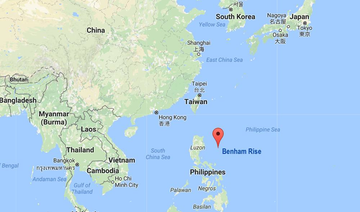
Duterte also said that he did not want to have a “fight” with China over Benham Rise — waters recognized by the UN as indisputably Philippine territory — partly because he wanted Chinese economic help.
“They have no incursion because we have an agreement,” Duterte told reporters when asked about the reported presence of Chinese surveillance ships at Benham Rise.
“Some people are just blowing it up. We previously agreed. It was a research ship. We were advised of it way ahead.”
Duterte’s comments came after his Defense Secretary Delfin Lorenzana said last week that Chinese surveillance ships had been seen in Benham Rise, which is believed to sit atop lucrative oil and gas deposits.
“The very concerning thing is they have several service ships plying this area, staying in one area sometimes for a month as if doing nothing. But we believe they are actually surveying the seabed,” Lorenzana said.
“I have ordered the Navy that if they see this service ship this year, to start to accost them and drive them away.”
Lorenzana said China may be “looking for a place to put submarines.”
Duterte emphasized on Monday that the Philippines was set to enjoy billions of dollars in Chinese investments and grants, following his decision not to argue with China over another territorial dispute in the South China Sea.
“Let us not fight about ownership or sovereignty at this time because things are going great for my country,” Duterte said in reference to China.
Benham Rise is an underwater landmass 250 km off the east coast of the main island of Luzon.
In 2012, the UN Commission on the Limits of the Continental Shelf approved the Philippines’ undisputed territorial claim to Benham Rise.
Chinese Foreign Ministry spokesman Geng Shuang said last week that although the UN had ruled in the Philippines’ favor, this did not mean Benham Rise was part of its territory.
China and the Philippines have had a long-running dispute over competing claims in the South China Sea. Parts of that strategically vital waterway are also claimed by Brunei, Malaysia, Taiwan and Vietnam.
Duterte’s predecessor, Benigno Aquino, had forcefully challenged China in diplomatic and legal circles over the South China Sea dispute, leading to a sharp deterioration in bilateral relations.
Duterte, who took office last year, has reversed that policy, preferring instead to placate China in return for hoped-for billions of dollars worth of investments and grants.
Also on Monday, President Duterte accused some miners of funding efforts to destabilize his government as he talked about a possible plan to impose a ban on mining given the environmental damage producers have caused.
“I know that some of you are giving funding to the other side to destabilize me,” President Duterte said, referring to companies in the mining sector he did not name.
Duterte, who has previously said the Southeast Asian nation can survive without a mining sector, added at Monday’s briefing that it may be “worthwhile” for Environment Secretary Regina Lopez to implement a ban on mining.
Duterte said he was looking at a total mining ban “and then we will talk.”
There is currently no ban on mining in the Philippines, the world’s top nickel ore supplier.
Lopez last month ordered the closure of 23 of the country’s 41 mines to protect watersheds.
She also suspended another five for environmental infringements.
Duterte said he wants to meet with local miners so they can explain to him what led to the destruction of the environment in areas where they operate.
The firebrand leader has said the government can live without an estimated 70 billion Philippine pesos ($1.39 billion) a year in revenue from the mining sector.


![]()

Duterte: Chinese ships allowed to survey Philippine territory
Duterte: Chinese ships allowed to survey Philippine territory
Latest updates


© 2026 SAUDI RESEARCH & PUBLISHING COMPANY, All Rights Reserved And subject to Terms of Use Agreement.