Bus fleeing accident kills 38 people in Haiti

1 / 2
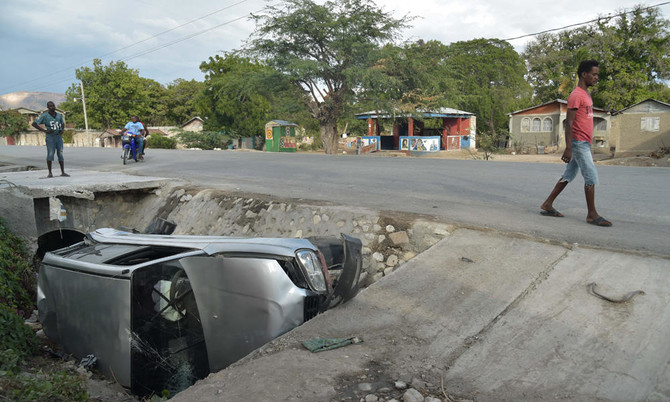
A car damaged by a bus lies on the side of a road on Sunday in Gonaives, 150 km northwest of the capital Port-au-Prince, Haiti. A bus speeding away from a hit-and-run accident plowed into dozens of street musicians in northern Haiti, killing 34 people, officials said. (AFP / HECTOR RETAMAL)
2 / 2
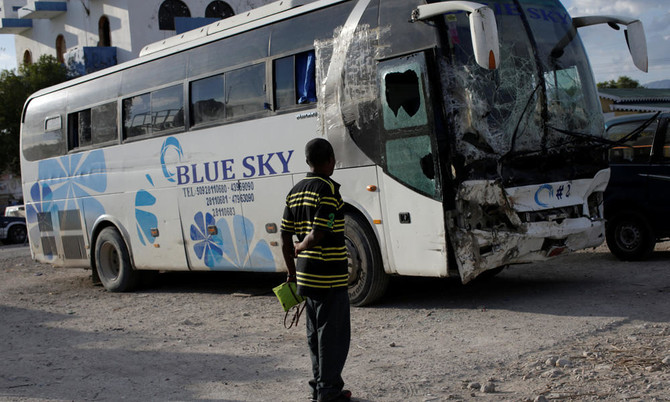
A man looks at a bus, which drove into a parade of pedestrians, parked in the police station of Gonaives, Haiti, on Sunday. (REUTERS/Andres Martinez Casares)
Updated 13 March 2017
Follow

Bus fleeing accident kills 38 people in Haiti

PORT-AU-PRINCE, Haiti: At least 38 people were killed and about a dozen injured in northern Haiti late on Saturday after a bus drove into a parade of pedestrians while fleeing from an accident, civil protection authorities said on Sunday.
The bus, which was traveling from Cap Haitien to the capital Port-au-Prince, initially hit two people in a town outside Gonaives in northern Haiti, killing one, said Joseph Faustin, civil protection head in the Artibonite department.
The bus driver then fled and crashed into three “rara” parades in Mapou, about 5 km (3 miles) away, Faustin said.
Rara parades, which usually take place around Easter, are groupings of musicians playing traditional instruments who are often joined by passers-by.
In total, 34 people were killed at the scene and an another four people died in hospital, said Fred Henry, the area’s deputy representative, who added that the incident had occurred around 4 a.m.
“Usually the drivers involved in such accidents don’t stop because they are afraid they might be killed (in reprisal),” Henry said.
It was not immediately clear what caused the accident.
The driver and passengers on the bus were taken to the police station, said Patrick Cherilus, a Civil Protection spokesman for Artibonite.
They have since been released and the bus driver has fled, said Jean Bazlais Bornelus, the police chief for the area.
After the accident, other musicians and people in the parade began hurling rocks at the bus and passing vehicles, injuring other people, said Albert Moulion, the Ministry of the Interior’s spokesman.
Haitian roads are dangerous and chaotic, with few rules observed by pedestrians, motorcyclists and drivers.
President Jovenel Moise called for an investigation into the incident.
“The head of state sends ... sincere condolences to the victims’ families and loved ones,” he added. (Reporting by Makini Brice and Joseph Guy Delva)


South Korea will boost medical school admissions to tackle physician shortage

Updated 9 sec ago
Follow

South Korea will boost medical school admissions to tackle physician shortage

  • Jeong said all of the additional students will be trained through regional physician programs

SEOUL: South Korea plans to increase medical school admissions by more than 3,340 students from 2027 to 2031 to address concerns about physician shortages in one of the fastest-aging countries in the world, the government said Tuesday.

The decision was announced months after officials defused a prolonged doctors’ strike by backing away from a more ambitious increase pursued by Seoul’s former conservative government. Even the scaled-down plan drew criticism from the country’s doctors’ lobby, which said the move was “devoid of rational judgment.”

Kwak Soon-hun, a senior Health Ministry official, said that the president of the Korean Medical Association attended the healthcare policy meeting but left early to boycott the vote confirming the size of the admission increases.

The KMA president, Kim Taek-woo, later said the increases would overwhelm medical schools when combined with students returning from strikes or mandatory military service, and warned that the government would be “fully responsible for all confusion that emerges in the medical sector going forward.” The group didn’t immediately signal plans for further walkouts.

Health Minister Jeong Eun Kyeong said the annual medical school admissions cap will increase from the current 3,058 to 3,548 in 2027, with further hikes planned in subsequent years to reach 3,871 by 2031. This represents an average increase of 668 students per year over the five-year period, far smaller than the 2,000-per-year hike initially proposed by the government of former President Yoon Suk Yeol, which sparked the months long strike by thousands of doctors.

Jeong said all of the additional students will be trained through regional physician programs, which aim to increase the number of doctors in small towns and rural areas that have been hit hardest by demographic pressures. The specific admissions quota for each medical school will be finalized in April.