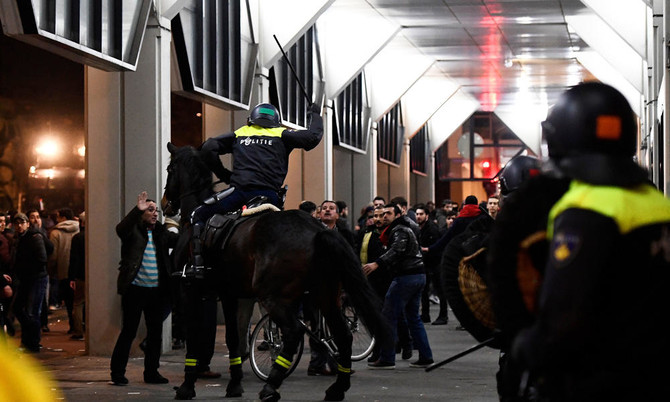


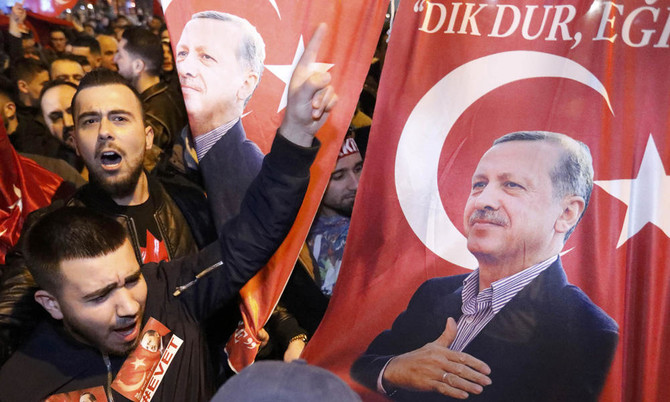
ROTTERDAM, Netherlands: Dutch police used water cannon and horses early Sunday to break up protests outside the Turkish consulate in Rotterdam as the city expelled a Turkish minister, amid an escalating diplomatic row with Ankara.
After several hours of calm demonstrations, police moved in to disperse over 1,000 people gathered close to the consulate, charging the crowd on horseback and using dogs to regain control.
Protesters hit back, throwing rocks at riot police, while hundreds of cars jammed the streets blaring their horns and revving their engines.
Tensions finally tipped over into violence after a day of fast-moving events, triggered when Turkish Foreign Minister Mevlut Cavusoglu said he planned to attend a pro-Turkish government rally in Rotterdam.
The Netherlands, which holds general elections on Wednesday, had repeatedly said Cavusoglu was not welcome to campaign for Turkey’s April referendum in the country and refused his plane permission to land.
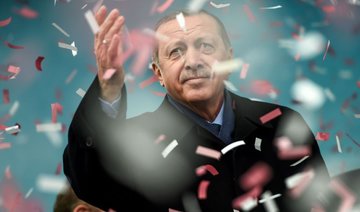
Turkish President Recep Tayyip Erdogan reacted angrily accusing the Dutch — who were once under Nazi occupation — of being “the vestiges of Nazis.”
The Dutch decision to ban Cavusoglu from visiting came after Germany and other European nations also blocked similar campaign events.
VIDEO: Dutch police clash with Turkish protesters in Rotterdam
“They are the vestiges of the Nazis, they are fascists,” Erdogan told an Istanbul rally on Saturday, days after he angrily compared moves to block rallies in Germany to “Nazi practices.”
“Ban our foreign minister from flying however much you like, but from now on let’s see how your flights will land in Turkey,” Erdogan said.
But later, Turkey’s Family Minister Fatma Betul Sayan Kaya appeared at the scene after reportedly traveling by car overland from Germany.
She was stopped just outside the consulate by Dutch police, and after several hours of negotiations escorted back to the German border.
Kaya was “on the way from Rotterdam to Germany,” Mayor Ahmed Aboutaleb told reporters, adding: “She has been expelled back to the country she came from.”
'Irresponsible act'
The Dutch government criticized Kaya as “irresponsible” for attempting to visit after being told she was not welcome and said it told Turkey it could not compromise on public order and security.
“The search for a reasonable solution proved impossible, and the verbal attacks that followed today from the Turkish authorities are unacceptable,” it said in a statement.
“In this context Minster Kaya’s visit was irresponsible. Through contacts with the Turkish authorities, the message was repeatedly conveyed that Minister Kaya is not welcome in the Netherlands... nevertheless she decided to travel.”
Kaya complained of her treatment, and could be seen in images on Dutch NOS television appearing to argue with Dutch police about the situation.
“We’ve been here for about four hours. We were not even offered water,” she told the NTV television channel.
“I was told to leave the country and return to Germany as soon as possible,” she added.
Cavusoglu, meanwhile, flew to France where he is expected to address a rally on Sunday in the eastern city of Metz. A French official said the visit had been cleared by the foreign ministry in Paris.
As the row raged, Turkish foreign ministry sources said the Dutch embassy in Ankara and consulate in Istanbul had both been sealed off for “security reasons.”
Dutch Prime Minister Mark Rutte said Erdogan’s criticism was “crazy.”
“I understand that they are angry but this is way out of line,” he said. “I really think we made the right decision here.”
Referendum campaign
Cavusoglu, speaking in Istanbul, said the ban was “unacceptable.”
“Why are you taking sides in the referendum?” he said, adding: “Is the foreign minister of Turkey a terrorist?“
The Turkish foreign ministry said the Dutch charge d’affaires in Ankara was summoned and told Turkey did not want the Dutch ambassador — currently on holiday — to return “for a while.”
The Netherlands is home to some 400,000 people of Turkish origin, and Ankara is keen to harness votes of the diaspora in Europe ahead of the April 16 referendum on creating an executive presidency.
The Turkish government argues the changes would ensure stability and create more efficient governance, but opponents say it would lead to one-man rule and further inflame tensions in its diverse society.
The latest row came after NATO allies Turkey and Germany sparred over the cancelation of a series of referendum campaign events there.
Germany is home to 1.4 million people eligible to vote in Turkey — the fourth-largest electoral base after Istanbul, Ankara and Izmir.
Although Berlin insisted the cancelations by local authorities were for logistical reasons, Turkish officials repeatedly hit back.