

Erdogan compares Dutch rally ban to Nazism as row spirals

1 / 2
Turkey's President Recep Tayyip Erdogan addresses his supporters in Istanbul on Saturday. (Kayhan Ozer/Pool Photo via AP)
2 / 2
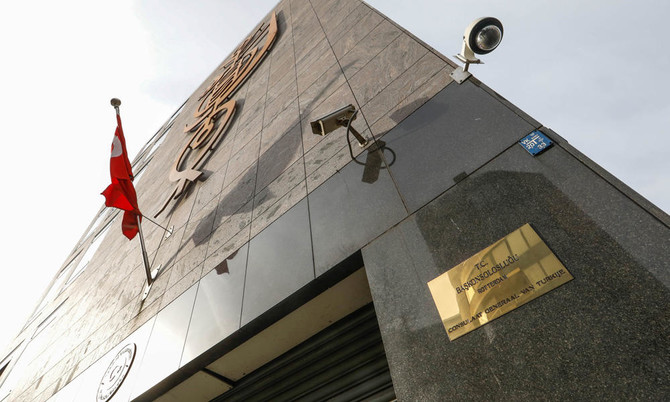
An outside view of the Turkish consulate in Rotterdam, Netherlands, on Saturday. (REUTERS/Yves Herman)
Updated 11 March 2017
Follow

Erdogan compares Dutch rally ban to Nazism as row spirals

ISTANBUL: Turkish President Recep Tayyip Erdogan on Saturday likened a Dutch ban on his foreign minister’s visit to Nazism, in a dramatic escalation of a row over campaign events abroad for Turkey’s high stakes referendum.
The leader’s strongly-worded comments came after The Hague said it would refuse Foreign Minister Mevlut Cavusoglu’s plane permission to land ahead of a rally to gather support for boosting Erdogan’s powers.
The Dutch decision to ban Cavusoglu from visiting and holding a rally in the port city of Rotterdam came after Germany and other European nations also saw moves to block campaign events.
Unlike in Germany, however, where a string of planned rallies were barred by local authorities, in the Netherlands it was the government that stepped in to block Cavusoglu’s visit.
“They are the vestiges of the Nazis, they are fascists,” Erdogan told an Istanbul rally Saturday, days after he angrily compared moves to block rallies in Germany to “Nazi practices.”
“Ban our foreign minister from flying however much you like, but from now on let’s see how your flights will land in Turkey,” Erdogan said.
The Turkish foreign ministry swiftly announced it had summoned the Dutch deputy ambassador in protest over the ban. The Dutch government said in a statement that its decision to bar Cavusoglu from visiting followed a Turkish threat of sanctions.
“For that reason the Netherlands has let it be known it will withdraw permission to land” for the minister’s plane, it said.

Turkish diaspora
The Netherlands is home to some 400,000 people of Turkish origin, and Ankara is keen to harness votes of the diaspora in Europe ahead of the April 16 referendum.
Erdogan accused the Netherlands of working against the “Yes” campaign and said: “Pressure however much you like. Abet terrorists in your country however much you like.
“It will backlash, and there’s no doubt that we’ll start retaliating after April 16... We are patient. Whoever is patient will reach victory.”
The latest escalation came after a string of European towns and cities canceled similar campaign rallies, citing logistical difficulties and security concerns.
Dutch Foreign Minister Bert Koenders had warned Thursday that his government would not facilitate Cavusoglu’s visit.
“We will not participate in a visit by a Turkish government official who wants to conduct a political campaign for a referendum,” he said.
Dutch far-right anti-Islam MP Geert Wilders celebrated the government’s ban, attributing it to “heavy PVV pressure,” in a reference to his party.
“I call on Prime Minister (Mark) Rutte, in the name of millions of Dutch people, to refuse the Turkish minister access to the Netherlands!” he tweeted earlier Saturday.
“Don’t let him land here!” wrote Wilders, whose party appears set to emerge as one of the largest in parliament in Wednesday’s vote.

Turkey-Germany row
The latest row came after NATO allies Turkey and Germany sparred over the cancelation of a series of referendum campaign events there.
Germany is home to 1.4 million people eligible to vote in Turkey — the fourth-largest electoral base after Istanbul, Ankara and Izmir.
Although Berlin insisted that the string of cancelations by local authorities were down to logistical reasons, Turkish officials repeatedly hit back, leading to Erdogan’s angry “Nazi” remark.
German Chancellor Angela Merkel said such rhetoric was “depressing,” belittled Holocaust victims and was “so out of place as to be unworthy of serious comment.”
Berlin has emerged as a strident critic of Ankara’s vast crackdown in the wake of the attempted putsch of last July, which has seen more than 100,000 people arrested, suspended from their jobs or sacked for alleged links to the plotters or to Kurdish militants.
Ankara has in turn accused Berlin of harboring “terrorists” and failing to respond to requests to hand over suspects from the coup as well as Kurdish militants who it believes are members of the outlawed PKK group.
Elsewhere in Europe, Austrian Chancellor Christian Kern has called for an EU ban on Turkish politicians campaigning for the referendum.
And Swiss police on Friday blocked a rally supporting a “yes” vote in the referendum, amid uncertainty over whether the Turkish foreign minister would be allowed to host a similar event planned for Zurich this weekend.


US, UN launch humanitarian fund with $700m for war-ravaged Sudan

Updated 7 sec ago
Follow

US, UN launch humanitarian fund with $700m for war-ravaged Sudan

  • Sudanese flee to Chad but face physical and mental wounds, women grapple with rape trauma

CAIRO, TINE, CHAD: The US and the UN are seeking to rally international support for humanitarian aid to war-ravaged Sudan, kicking off a new Sudan Humanitarian Fund with $700 million.

The Trump administration said it would contribute $200 million to the initiative from a basket of $2 billion it set aside late last year to fund humanitarian projects around the world. Several other participants promised they would make pledges but did not specify amounts.

“Today we are signaling that the international community will work together to bring this suffering to an end, and to ensure lifesaving aid reaches communities in such desperate, desperate need,” said UN humanitarian chief Tom Fletcher, who heads the UN Office for the Coordination of Humanitarian Affairs, or OCHA. 

Fletcher co-hosted the fundraising event in Washington with US senior adviser for Arab and African affairs Massad Boulos.

Fletcher said they have set the beginning of Ramadan, on Feb. 17, as a date “to make visible progress on this work.”

Boulos said the US has put forward a “comprehensive proposal” for a humanitarian truce that could be agreed on in the next few weeks.

Sudan has been in the throes of war since 2023, with the Rapid Support Forces paramilitary force and the Sudanese military clashing for power over the country.  The UN estimates that over 40,000 people have been killed in the war, but consider that the true number could be many times higher.

The conflict created the world’s largest humanitarian crisis, with over 14 million people forced to flee their homes and with famine declared in several regions of Sudan.

Fighting has concentrated in the Kordofan regions recently after the RSF took over El-Fasher, one of the army’s last strongholds in the Darfur region. But the military has since been making gains in Kordofan by breaking a siege in Kadugli and the neighboring town of Dilling. On Tuesday, the Sudanese military announced that it had opened a crucial road between Kadugli and Dilling.

The RSF launched a drone attack Tuesday that hit a medical center in Kadugli, killing 15 people including seven children, according to Sudan Doctors Network, which tracks the war. Meanwhile, in Tine, neighboring Chad, medical staff treated refugee Mahamat Hamid Abakar for a serious head wound from a drone attack using bandages and compresses outside the city hospital.

The 33-year-old, who fled his native Sudan as war erupted nearly three years ago, had just had a 5 mm metal fragment removed from his skull. Most of the wounded crossing the border are victims of drones, which have been heavily deployed by both sides in the conflict.

Sitting in the back of a pick-up truck, Abakar was traveling at night to deliver flour and sugar from Chad to his family who have stayed in Sudan.

“I was attacked by a drone in the area of Um Baru in Sudan three days ago,” he said, despite difficulties in talking.

Three other occupants of the vehicle — two men and a woman — were burned to death in the explosion.

The travel companion seated next to him died from his injuries the next morning, shortly after being picked up by rescue teams, who transported them to the Chadian border 150 km away.

Set on a hill overlooking a parched river marking the border, the hospital at Tine is on the front line for receiving wounded Sudanese.

“Since the capture of El-Fasher at the end of October, we have taken in a thousand Sudanese,” said Awadallah Yassine Mahamat, a carer from Sudan’s western region of Darfur who volunteers at the hospital after fleeing to Tine a year and a half ago.

El Fasher is the state capital of North Darfur.

“In Darfur, many hospitals, health centers and even pharmacies were destroyed during fighting,” he said, showing photographs on his phone of emaciated and charred bodies at the hospital where he worked before leaving.

Dressed in a thick, black jacket, the man in his 40s said most victims arriving in Chad had fractures following drone attacks.

In recent weeks, the wounded have flooded in from border areas being attacked by RSF forces.

Abakar Abdallah Kahwaya and Mahamat Abakar Hamdan, both aged 27, said they had been fighting for an army-aligned faction led by Darfur Gov. Minni Minnawi.

They have been in hospital for two weeks after being wounded during clashes with the RSF in Girgira, a Sudanese town about 50 km south of Tine.

“We put down our weapons to enter Chad and receive treatment,” said Kahwaya, who has an abdomen wound. “But as soon as we can fight again, we’ll return to Sudan,” Hamdan added.

Mahamat, the volunteer caregiver, stressed that the hospital accepted anyone who was wounded, whether civilian or combatant — but acknowledged the limits of the care the hospital was able to give.

“We’re short on caregivers and they are not sufficiently trained to care for all the wounded,” he said.

But the wounds are not only physical — treating the mental distress of refugees poses a significant challenge.

“The lack of resources and prospects in the camps further increases their vulnerability,” said Kindi Hassan, a mental health official with the International Rescue Committee at the Goudrane camp, which accommodates around 60,000 refugees.

Hassan was helping 30-year-old Asma who escaped an RSF attack on Zamzam, the largest refugee camp in North Darfur, in April.

In tears, the woman recounted the day she spent holed up in a makeshift bunker dug beneath her home before managing to get out of the camp.

She left behind the bodies of 11 family members killed in a bombing.

“Soldiers arrested me and three friends as we were fleeing,” she said, wiping away the tears with her headscarf.

“They beat us with the butts of their rifles until we couldn’t walk anymore and took turns raping us until the morning,” she said.

Medicine now helps to keep at bay the images that had haunted her and stopped her sleeping.

“Mental health is stigmatized and most cases of post-traumatic stress are kept quiet,” Hassan, of the IRC, said.

She said refugees waited a long time before talking about their trauma, adding: “Our response is inadequate to meet the enormous needs.”

Four NGOs are caring for the mental health of victims of conflict in Goudrane camp, including the IRC, which has helped almost 800 people in a year.

If additional resources don’t arrive, the plight of refugees in Chad’s camps risks worsening, warned Hassan, who spoke of an increasing trend of “suicidal thoughts.”

“Some people even go so far as to poison or hang themselves to escape their distress,” she said.