MANILA: Philippine President Rodrigo Duterte on Thursday pleaded for help from mayors in Muslim parts of the south to deal with Islamist militants, and threatened to impose martial law there if the problem is not tackled.
The largely Roman Catholic Philippines has been struggling to thwart two small but violent Daesh-linked groups behind kidnappings, piracy, bombings and the recent beheading of a German captive.
“I plead before you because I do not want the trouble in (the southern island of) Mindanao to spin out of control,” Duterte told mayors in a speech in Davao.
“Because then, as president, I will be forced, I will be compelled, to exercise the extra-ordinary powers.”
He added: “Help me. If not, you know, martial law, then I have to authorize the military just to arrest them, detain you.”
The Philippines is fighting Abu Sayyaf militants on two remote islands in the south. The government is seeking the support of separatists who are talking peace with the government to root out groups with extremist agendas.
After years of denials by the Philippines that Daesh is seeking a foothold in the country, Duterte's administration says it is now certain that local rebels are in contact with Middle East extremists and receiving funds.
Duterte has warned of a “contamination” and the possibility of Daesh fighters driven from Iraq and Syria taking refuge in the Philippines.
Defense Secretary Delfin Lorenzana said Abu Sayyaf’s kidnappings were a national embarrassment, with the number of hostages increasing to 31 from 18 captives when Duterte came to power on June 30.
“It’s giving me a headache,” he told reporters, adding the military’s deadline to eliminate the militants by June was unrealistic.
“Sometimes, I couldn’t sleep at night.”
He said the army would move an infantry division to Jolo island, an Abu Sayyaf stronghold where most of the captives are held. A marine and naval task force would be deployed to tackle piracy.
Lorenzana said the Philippines would jointly patrol southern seas with Indonesia and Malaysia from April, creating a sea lane for the merchant ships Abu Sayyaf has been intercepting.
Defense secretary suspicious
of Chinese activities
The Philippine defense minister on Thursday said he was “disturbed” by what he believes are survey missions by Chinese ships deep into its 200-nautical-mile exclusive economic zone (EEZ) and in an area designated as its continental shelf.
Lorenzana said Chinese ships had been monitored in recent months at various locations close to the Philippines. A warship was detected 70 miles off its Western coast in the South China Sea and survey ships were seen at the north and south of the eastern seaboard.
While Duterte has frequently praised China amid a warming relationship, Lorenzana has remained openly suspicious, noting that its fortification of manmade islands inside the Philippine EEZ has continued.
China claims most of the energy-rich waters through which about $5 trillion in ship-borne trade passes every year. Neighbors Brunei, Malaysia, the Philippines, Taiwan and Vietnam also have claims.
Lorenzana said that satellite imagery provided by allies had tracked Chinese vessels for three months last year in Benham Rise, a vast area declared by the UN as part of the Philippines’ continental shelf.
“I am disturbed by China’s presence there, it is annoying if they will claim the area,” he told Reuters.
Lorenzana earlier gave a presentation to media showing where Chinese vessels had been and said he was suspicious of its activities to the east, because China had never laid claim to those waters.
He told reporters he had received information suggesting China may have been surveying water depths to prepare submarine routes to the Pacific. He has told the navy to intercept vessels if they return.
The reported Chinese activity comes as the two countries seek to forge closer trade and investment ties under Duterte after years of bickering and mistrust, mostly over the South China Sea.


Duterte pleads with Muslim Mindanao mayors to stop extremists, threatens martial law in region
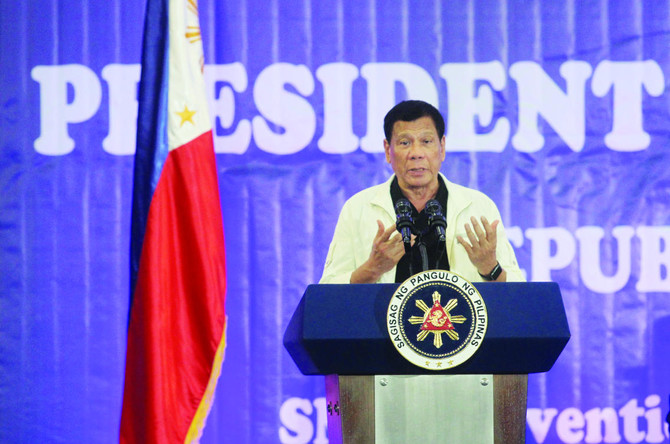
Duterte pleads with Muslim Mindanao mayors to stop extremists, threatens martial law in region

Uganda partially restores internet after president wins 7th term
- “The internet shutdown implemented two days before the elections limited access to information, freedom of association, curtailed economic activities ... it also created suspicion and mistrust on the electoral process,” the team said in their report
KAMPALA: Ugandan authorities have partially restored internet services late after 81-year-old President Yoweri Museveni won a seventh term to extend his rule into a fifth decade with a landslide victory rejected by
the opposition.
Users reported being able to reconnect to the internet and some internet service providers sent out a message to customers saying the regulator had ordered them to restore services excluding social media.
“We have restored internet so that businesses that rely on internet can resume work,” David Birungi, spokesperson for Airtel Uganda, one of the country’s biggest telecom companies said. He added that the state communications regulator had ordered that social media remain shut down.
The state-run Uganda Communications Commission said it had cut off internet to curb “misinformation, disinformation, electoral fraud and related risks.” The opposition, however, criticized the move saying it was to cement control over the electoral process and guarantee a win for the incumbent.
The electoral body in the East African country on Saturday declared Museveni the winner of Thursday’s poll with 71.6 percent of the vote, while his rival pop star-turned-politician Bobi Wine was credited with 24 percent
of the vote.
A joint report from an election observer team from the African Union and other regional blocs criticized the involvement of the military in the election and the authorities’ decision to cut
off internet.
“The internet shutdown implemented two days before the elections limited access to information, freedom of association, curtailed economic activities ... it also created suspicion and mistrust on the electoral process,” the team said in their report.
In power since 1986 and currently Africa’s third longest-ruling head of state, Museveni’s latest win means he will have been in power for nearly half a century when his new term ends in 2031.
He is widely thought to be preparing his son, Muhoozi Kainerugaba, to take over from him. Kainerugaba is currently head of the military and has expressed presidential ambitions.
Wine, who was taking on Museveni for a second time, has rejected the results of the latest vote and alleged mass fraud during the election.
Scattered opposition protests broke out late on Saturday after results were announced, according to a witness and police.
In Magere, a suburb in Kampala’s north where Wine lives, a group of youths burned tires and erected barricades in the road prompting police to respond with tear gas.
Police spokesperson Racheal Kawala said the protests had been quashed and that arrests were made but said the number of those detained would be released later.
Wine’s whereabouts were unknown early on Sunday after he said in a post on X he had escaped a raid by the military on his home. People close to him said he remained at an undisclosed location in Uganda. Wine was briefly held under house arrest following the previous election in 2021.
Wine has said hundreds of his supporters were detained during the months leading up to the vote and that others have been tortured.
Government officials have denied those allegations and say those who have been detained have violated the law and will be put through due process.