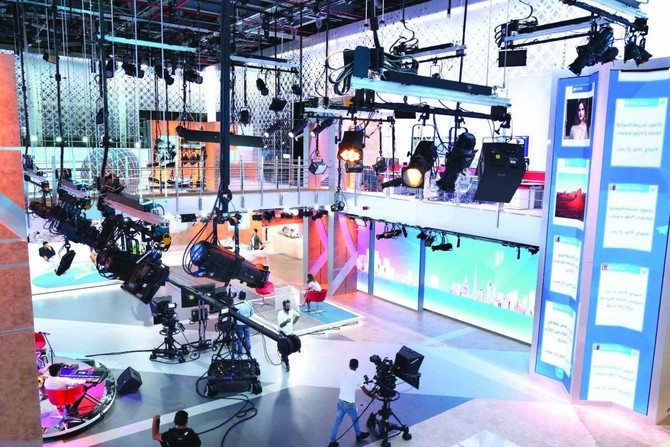
DUBAI: The Middle East broadcaster MBC has opened new studios in Dubai, which it said boast “state-of-the-art” equipment.
The media giant also introduced seven programs to be broadcast from the new location at Dubai Studio City.
The facility will be used for programming for MBC’s satellite network, primarily MBC1 and MBC3, and online portals.
The television studios have “cutting-edge” equipment that meets international standards, the broadcaster said in a statement.
Dubai Studio City is located inland, and the new studios complement MBC’s facilities at its headquarters in Dubai Media City.
“The presence of MBC today in Dubai Studio City started with the launch of our partnership with O3 Productions in 2013 for the production and distribution of drama and film content. Following that, our studios were soon equipped with state-of-the-art equipment and cutting-edge technology that puts us on par with the world’s top studios,” said Ali Jaber, group TV director at MBC.
“Today, we follow through with what we started four years ago — to enrich the region with the most creative media and entertainment content that ranges from drama productions right through to live programming.
“Hence, stems the strategic importance of this partnership that constitutes a quantum leap that will inevitably lead to the development of content in all its forms across MBC Group’s channels and other media platforms. Through this partnership, we will also be able to attract top talent, the right expertise, and bright, creative minds of the various disciplines that are related to the creative and production fields.”
MBC said seven key shows will be made at the new facility. “Ma Lam Tarra,” fronted by Ibrahim Al-Farhan, investigates social issues by uncovering hidden facts and events. “Badriyah,” a current affairs program, live interview show “Bil-Mokhtasar”, and family breakfast show “Sabah Alkhair Ya Arab” (Good Morning, Arab World) will also be made there. “MBC Fi Isbo’o” (MBC In A Week), a news bulletin and sports show will also be made at the Dubai Studio City complex.
MBC Group — considered the largest TV broadcaster in the Arab world, with 20 stations including MBC Drama and the Al Arabiya News Channel — gets most of its revenues from advertising.
The outlook for the wider advertising market is gloomy for this year. Elie Khouri, chief executive of the Omnicom Media Group in MENA, earlier told Arab News that investments in Middle East and North Africa (MENA) advertising fell by 10 percent in 2016, and expects a similar drop this year.
But the executive expects the market to recover in late 2017 and early next year.


Media giant MBC opens new studios in Dubai


Media giant MBC opens new studios in Dubai


Israel extends foreign media ban law until end of 2027
- Order replaces temporary emergency legislation that allowed authorization of so-called ‘Al Jazeera bill’
- Extension of temporary order empowers Communications Ministry to restrict foreign channels deemed to cause ‘real harm to state security’
LONDON: Israel’s Knesset approved late Monday an extension of the temporary order empowering the Communications Ministry to shut down foreign media outlets, pushing the measure through until Dec. 31, 2027.
The bill, proposed by Likud lawmaker Ariel Kallner, passed its second and third readings by a 22-10 vote, replacing wartime emergency legislation known as the “Al Jazeera Law.”
Under the extended order, the communications minister — with prime ministerial approval and security cabinet or government ratification — can restrict foreign channels deemed to cause “real harm to state security,” even outside states of emergency.
Measures include suspending broadcasts, closing offices, seizing equipment, blocking websites, and directing the defense minister to block satellite signals, including in the West Bank, without disrupting other channels.
Administrative orders last 90 days, with possible extensions. Unlike the temporary measure, the new law does not require court approval to shut down a media outlet.
The move has drawn sharp criticism from human rights and media groups, who warn it entrenches restrictions on Arab and foreign outlets amid a broader erosion of press freedoms.
“Israel is openly waging a battle against media outlets, both local and foreign, that criticize the government’s narrative; that is typical behavior of authoritarian regimes,” International Federation of Journalists General Secretary Anthony Bellanger said in November after the bill’s first reading.
“We are deeply concerned about the Israeli parliament passing this controversial bill, as it would be a serious blow to free speech and media freedom, and a direct attack on the public’s right to know.”
In a parallel development, the Israeli Cabinet unanimously approved on Monday the shutdown of Army Radio (Galei Tzahal) after 75 years, with operations ceasing on March 1, 2026.
In a statement, Attorney General Gali Baharav-Miara warned the decision “undermines public broadcasting in Israel and restricts freedom of expression,” lacking a legal basis.


