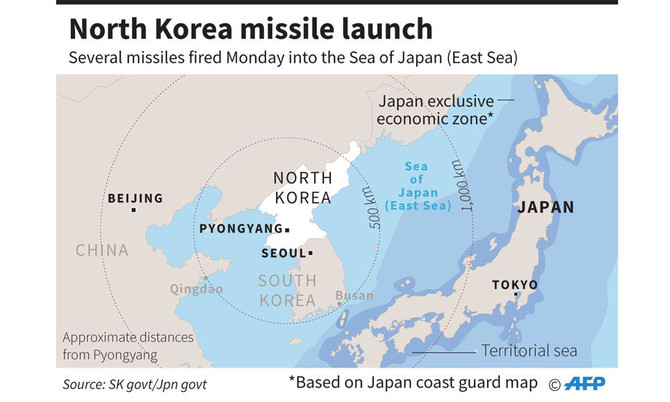
SEOUL, South Korea: North Korea on Monday fired four banned ballistic missiles that flew about 1,000 kilometers (620 miles) on average, with three of them landing in waters that Japan claims as its exclusive economic zone, South Korean and Japanese officials said. The test-launches appeared to be in reaction to huge US-South Korean military drills that Pyongyang insists are an invasion rehearsal.
It was not immediately clear the exact type of missile fired, but the tests will be viewed as a provocation by the Trump administration, which is working on its policy for North Korea. The New York Times reported over the weekend that the United States still can’t effectively counter Pyongyang’s actions despite efforts to perfect cyber and electronic strikes against North Korea’s missile program.
Pyongyang has test-launched a series of missiles of various ranges in recent months, including a new intermediate-range missile in February; it also conducted two nuclear tests last year. The ramped-up tests come as leader Kim Jong Un pushes for a nuclear and missile program that can deter what he calls US and South Korean hostility toward the North.
There have been widespread worries that the North will conduct an ICBM test that, when perfected, could in theory reach the US mainland. Washington would consider such a capability a major threat.
US national security adviser H.R. McMaster and his South Korean counterpart Kim Kwan-jin talked by phone after the missile firings. The two condemned the launches and agreed to boost cooperation to get the North to face more effective sanctions and pressure, according to South Korea’s presidential office.
Japanese officials said three missiles landed in the 200-nautical-mile offshore area where Tokyo has sovereign rights for exploring and exploiting resources. It’s the third time that North Korean missiles have fallen in Japan’s exclusive economic zone, beginning last August. Japanese leaders see the launches into nearby waters as a growing threat.
South Korea’s Joint Chiefs of Staff said in a statement that Monday’s launches were made from the Tongchang-ri area in North Phyongan province. The area is the home of the North’s Sohae rocket launch site where it has conducted prohibited long-range rocket launches in recent years.
US State Department spokesman Mark Toner said, “We remain prepared — and will continue to take steps to increase our readiness — to defend ourselves and our allies from attack, and are prepared to use the full range of capabilities at our disposal against this growing threat.”
Seoul and Washington call their military drills on the Korean Peninsula, which remains in a technical state of war because the 1950-53 Korean War ended with an armistice and not a peace treaty, defensive and routine.
The North hates the military drills, which run until late April and which analysts say force its impoverished military to respond with expensive deployments and drills of their own. An unidentified spokesman for the North’s General Staff of the Korean People’s Army said last week that Pyongyang’s reaction to the southern drills would be the toughest ever but didn’t elaborate
The United States has 28,500 troops stationed in South Korea, and 50,000 in Japan, as a deterrent against a potential aggression from the North.


North Korea fires 4 banned ballistic missiles into sea
North Korea fires 4 banned ballistic missiles into sea


How a Syrian refugee chef met Britain’s King Charles
- Alarnab, 48, said he had asked the king to come to the popular eatery when he met him at Buckingham Palace
LONDON: Pots clanged and oil sizzled inside the London kitchen of Syrian chef Imad Alarnab, as the former refugee who fled his country’s civil war recalled hosting King Charles III.
When the chef left his war-torn homeland in 2015, he never imagined that one day he would watch as cameras flashed and wide-eyed crowds greeted the monarch arriving at his Soho restaurant last year.
Alarnab, 48, said he had asked the king to come to the popular eatery when he met him at Buckingham Palace before an event honoring humanitarian work in 2023.
“I told him ‘I would love for you to visit our restaurant one day’ and he said: ‘I would love to’... I was over the Moon to be honest.”
The chef has come a long way since he arrived in London after an arduous journey from Damascus with virtually no money in his pocket.
Fearing for his life, he had escaped Syria after his family was uprooted again and again by fighting.
His culinary empire — restaurants, cafes, and juice bars peppered across the Syrian capital — had been destroyed by bombing in just six days in 2013.
Alarnab spent three months crisscrossing Europe in the back of lorries, aboard trains, on foot and even on a bicycle before he reached the UK.
“When I left, I left with nothing,” he told AFP, as waiters whirled past carrying steaming plates of traditional Syrian fare.
Starving and exhausted, he spent the last of his money on a train ticket to Doncaster where his sister lived.
“Love letter from Syria”
To make a living, Alarnab initially picked up any odd jobs, such as washing and selling cars, saving enough to bring his wife and three daughters over after seven months.
His love of cooking never left him though. In France, while he was sleeping on the steps of a church, Alarnab had often cooked for hundreds of other refugees.
“I always dreamed of going back to cooking,” he said.
So it wasn’t long before he found himself back in the kitchen, cooking up a storm across London with his sold-out supper clubs, bustling pop-up cafes, and crowded lunchtime falafel bars.
Alarnab’s friends gave him the initial boost for his first pop-up in 2017, and profits from his new catering business then covered the costs of later events.
He now runs two restaurants in the city — one in Soho’s buzzing Kingly Court and another nestled in a corner of the vibrant Somerset House arts center.
“I was looking for a city to love when I found London,” Alarnab said, adding it had offered him “space to innovate” and add his own modern twist to classic Syrian dishes.
Far from home, Alarnab said his word-of-mouth success had grown into a “love letter from Syria to the world” that needs no translation.
“You don’t really need to speak Arabic or Syrian to know that this is the best falafel ever,” he said, pointing to a row of colorful plates.
“There is hope”
For Alarnab, spices frying, dough rising and cheese melting inside a kitchen offered an unlikely escape from the real world.
“All my problems, I leave them outside the kitchen and walk in fresh.”
When he fled Syria, Alarnab thought going back to Damascus was forever off the table.
Yet he returned for the first time in October, almost a year to the day after longtime leader Bashar Assad was toppled in a lightning rebel offensive — ending almost 14 years of brutal civil war.
He walked the familiar streets of his old home, where his late mother taught him to cook many years ago.
“To return to Damascus and for her not to be there, that was extremely difficult.”
Torn between the two cities, Alarnab said he longed to one day rebuild his home in Damascus.
“I wish I could go back and live there. But at the same time, I feel like London is now a part of me. I don’t know if I could ever go back and just be in Syria,” he said.
Although Syrians still bear the scars of war, Alarnab said he had seen “hope in people’s eyes which was missing when I left in 2015.”
“The road ahead is still very long, and yes this is only the beginning — but there is hope.”