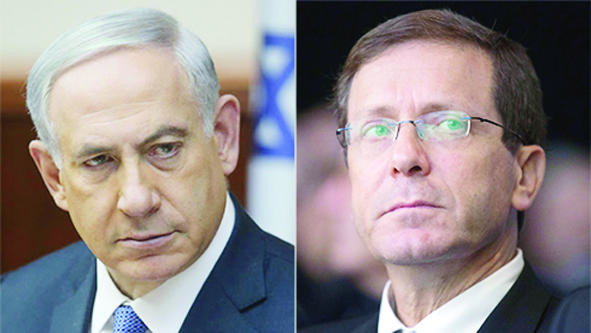
JERUSALEM: Prime Minister Benjamin Netanyahu offered a plan to form a unity government with Israel’s opposition last year as part of a regional peace bid, but later backtracked, a newspaper reported Sunday.
The plan centered on a document delivered to opposition leader Isaac Herzog in September, but Netanyahu later pulled back and talks collapsed in October, Israeli newspaper Haaretz reported.
Spokesmen for Netanyahu and Herzog, who heads the Zionist Union coalition dominated by his Labour party, did not immediately respond to requests for comment.
The effort came as moves were underway to restart peace talks with the Palestinians through a process that would include Arab countries in the region.
Netanyahu currently heads what is seen as the most right-wing government in Israeli history, with key members of his coalition openly opposing a Palestinian state.
Forming a unity government with the center-left could have reassured Arab nations of his sincerity.
The document reportedly delivered to Herzog in September was a proposal for a joint declaration reiterating their commitment to a two-state solution and their desire to seek a resolution with the Palestinians.
It came some seven months after a previously reported secret meeting between Netanyahu, Egyptian President Abdel Fattah El-Sisi, Jordan’s King Abdallah II and then US Secretary of State John Kerry.
The meeting in the Jordanian city of Aqaba saw Kerry pitch a regional peace effort.
Arab countries have previously offered normalized relations with Israel in exchange for resolving the decades-old Israeli-Palestinian conflict.
Under Netanyahu’s plan, the draft document negotiated with Herzog was to be submitted at a summit in Egypt in October to launch a regional peace initiative.
The two men were then to announce negotiations for the formation of a unity government after returning from the summit, which ultimately did not occur, Haaretz said.
According to the paper, Netanyahu later told Herzog he wanted to resolve controversy surrounding the evacuation of a Jewish outpost in the occupied West Bank first, and talks later collapsed.
Donald Trump has since taken office as US president and has sent mixed signals regarding the Israeli-Palestinian conflict.
Last month as Netanyahu visited the White House, Trump backed away from Washington’s years-long commitment to a two-state solution, saying he would support a single state if it led to peace.
Israeli right-wing politicians have welcomed Trump’s election, with some calling for an end to the idea of a Palestinian state.


![]()
Netanyahu offered unity govt as part of peace bid
Netanyahu offered unity govt as part of peace bid
Latest updates




© 2026 SAUDI RESEARCH & PUBLISHING COMPANY, All Rights Reserved And subject to Terms of Use Agreement.