GENEVA: More than a week of UN-sponsored peace talks ended in Geneva on Friday, the main opposition group said, calling the results “more positive” than previous rounds.
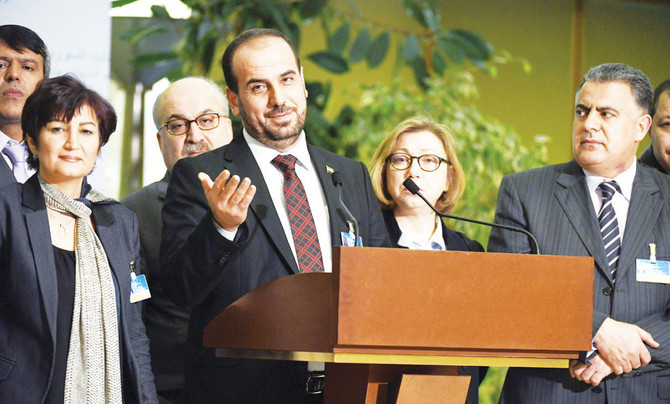
“We are closing this round without (a) clear result ... but I can say this time was more positive,” Nasr Al-Hariri, the chief negotiator of the High Negotiating Committee (HNC), told reporters.
“It was the first time we discussed in an acceptable depth the issues of the future of Syria and political transition,” he said after the talks, the fourth mediated by UN envoy Staffan de Mistura.
De Mistura handed all the delegations a paper with 12 principles that would be the basis for a second round of negotiations, said the head of the “Moscow Platform” political grouping at the talks.
Hamzi Menzer cited de Mistura, who gave the group a copy of the one-page document, as saying that the Geneva process would resume in the coming weeks.
The Syrian opposition provisionally accepted the 12 principles, chief negotiator Nasr Al-Hariri said.
The general principles on the future of Syria were derived from points set out by de Mistura last year, Hariri told reporters.
He said the round had ended without clear results but for the first time issues related to political transition had been discussed in acceptable depth.
His rival, Syrian regime negotiator Bashar Al-Jaafari, left the talks without commenting.
De Mistura said he plans to invite negotiators back to Geneva for another round of talks later this month, at the end of the latest discussions.
“I am planning to invite the Syrian parties back here in March for a fifth round.”
The talks, he said, had produced a “clear agenda” for the war-scarred country.
Meanwhile, the Russian military said its officers planned and directed the Syrian operation to recapture Palmyra.
Col. Gen. Sergei Rudskoi of the military’s General Staff said Friday Russian warplanes and special forces played a “decisive role” in driving out the Daesh militants.
Syria’s military announced the previous night that its forces have fully recaptured Palmyra, the third time the town famed for its ancient Roman ruins has changed hands in one year. Rudskoi said the Russian military spared Palmyra’s heritage sites which Daesh had sought to destroy. Rudskoi said over 1,000 Daesh militants were killed in the fight for Palmyra. He said the top-of-the line Ka-52 helicopter gunships proved their efficiency in combat.
He said that Russian explosives experts would soon join the Syrian Army in clearing mines in Palmyra.


![]()
Syria peace talks head to Geneva 5
Syria peace talks head to Geneva 5
Related




Latest updates


© 2026 SAUDI RESEARCH & PUBLISHING COMPANY, All Rights Reserved And subject to Terms of Use Agreement.