Germany arrests suspected Syrian war criminal

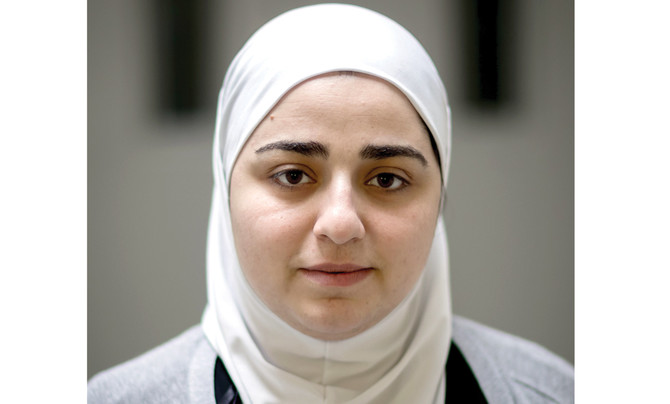
Syrian Abier Farhud, a victim of torture and abuse in Syrian regime cells. (Reuters)
Updated 03 March 2017
Follow

Germany arrests suspected Syrian war criminal

BERLIN: German police have arrested two Syrian men, one of whom is suspected of involvement in the killing of 36 Syrian regime’s employees in Syria in March 2013 and committing war crimes, prosecutors said on Thursday.

Abdalfatah H. A., 35, is suspected of being a member of the Al-Qaeda-linked Nusra Front and of carrying out a death sentence.

With other members of his unit, he is believed to have killed 36 employees of the Syrian regime who were protected under international law, said the prosecutors.

He was arrested in Duesseldorf in northwestern Germany.

Spiegel Online reported that he was an asylum seeker but the prosecutor’s office refused to confirm that.

The second man, Abdulrahman A.A., 26, is also suspected of being a member of the Nusra Front and of dealing with money and transport for his unit. He was arrested in the western German town of Giessen.

Both men are believed to have been equipped with Kalashnikovs, and to have helped seize a big arms depot in November 2013 near Mahin, south of the Syrian city of Homs.

In Germany, suspects are identified only by their first names and initials.

Prosecutors separately confirmed they had received a complaint filed by a group of people who said they had been tortured in Syrian intelligence service prisons.

The European Center for Constitutional and Human Rights, seven Syrians and two Syrian lawyers said they had submitted the first such complaint against six senior officials in the Syrian Military Intelligence Service known by name.

The aim of the complaint was to secure international arrest warrants and to start investigations by the prosecutors’ office against those responsible for crimes, said the complainants in a statement.

“This complaint is very welcome because it may lead us to an investigation,” said a spokeswoman for prosecutors in Karlsruhe, adding that German authorities had since 2011 been involved in looking at possible investigations of crime committed in Syria. 

The new complaint alleges crimes against humanity and war crimes committed in three Damascus prisons between October 2011 and July 2015, based on the testimonies of 12 witnesses, seven of whom are complainants.

The Syrian ex-detainees, men and women aged 26 to 57, are joined by Syrian lawyers Anwar Al-Bunni and Mazen Darwish, who have both themselves been victims of torture and abuse in Syrian regime cells.

“In Syria there is total impunity, which produces further violence. Without justice there will be no political solution to the conflict,” said Darwish.

Al-Bunni added: “Massive human rights violations must not remain unanswered. This is clear since the Nuremberg trials. Torture is absolutely forbidden.”

The complaint was launched under the principle of universal jurisdiction, which allows the German judiciary to become active in cases where neither the victims nor the perpetrators are German citizens.


Sudan defense minister dismisses ‘intelligence document’ as fabrication after convoy strike

Updated 12 February 2026
Follow

Sudan defense minister dismisses ‘intelligence document’ as fabrication after convoy strike

  • Gen. Hassan Kabroun tells Arab News claims that army hid weapons in aid convoy are “completely false”

RIYADH: Sudan’s defense minister has firmly denied reports attributed to Sudanese intelligence alleging that a convoy targeted in North Kordofan was secretly transporting weapons under the cover of humanitarian aid.

Gen. Hassan Kabroun described the claims as “false” and an attempt to distract from what he called a militia crime.

The controversy erupted after news reports emerged that a document attributed to Sudan’s General Intelligence Service claimed the convoy struck in Al-Rahad on Friday was not a purely humanitarian mission, but was instead carrying “high-quality weapons and ammunition” destined for Sudanese Armed Forces units operating in the state.

The report further alleged that the convoy had been outwardly classified as humanitarian in order to secure safe passage through conflict zones, and that the Rapid Support Forces had destroyed it after gathering intelligence on its route and cargo.

Kabroun categorically rejected the narrative.

“First of all, we would like to stress the fact that this news is false,” he told Arab News. “Even the headline that talks about the security of the regions, such as Al-Dabbah, is not a headline the army would use.”

He described the document as fabricated and politically motivated, saying it was designed to “cover up the heinous crime they committed.”

The minister affirmed that the area targeted by drones is under full control of the Sudanese Armed Forces and does not require any covert military transport.

“Second, we confirm that the region that was targeted by drones is controlled by the army and very safe,” Kabroun said. “It does not require transporting any military equipment using aid convoys as decoys because it is a safe area controlled by the army, which has significant capabilities to transport humanitarian aid.”

According to the minister, the Sudanese military has both the logistical capacity and secure routes necessary to move equipment openly when needed.

“The army is professional and does not need to deliver anything to Kadugli or Dalang on board aid convoys,” he said. “The road between Dalang and Kadugli is open. The Sudanese forces used that road to enter and take control of the region. The road is open and whenever military trucks need to deliver anything, they can do so without resorting to any form of camouflage.”

Kabroun further rejected any suggestion that the military uses humanitarian operations as cover.

“Aid is transported by dedicated relief vehicles to the areas in need of this assistance,” he said. “Aid is not transported by the army. The army and security apparatus do not interfere with relief efforts at all, and do not even accompany the convoys.”

He stressed that the Sudanese Armed Forces maintains a clear institutional separation between military operations and humanitarian work, particularly amid the country’s crisis.

“These are false claims,” he said. “This fake news wanted to cover up the heinous crime they committed.”

Sudan has been gripped by conflict since April 2023, when fighting broke out between the Sudanese Armed Forces and the Rapid Support Forces, plunging the country into what the United Nations has described as one of the world’s worst humanitarian disasters.

The latest dispute over the convoy comes amid intensified fighting in South Kordofan, a strategically sensitive region linking central Sudan with the contested areas of Darfur and Blue Nile.

The false report suggested that intelligence monitoring had enabled the RSF to strike what it described as a military convoy disguised as humanitarian aid. But Kabroun dismissed that version outright.

“The intelligence agency is well aware of its duties,” he said. “The Sudanese Army has enough weapons and equipment to use in the areas of operations. These claims are completely false.”

He argued that the narrative being circulated seeks to shift blame for attacks on civilian infrastructure and humanitarian movements.

“This shows that they are trying to cover up the atrocities,” he added, referring to the militia.

Kabroun maintained that the army has regained momentum on multiple fronts and remains fully capable of sustaining its operations without resorting to deception.

“The region is secure, the roads are open, and the army does not need camouflage,” he said. “We are operating professionally and transparently.”

“These claims are completely false,” Kabroun said. “The Sudanese Army does not use humanitarian convoys for military purposes.”