BELFAST: Northern Ireland began voting Thursday in snap elections to resolve a political crisis fueled by bad blood and Brexit, which is testing the delicate peace in the British province.
Long-simmering tensions boiled over in January when the Sinn Fein party — once the political arm of the Irish Republican Army — brought down the province’s semi-autonomous government.
That triggered fresh elections to the Northern Ireland Assembly, a legislature in Belfast in which representatives of once warring communities have shared power on and off since a 1998 peace deal.
Observers predict a similar outcome to the May 2016 elections, in which the conservative and pro-British Democratic Unionist Party won slightly more seats than the socialist and pro-Irish republican Sinn Fein.
If the two parties cannot resolve their differences within three weeks of the vote, the assembly’s executive could be suspended and the province fully governed from London.
“I’d be more pessimistic than optimistic that the DUP and Sinn Fein can get back in a government together quickly,” Jonathan Tonge, a Northern Ireland politics expert at Liverpool University, told AFP.
Martin McGuinness, a former IRA commander who became the deputy first minister of Northern Ireland, resigned in January in protest over a botched green energy subsidy scheme.
It had been instigated by First Minister Arlene Foster, head of the DUP, when she was economy minister.
Deeply engrained historical enmity was also exacerbated by the June vote for Britain to leave the European Union, which the DUP supported but Sinn Fein opposed.
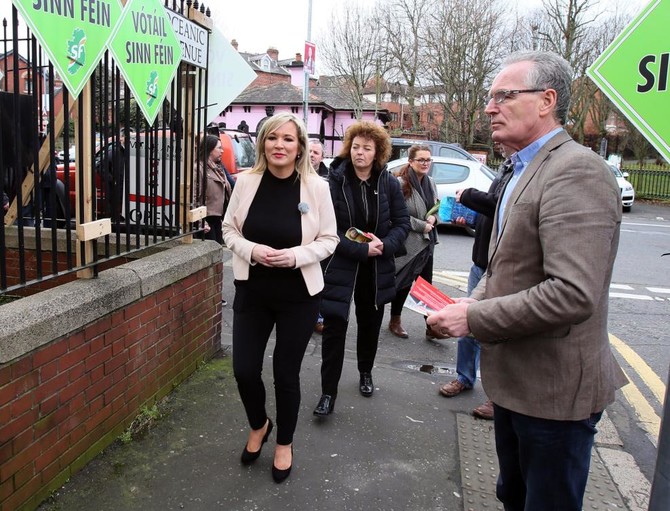
McGuinness is not standing again due to ill health, and his successor as Sinn Fein’s leader in Northern Ireland, Michelle O’Neill, has signaled a possible way out.
“We’re up for going back into government but only on the basis of equality, respect and integrity,” she told AFP on the final day of campaigning on Wednesday.
“We cannot go into government with Arlene Foster as first or deputy first minister while there is a shadow hanging over her, but that doesn’t mean we can’t find a way forward.”
Foster has appealed for unionists to resist Sinn Fein’s demands for her to stand aside pending an investigation into the energy scheme.
“If you feed a crocodile it will keep coming back for more,” she told a party rally.
In the streets of Belfast, there was disillusionment over the scandal.
“I’m just fed up with all the corruption and all the scandals to do with the heating and all the rest of it,” civil servant Catherine Aouad said.
Annette Martin, who works for the Marie Curie charity, said: “I’m not sure I expect an awful lot, to be honest, but I still wanted to make my vote.”
Prime Minister Theresa May has said Britain will leave the EU’s single market and likely the customs union after Brexit, which would make the border between Northern Ireland and the Republic of Ireland the only land border with the European Union.
The possibility of a return to border checkpoints has revived memories of “The Troubles,” three decades of strife over British control of Northern Ireland, in which more than 3,500 people were killed.
Sinn Fein’s leader in Ireland, Gerry Adams, has described Brexit as a “hostile action” by the British government, which would have a “negative impact” on peace agreement in Northern Ireland.
There are also concerns about damaging cross-border trade.
British minister James Brokenshire emphasised the importance of a “frictionless” border during talks in Brussels this week, and promised to “take no risks” with political stability in the province.
Ireland’s Prime Minister Enda Kenny and European Commission chief Jean-Claude Juncker also agreed last week that there should be no return to hard borders.
In last June’s referendum on EU membership, Northern Ireland voted by 55 percent to remain in the bloc, but was outvoted by an overall British majority of 52 percent to leave.
Casting his ballot in east Belfast Thursday, Neal Wilson, a 34-year-old public sector worker, said he believed the fears were overblown.
“There is a lot of talk about how the Troubles will come back because we are not in the European Union. It’s actually very insulting for the people here,” he said, predicting a successful outcome from Brexit.
Polls close at 2200 GMT but results are not expected until Saturday.


![]()
Northern Ireland holds snap election in shadow of Brexit
Northern Ireland holds snap election in shadow of Brexit


Latest updates


© 2026 SAUDI RESEARCH & PUBLISHING COMPANY, All Rights Reserved And subject to Terms of Use Agreement.