SEATTLE, United States: Airport officials and civil rights lawyers around the country are getting ready for President Donald Trump’s new travel ban — mindful of the chaos that accompanied his initial executive order but hopeful the forthcoming version will be rolled out in a more orderly way.
The new order is expected to be issued in the coming days. A draft suggested it would target people from six of the original seven predominantly Muslim countries but would exempt travelers who already have visas to come to the US The latest draft in circulation no longer includes Iraq.
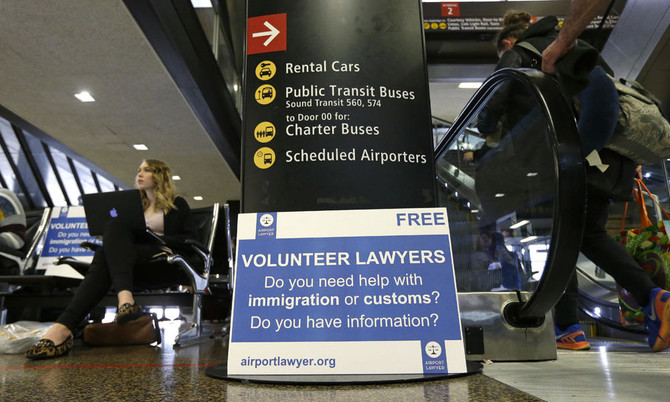
Since last month’s ban, which courts have put on hold, a section of the international arrivals area at Dulles International Airport outside the nation’s capital has been transformed into a virtual law firm, with legal volunteers ready to greet travelers from affected countries and ask if they saw anyone being detained.
Similar efforts are underway at other airports, including Seattle-Tacoma International, where officials have drawn up plans for crowd control after thousands crammed the baggage claim area to protest the original ban.
“The plan is to be as ready as possible,” said Lindsay Nash, an immigration law professor at Cardozo School of Law in New York who has been helping prepare emergency petitions on behalf of those who might be detained.
Trump’s initial action, issued Jan. 27, temporarily barred citizens of Iran, Iraq, Syria, Yemen, Somalia, Sudan and Libya from coming to the US and halted acceptance of all refugees. The president said his administration would review vetting procedures amid concerns about terrorism in those seven nations.
Protesters flooded US airports that weekend, seeking to free travelers detained by customs officials amid confusion about who could enter the country, including US permanent residents known as green-card holders.
Attorneys also challenged the order in court, including officials from Washington state. That lawsuit, which Minnesota joined, resulted in a federal judge temporarily blocking the government from enforcing the travel ban, a decision unanimously upheld by a panel of the 9th US Circuit Court of Appeals.
Many civil rights lawyers and activists have said they don’t believe a new order would cure all the constitutional problems of the original, including the claim that it was motivated by anti-Muslim discrimination.
Trump has said he singled out the seven countries because they had already been deemed a security concern by the Obama administration.
In his first address to Congress on Tuesday night, Trump said his administration “is taking strong measures to protect our nation from radical Islamic terrorism” and is working on improved vetting procedures.
“And we will shortly take new steps to keep our nation safe — and to keep out those who would do us harm,” Trump said.
Last week, analysts at the Homeland Security Department’s intelligence arm found insufficient evidence that citizens of the seven Muslim-majority countries pose a terror threat to the United States.
“It’s not enough to just tweak an order and not change the nature of why it was issued in the first place,” said Rula Aoun, director of the Arab American Civil Rights League in Dearborn, Michigan, which sued over the initial ban and is prepared to do the same with the rewrite if necessary.
In New York, American Civil Liberties Union attorney Lee Gelernt said the organization was ready to go to court if the administration tries to immediately enforce its new order.
“The primary focus is being able to respond immediately to any request by the government to lift any of the injunctions, before the courts have had a chance to examine the new order,” he said.
Activists and airport officials alike said they hoped it would be phased in to give travelers fair warning, which might preclude any detentions from arriving flights.
“We are prepared and willing,” said Rebecca Sharpless, who runs the immigration clinic at the University of Miami School of Law. “But it’s unlikely to cause the same kind of chaos of last time.”
At Dulles, Sea-Tac, Minneapolis-St. Paul and other airports, legal volunteers have greeted arriving travelers in shifts every day since the initial ban, wearing name tags or posting signs in different languages to identify themselves.
The legal-services nonprofit OneJustice was ready to send e-mail alerts to 3,000 volunteers in California if needed, deploying them to San Francisco and Los Angeles airports for people affected by any new order, chief executive Julia Wilson said.
In Chicago, travelers have been signing up for an assistance program started by the local Council on American-Islamic Relations office to ensure swift legal help if they’re detained.
Groups urged those arriving at 17 other airports, including Miami, Atlanta and San Diego, to register with Airport Lawyer , a secure website and free mobile app that alerts volunteer lawyers to ensure travelers make it through customs without trouble.
Asti Gallina, a third-year student at the University of Washington Law School, volunteered at Sea-Tac for the first time Tuesday. It was quiet, she said.
“An essential part of the American narrative is the ability to come to America,” Gallina said. “Any infringement of that is something that needs to be resisted.”
___
Associated Press writers Tammy Webber and Sophia Tareen in Chicago; Deepti Hajela and Larry Neumeister in New York; Matthew Barakat in Alexandria, Virginia; Adriana Gomez Licon in Miami; and Amy Forliti in Minneapolis contributed to this report.


![]()
US airports, legal volunteers prepare for new Trump travel ban
US airports, legal volunteers prepare for new Trump travel ban
Latest updates


© 2026 SAUDI RESEARCH & PUBLISHING COMPANY, All Rights Reserved And subject to Terms of Use Agreement.