

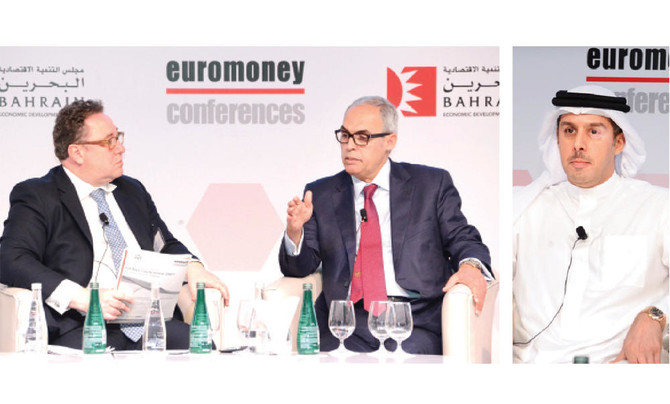
MANAMA: Bahrain aspires to become the face of innovation in finance in the Middle East and a hub for financial technology (FinTech) in the region.
Rasheed Al-Maraj, governor of the Central Bank of Bahrain (CBB), stressed the need for a progressive approach to promote an environment conducive to new businesses. “Banking is a very regimental industry,” he said at the two-day 6th GCC Financial Forum in Manama that ended Tuesday, adding that Bahrain plans to introduce the latest technology in the sector.
“It will create a new set of rules for our industry to go forward,” the banker said.
A number of key components are required to transform these aspirations into a reality. David Parker, executive director of financial services at Bahrain Economic Development Board (EDB), pointed out those components: A regulatory sandbox, having a physical FinTech hub for entrepreneurs and setting up a FinTech fund.
“I’m working with the regulator (CBB) to see how to put a sandbox in place that is going to work,” said Parker said on the sidelines of the forum on Tuesday.
The CBB will be in charge of establishing the sandbox and the EDB has brought Singapore FinTech Consortium on board to help advise on that process.
Elaborating on the second factor that can provide Bahrain with a strong basis to enhance on FinTech, Parker said: “Putting in place some form (of) physical FinTech hub whereby entrepreneurs can use Bahrain as a physical and online space to test and develop new ideas relevant to the industry here… regionally… and internationally.”
He said that it could initially kick off as an incubator or a co-working space for startups. But what the EDB would like to bring in on top of that in the future is to work with a partner to develop it as an accelerator.
The Singaporean model is also favored by Bahrain in this area, particularly because Singapore has launched the world’s largest FinTech accelerator in 2016.
A FinTech fund is the third on the list of necessities in shaping Bahrain’s FinTech sphere. It aims to provide entrepreneurs, who come to Bahrain in the initial stages of their projects, with access to funding.
“I would like that fund to be available to entrepreneurs outside of Bahrain as well as inside... We need to acknowledge if Bahrain is going to be a player within this space. Bahrain is a small country (and) there is a limited market. We want to encourage Bahrain to be…where entrepreneurs come to test their ideas and services. Maybe in some cases we need to acknowledge the need to move on to a bigger market,” said Parker said.
Second causeway: tourism booster
The proposed second causeway linking Saudi Arabia and Bahrain is likely to boost Bahrain’s tourism industry, Khalid Al-Rumaihi, CEO of the EDB, told Arab News.
Bahrain, with a population of 1.3 million, had 12.2 million visitors last year, up from 11.6 million the year before. An estimated 8 million came to Bahrain through Saudi borders.
“The causeway is a massive source of tourism, and it’s something we’d like to capture,” Al-Rumaihi said.
The EDB tracks the travel habits of those visitors, monitoring their length of stay. Statistics show that about 10 percent spend at least two nights in Bahrain.
“There’s huge potential to outgrow that. We’d like to see that grow from 10 to 15 or maybe 20 percent,” Al-Rumaihi said. The second 87-km causeway will be parallel to King Fahd Causeway, and is set to comprise a GCC rail network as well.
Having rail connections across Jeddah and Riyadh is also expected to allow even more visitors from the western and central provinces to have better land access to Bahrain.
Bahrain is focused on being an attractive destination for tourists from countries in the region who wish to come on short vacations and spend less money than they would if they traveled outside the region.
Rather than investing more on reaching out to tourists from other regions such as Europe, Al-Rumaihi said his country is more interested in expanding on the 12.2 million that come from the GCC.
He sees potential to develop medical tourism and get patients from neighboring Saudi Arabia, as well as sports tourism. Bahrain hosts the Formula 1, which attracts a large number of car-racing fans.
According to the EDB, Bahrain allows around 100 nationalities the flexibility of getting an e-visa or a visa upon arrival at the airport.
New laws
The CBB last month enacted three laws — Trusts Law, Investment Limited Partnerships Law and Protected Cells Companies Law — based on international best practice and need of financial services sector and financial institutions.
The new laws aim to enhance the competitiveness of Bahrain’s financial sector. The contribution of the financial services sector to Bahrain’s gross domestic product (GDP) is 17.5 percent. There are 113 banks in Bahrain, 25 of which are fully Shariah-complaint.
“When it comes to Islamic banking as well, Bahrain has come a long way in terms of introducing new products and helping the industry to move forward. One of the recent products is a ‘Wakala’ facility (liquidity tool) for Islamic banks to mobilize their excess liquidity and place it with the central bank,” said Al-Maraj.


