WASHINGTON: FBI Director James Comey is again in a familiar spot these days — the middle of political tumult.
As a high-ranking Justice Department official in the George W. Bush administration, he clashed with the White House over a secret surveillance program. Years later as head of the FBI, he incurred the ire of Hillary Clinton supporters for public statements on an investigation into her e-mails. Now, Comey is facing new political pressure as White House officials are encouraging him to follow their lead by publicly recounting private FBI conversations in an attempt to dispute reports about connections between the Trump administration and Russia.
It’s an unusual position for a crime-fighting organization with a vaunted reputation for independence and political neutrality. Yet Comey, the former top federal prosecutor in Manhattan who later became deputy attorney general of the United States, is known for an unshaking faith in his own moral compass.
“I’m not detecting a loss of confidence in him, a loss of confidence in him by him,” said retired FBI assistant director Ron Hosko, noting the broad recognition that “these are very tumultuous, polarized, angry, angry times.”
The latest flare up occurred Friday, when White House officials told reporters that chief of staff Reince Priebus had asked top FBI officials to dispute media reports that Donald Trump’s campaign advisers were frequently in touch with Russian intelligence agents during the election. The officials said the FBI first raised concerns about New York Times reporting but told Priebus the bureau could not weigh in publicly on the matter. The officials said Deputy Director Andrew McCabe and Comey instead gave Priebus the go-ahead to discredit the story publicly, something the FBI has not confirmed.
As the FBI declined to discuss the matter, pressure mounted on Comey to either counter or affirm the White House’s account. Even the Trump administration urged him to come forward, which as of Friday was not happening.
“Politicized assertions by White House chief of staff Priebus about what may or may not be the findings of an FBI investigation are exactly the wrong way for the public to hear about an issue that is of grave consequence to our democracy,” Sen. Ron Wyden, an Oregon Democrat and member of the Senate Intelligence Committee, said in a statement. “The American people deserve real transparency, which means Director Comey needs to come forward, in an open hearing, and answer questions.”
The push on Comey to publicly discuss the bureau’s investigation of Russian interference in the 2016 presidential election is especially acute given his statements in the run-up to Nov. 8 that many Democrats believe cost Clinton the election. He detailed the results of the FBI’s investigation at an unusual July news conference, testified on it for hours on Capitol Hill and alerted Congress less than two weeks before Election Day that the FBI would be reviewing new e-mails potentially connected to the case.
But it’s not clear that Comey, now in the fourth year of a 10-year term, will be swayed by any public hand-wringing. People who have worked with the FBI director describe him as holding strong personal convictions.
As deputy attorney general, he confronted White House officials in the hospital room of then-Attorney General John Ashcroft in an effort to quash the reauthorization of a counterterrorism surveillance program.
When nominating Comey for FBI director in 2013, President Barack Obama praised him for his “fierce independence and deep integrity.” Comey stood apart from the administration on a few occasions after that, including when he floated the possibility that police concerns over being recorded on video were causing officers to pull back and contributing to an uptick in homicides, a viewpoint the White House refused to endorse.
His decision to announce the FBI’s recommendation against criminal charges in the Clinton e-mail case was made without any notice to the Justice Department, and his notification to Congress about the new e-mails was not supported by department leaders, including Attorney General Loretta Lynch.
Decisions that reach the desk of the top leadership of the FBI are generally not easy, said Robert Anderson, a retired FBI executive assistant director.
“The director of the FBI is a hard job, even when it’s an easy day or nothing’s in the newspaper,” Anderson said. “By the time it makes it up to Jim, it’s all hard at that point.”


![]()
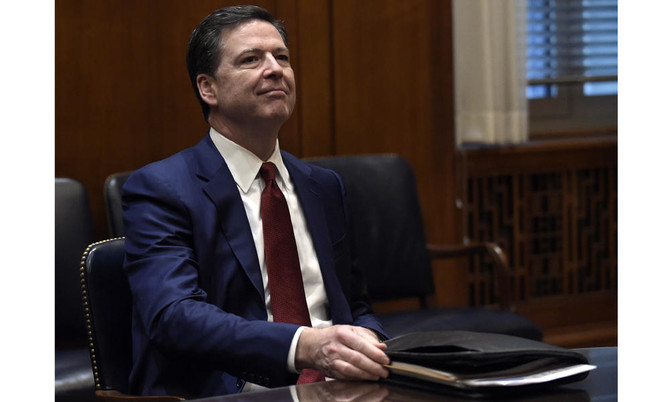
FBI chief faces pressure as White House fights Russia reports
FBI chief faces pressure as White House fights Russia reports
Latest updates


© 2026 SAUDI RESEARCH & PUBLISHING COMPANY, All Rights Reserved And subject to Terms of Use Agreement.