JEDDAH: Prominent Saudi singer Mohammed Abdu wowed crowds in Jeddah in a rare public concert on Monday evening. Around 6,000 music lovers attended the long-awaited show organized by Rotana at King Abdullah Sports City. Abdu, dubbed “The Artist of Arabs,” was backed by an Egyptian orchestra and performed alongside another Saudi artist, Rabeh Sager, and Iraqi-Saudi singer Majid Al-Muhandis.
As Abdu took the stage, an excited audience welcomed their star with a wave of applause. It was a performance filled with many of the singer’s masterpieces and constant audience interactions.
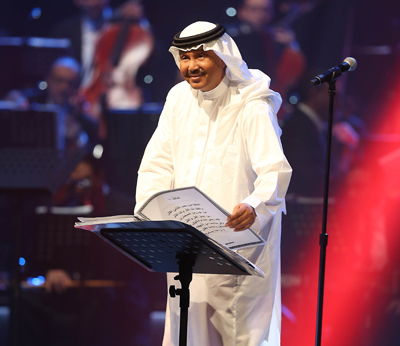
At one point, when Abdu sang his famous nationalistic song “Fouq Ham Al-Sahab,” the audience began to sing along with him, prompting Abdu to stop and listen to them sing.
As a show of his love and appreciation for the audience, Abdu flung his igal, a black rope-like cord used to secure the ghutra, at them.
Later, Sager and Al-Muhandis entertained the audience with the rendition of their old and new songs.
“I am very happy to sing in my homeland,” Sager said, adding, “Please don’t make me cry.” Jeddah previously featured live concerts held during summer festivals, but these were completely stopped more than seven years ago.
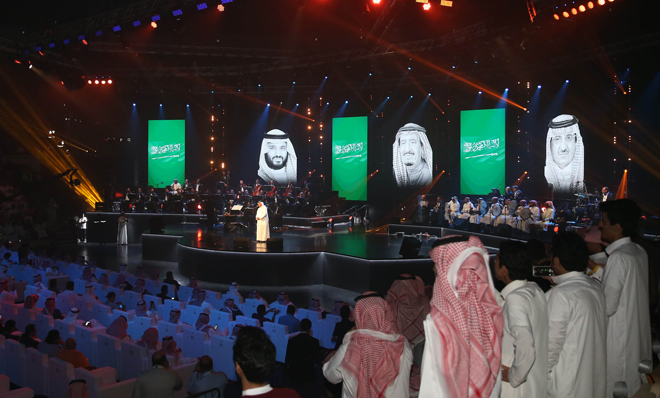
Other events have been held in closed stadiums, Jeddah’s International Exhibition and Convention Center and private wedding halls.
Abdu launched his masterpiece “Al-Amaken” in 2005 during a memorable concert at the Jeddah Festival. He was set to perform live at the King Fahd Cultural Center in Riyadh during Eid festivities but it was later canceled.

‘Artist of Arabs’ Mohammed Abdu enchants Jeddah in rare gig
Hamza Hawsawi on headlining The Fridge in Riyadh
DUBAI: Saudi R&B artist Hamza Hawsawi headlined The Fridge’s “Concert Series KSA Season 1” over the weekend, performing a show in Riyadh’s JAX District as part of a two-day program spotlighting emerging talent.
Hawsawi’s performance followed “The Fridge Open Mic,” which took place at the same venue the night before. The open mic offered rising artists a professional stage to perform original material in front of a live audience, creating space for experimentation and discovery within the local music scene.
Speaking during the event, Hawsawi highlighted the importance of platforms such as open mics for artists. “I think it is important because an open mic is an opportunity to get to know new artists,” he said. “For industry professionals, like Fridge, it is an eye-opener to the scene, and it lets you understand how the scene is going, what kind of artists you’re gonna be dealing with in the future.”
From an artist’s standpoint, he added, the format remains essential for growth. “We do need open mics. We do need to be out there and to try different things, and to sing to different people, and to test our art and find out if people are gonna gravitate towards it or not.”
Hawsawi has spent more than 15 years developing a sound rooted in R&B, soul and pop, building an audience that now spans the region and beyond. He has accumulated more than 33 million global views and collaborated with a range of regional and international artists.
His track “Million Miles” was selected as the official Rally Dakar anthem, while his live performances have included stages such as MDLBeast and the Abu Dhabi Grand Prix.
Asked whether he feels a responsibility to help shape the Saudi R&B scene, Hawsawi described a fluid relationship with that role. “Sometimes I feel that sense of responsibility,” he said. “Other times I feel like I’m just a human being trying to express my feelings … But we’re just artists at the end of the day.”
He added that while he sometimes embraces being a beacon for the genre, “other times I feel like I want to be low-key, and I don’t even want to be seen or heard.”
Hawsawi also reflected on one of his personal challenges as an artist in the Kingdom: writing and performing primarily in English.
“That has been the biggest challenge to face,” he said.
While Arabic remains the most widely spoken language in Saudi Arabia, Hawsawi explained that English allows him to express what he feels more clearly, particularly when it comes to emotion and meaning.
“The nuances of what I feel and all the metaphors for me trying to say something but not saying it, you know, not a lot of people get that,” he said, noting that his work often reaches a niche audience. “But I’m happy with that.”