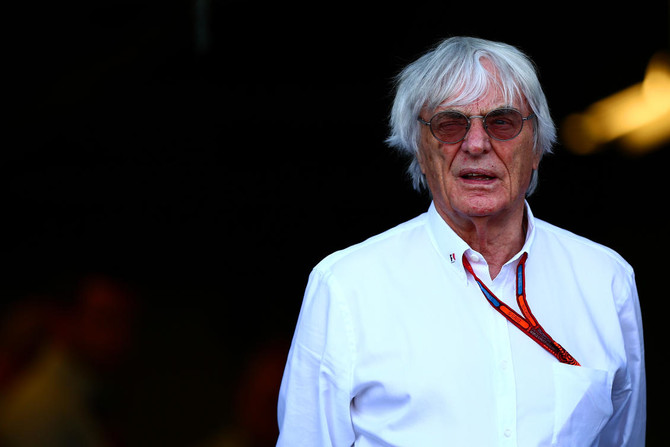
PARIS: Bernie Ecclestone, ousted as Formula One chief by its new American owner, transformed grand prix racing into one of the most profitable sports and made himself a billionaire powerbroker.
A former second-hand car salesman, Ecclestone, now 86, ran Formula One with an iron fist for more than four decades, building it into a global empire with a cut-glass brand.
His rule came crashing down Monday when Liberty Media completed its multi-billion-dollar takeover of the sport and appointed American Chase Carey as chairman and chief executive, elbowing Ecclestone aside with title of “chairman emeritus.”
Typically forthright, Ecclestone saw through the corporate smokescreen, saying bluntly “I was dismissed today.”
Ecclestone was the flamboyant figure at the center of Formula One since the 1970s, crafting it into one of the world’s most glamorous and best known sports.
But his career has not been without controversy.
Ecclestone paid $100 million to German authorities to end a high-profile bribery trial in 2014, which was linked to the sale of Formula One’s rights in 2006 and 2007.
Although he had faced a possible 10-year prison sentence if found guilty, many in the F1 paddock remained loyal.
“F1 is what it is thanks to Bernie Ecclestone, to the way he has built this sport over the past 35 years,” Christian Horner, team principal at Red Bull, said at the time. “I think that without him we would have big problems.”
Dubbed “Napoleon” due to his 1.59-meter (five foot three inch) stature and autocratic control, the fortune of Ecclestone is valued by Forbes magazine at $2.9 billion (2.7 billion euros, 2.3 billion pounds).
“I prefer strong leaders,” he said, stoking up controversy in 2009 by claiming that Adolf Hitler was a man who “was able to get things done” and that democracy had not worked out for Britain.
He was also in the spotlight in late 1997 over a donation of 1.5 million pounds to the British Labour Party under Tony Blair, whose goverment subsequently authorized the continued use of tobacco advertising by the sport.
Holder of a chemistry degree from Woolwich Polytechnic in southeast London, Ecclestone, known for his grey mop-top hairstyle, began his career selling cars and motorcycles in the capital, and also briefly drove race cars himself.
His own modest career was cut short following a series of accidents and he turned to the business side of racing.
He was a manager of promising British F1 driver Stuart Lewis-Evans, who died in a fiery crash in 1958. A decade later he managed Austrian Jochen Rindt, who was killed in a crash in 1970 and is the only driver to posthumously win the F1 world title.
In 1971 Ecclestone bought the Brabham team, becoming a member of the Formula One Constructors’ Association, the group that represented teams against what became the International Automobile Federation (FIA).
Ecclestone’s influence increased as he took over responsibility for negotiating television rights for Formula One, which until then was done on a race-by-race basis.
One of the first to recognize the potential in sponsorship, he became the exclusive manager of F1 rights, taking the helm of Formula One Management, negotiating with circuits, advertisers and television stations.
“The contracts he negotiated, the circuits and the countries to which he brought F1, are remarkable,” Horner said.
Ecclestone’s fortune has been little dented despite having had to pay out one billion euros ($1.3 billion) to divorce his wife Slavica — the mother of two of his children, Tamara and Petra.
In 2012, he remarried for a third time, to Brazilian Fabiana Flosi, 46 years his junior and whom he met at the South American country’s grand prix.
His family was in the headlines again last year when his 67-year-old mother-in-law Aparecida Schunck Flosi Palmeira was kidnapped, with a ransom of $36.5m demanded.
Brazilian police tracked her down and arrested a helicopter pilot who worked for the British billionaire’s family.

Formula One: Ecclestone, the racing Napoleon, forced into exile
India crushes Pakistan by 61 runs in marquee game in T20 World Cup. No handshakes again
- India made a competitive 175-7 on Sunday on a sticky pitch at R. Premadasa Stadium. In reply Pakistan was bowled out for 114 in 18 overs
COLOMBO, Sri Lanka: Archrivals India and Pakistan declined to shake hands before and after the most-anticipated game of cricket’s Twenty20 World Cup, with India easily winning by 61 runs on Sunday to secure its Super 8 spot.
India opener Ishan Kishan scored 77 off 40 deliveries in a match which almost didn’t take place after Pakistan had threatened a boycott earlier this month before reversing its decision.
Pakistan captain Salman Ali Agha and India captain Suryakumar Yadav didn’t shake hands at the toss, which Pakistan won and chose to field. India and Pakistan players had refused to shake hands at last year’s acrimonious Asia Cup tournament in the United Arab Emirates that took place amid diplomatic and military tensions between the two neighbors.
India made a competitive 175-7 on Sunday on a sticky pitch at R. Premadasa Stadium. In reply Pakistan was bowled out for 114 in 18 overs. Despite the heavy defeat, Pakistan can still advance from Group A. It plays Namibia in its last group game.
Sunday’s game was the first time the teams have met since the Asia Cup, won by India.
Early setback for India
India’s batting suffered an early setback when its most aggressive batter Abhishek Sharma was dismissed without scoring. Agha bowled the first over with four consecutive dot balls and had Sharma caught by Shaheen Shah Afridi.
Kishan pulled India back with a six and two fours in the following over and he dominated an 87-run stand for the second wicket off 46 deliveries with Tilak Varma.
Kishan’s innings included three sixes and 10 boundaries before being bowled by off spinner Saim Ayub.
Ayub took two consecutive wickets in his last over to finish with his career-best T20 bowling of 3-25.
India captain Yadav (32 off 29) and Shivam Dube (27 off 17) made useful contributions for India.
Poor start for Pakistan’s chase
Seam bowler Hardik Pandya gave India an ideal start with a wicket-maiden over, dismissing Sahibzada Farhan in the fourth delivery.
Jasprit Bumrah took two wickets in the next over — Ayub (lbw for 6) and Agha (caught by Pandya for 4).
Spinner Axar Patel bowled Babar Azam (5), leaving Pakistan 34-4.
Usman Khan resisted with a 34-ball 44 but was stumped when he stepped out to hit Patel.
Pandya, Bumrah, Patel and Varun Chakravarthy took two wickets each.
All eyes on Colombo
In the lead-up to the match in Colombo, Agha said he believed it was up to the Indian players to decide whether they would shake hands with his team before and after Sunday’s game.
Yadav, for his part, had been non-committal.
“Why are you highlighting that?” Suryakumar asked reporters on the eve of the game. “We are here to play cricket. We will play good cricket. We will take all those calls tomorrow. We will see tomorrow.”
Pakistan’s government considered not playing Sunday’s match after the International Cricket Council kicked Bangladesh out of the World Cup for refusing to play matches in India, citing security concerns.
Pakistan only agreed to play after intense discussions with the ICC. The fixture is a major revenue earner for the ICC.
Political and military tensions have meant the two teams have not played a bilateral series for years.
India has not traveled to Pakistan since 2008 and Pakistan visited India for the 50-over World Cup in 2023 but has since played ICC tournaments at neutral venues.
India has defeated Pakistan 13 times in the 17 T20 games they have played. It now also has an impressive 8-1 record in the nine T20 World Cup matches since the first edition in 2007.
West Indies makes it 3 in 3, US keeps slim hopes alive
At Mumbai, West Indies notched its third successive win in Group C when it thumped Nepal by nine wickets and qualified for the Super 8 stage of the tournament.
West Indies had already beat Scotland and England to take command of Group C.
Nepal showed plenty of promise in its first game when it lost narrowly to England, but then two heavy defeats against first-timer Italy and Sunday against West Indies saw it eliminated.
Fast bowler Jason Holder grabbed 4-27 and restricted Nepal to 133-8. ShaiHope then smashed an unbeaten 61 off 44 balls and Shimron Hetmyer scored 46 off 32 balls as West Indies cruised to 134-1 in 15.2 overs.
Sanjay Krishnamurthi kept the United States’ hopes of Super 8 qualification alive with a maiden T20 half-century – 68 not out off 33 balls – against Namibia in their Group A clash.
Skipper Monank Patel also scored 52 off 30 balls as the US notched up its tournament highest score – 199-4 in 20 overs.
In reply, Namibia was restricted to 168-6, losing its third game and is now eliminated from the competition.
The US won its final game by 31 runs.