RIYADH: An extraordinary session of the Cabinet chaired by King Salman here on Thursday approved Saudi Arabia’s general budget for 2017.
The budget seeks to improve the efficiency of capital and operational expenditures, strengthen public finances, enhance their sustainability and give priority to developmental and service projects and programs that serve citizens directly.
It also aims to contribute to activating the role of the private sector and increasing its contribution to gross domestic product (GDP).
The king underscored that the budget announcement comes amid economically volatile situations suffered by most states, which have led to a slowdown of global economic growth and a fall in oil prices, something that impacted Saudi Arabia too.
“Our economy is firm and it has sufficient strength to cope with the current economic and financial challenges and this is the result of the prudent fiscal policies taken by the state,” he underlined.
“We are determined to strengthen the elements of our national economy, where we adopted Saudi Vision 2030 and its programs according to a comprehensive reform plan that can transfer the Kingdom to broader and more comprehensive horizons to meet the challenges and strengthen its position in the global economy.”
King Salman maintained that the vision is not only a set of ambitions, but that it also includes executive programs to enable Saudi Arabia to achieve its national priorities and provide opportunities for all, through strengthening and developing partnerships with the private sector, building a system capable of achievement, raising the pace of coordination and integration among all government agencies, continuing fiscal discipline and promoting transparency and integrity.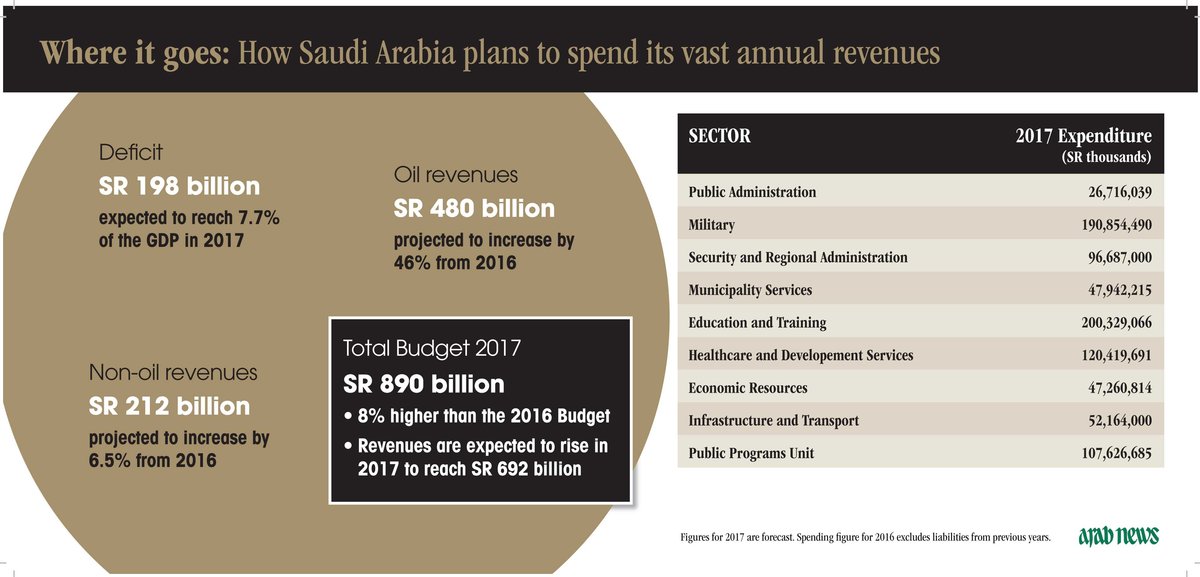
“We are optimistic about our ability to achieve the desired economic prosperity,” said King Salman.
Later, Finance Minister Mohammed Al-Jadaan gave a briefing about the budget, disclosing the financial results for the current fiscal year and highlighting the salient points for 2017.
The minister said that the Kingdom’s economy is considered one of the biggest in the Middle East and North Africa.
He pointed out that the financial policy in the Kingdom aims to strengthen the financial position and raise the efficiency of the governmental spending as well as to reach a balanced budget by 2020 according to the trends of the Kingdom’s Vision 2030 and its programs including the National Transformation Plan.
He further said the total revenues for 2016 are expected to reach SR528 billion, an increase of 2.7 percent of what was estimated in the budget, at SR514 billion.
It is also expected that non-oil revenues are to reach SR199 billion in comparison to the SR181 billion which was estimated within the budget for this year. The government’s expenditures for 2016 are set to reach SR825 billion, a decrease of the SR840 billion forecast in the 2016 budget.
Due to the measures taken in the field of spending, it is expected that the deficit is to reduce in 2016 to reach SR297 billion after reaching its highest level in 2015, of about SR366 billion.
The minister indicated that the ministry is working in collaboration with government agencies and other relevant partners and ministries to develop the process of transformation.


Budget 2017 to enhance sustainability, prioritize development

Budget 2017 to enhance sustainability, prioritize development

Saudi aid agency launches food distribution projects in Djibouti and Guinea
- Projects to benefit 40,000 individuals across Djibouti and 50,000 in Guinea
- KSrelief's aid programs have reached a total of 113 countries across four continents
RIYADH: The King Salman Humanitarian Aid and Relief Center (KSrelief) has launched its 2026 food distribution projects in the African republics of Djibouti and Guinea.
The initiatives are part of Saudi Arabia’s broader humanitarian relief efforts to enhance global food security for vulnerable populations, according to statements carried by the Saudi Press Agency (SPA).
In Djibouti, Saudi Ambassador Mutrek Al-Ajaleen and other local officials rolled out the fifth phase of the year’s project. It consists of 6,715 baskets of essential food items designed to support 40,000 individuals across multiple regions of the country.
In Guinea, Saudi Ambassador Dr. Fahad Al-Rashidi led the launch ceremony for a similar initiative. Under this project, 8,400 food baskets will be distributed, benefiting 50,000 people nationwide.
Since its establishment in 2015, KSrelief has served as Saudi Arabia's primary humanitarian arm, making food security one of its largest and most critical operational sectors. According to the center's official statistics, KSrelief has implemented over 1,150 dedicated food security projects at a total cost of more than $2.2 billion.
These specific food distribution initiatives have successfully delivered vital sustenance to vulnerable populations in 86 countries worldwide. Broadening the scope beyond just food security, KSrelief's overall humanitarian and development aid programs have reached a total of 113 countries across four continents.


