WASHINGTON: As the US Presidential race heads into the final stretch less than a week before the vote on Tuesday, excitement and organizational strengths are reshaping the Arab-American vote. However, the question remains if they could tip the balance in the race between Republican nominee Donald Trump and Democratic rival Hillary Clinton in key battleground states. 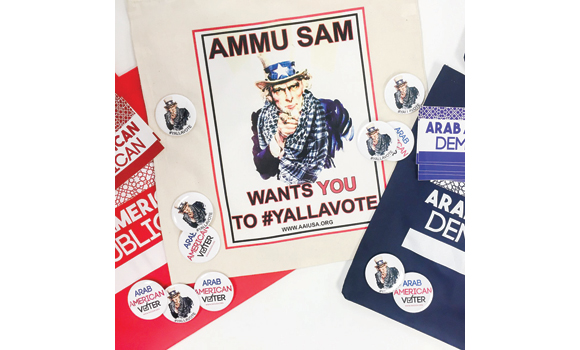
From phone banking to canvassing and participating in state, and legislative races, the Arab-American vote is no longer a dormant block in US politics. The “Yalla Vote” (Let’s Vote) campaign, “Ammu Sam” (Uncle Sam) wearing a Kaffiyah poster, and a signature “Arab American” logo from the Clinton campaign embody the level of organization and turnout push among more than a million and a half Arab-Americans living the US today.
High visibility and participation
The visibility and increased participation by Arab-Americans in this election is no surprise for James Zogby, the founder and president of the Arab American Institute that has launched the “Yalla Vote” campaign in 1998, with repeated successes in 2008, 2012 and today. Zogby tells Arab News that percentage of Arab-Americans voting and getting involved in the election is “higher than the average population as a whole.”
This year especially, Zogby points out to a robust effort in Michigan where Dearborn could get its first Arab-American state representative. He says that with Arab-Americans making 5 percent of the population in Michigan, and in a tight race between Clinton and Trump in the state, the participation and turnout could tip the scale for either candidate on Tuesday.
Illustrating the significance of the Arab-American vote in Michigan, a giant billboard in Arabic taunting Trump with the words “Donald Trump can’t read this, but he’s afraid of it anyway” is over a major Dearborn highway. In an election that was interjected by the Republican nominee Donald Trump’s suggested ban on Muslims and incidents of discrimination and rising anti-Arab and Islamophobic sentiment, the community sees a lot at stake in the outcome. 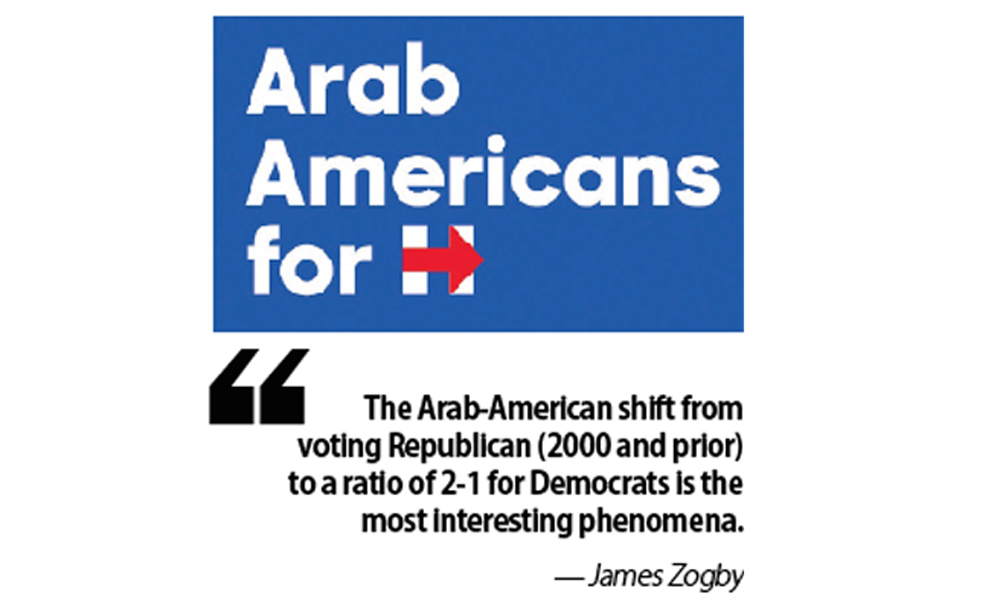
Advantage Democrats
Zogby who has closely studied the Arab-American vote over the last three decades, sees the shift from voting Republican (2000 and prior) to a ratio of 2-1 for Democrats today as the most interesting phenomena when discussing the community’s impact in 2016.
In a survey conducted by Zogby Analytics earlier this month, this shift toward Democrats is evident. Hillary Clinton tops Donald Trump among likely Arab-American voters 60 percent to 26 percent. Zogby reads these numbers as consolidating the trend for Democrats in the community and that “it is not a fluke” after the Obama years. In the same poll, 88 percent of Arab-American millennials say they are planning to vote, favoring Clinton to Trump in a 57 percent-26 percent ratio.
This support is not particularly driven by enthusiasm toward Clinton, with one-third supporting the former secretary of state as a way of casting a ballot against Trump. Nevertheless, the issues that take priority in the community, explains why it has leaned for Democrats. Jobs and the economy lead Arab-Americans’ priorities in this race, followed by gun violence. The issue of discrimination is also front and center in polling the community, whereby 8 out of 10 Arab-Americans of Muslim background voice concerns. This is also visible in the ground participation of Arab-Americans in the Democratic campaigns.
While former Democratic candidate Bernie Sanders has brought forward a strong outreach to the community with a more pro-Palestinian and anti-war message, an army of Arab-American and Muslim volunteers has continued the outreach in the Clinton campaign. 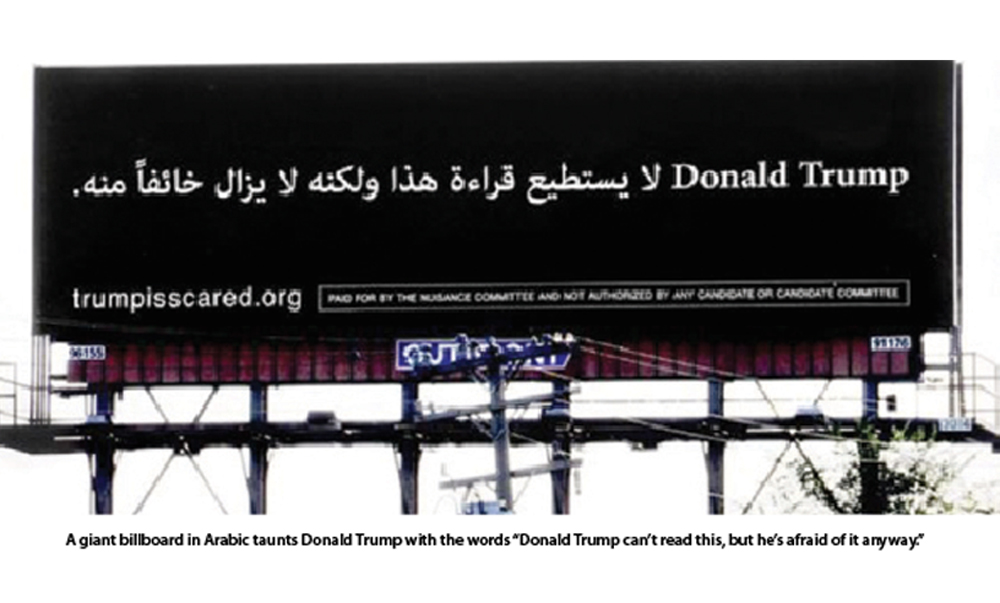
Zogby underscores the importance of geography when noting the Arab-American influence in this race. He estimates, besides the 5 percent in Michigan, a 1.5 percent-2 percent in Ohio and Pennsylvania, and a concentrated number in Florida, Virginia, and Minnesota. It is highly unlikely that either candidate can clinch the Presidency without winning some of these states.
More than anything, the 2016 race will be decided by turnout. “It is a turnout game,” says Zogby, and in that game, the “Yalla Vote” T-shirts and Arabic logos will be a testimony to the community’s engagement and participation which will continue beyond next Tuesday.


![]()

Arab-Americans shout ‘Yalla Vote,’ but will they make a difference?
Arab-Americans shout ‘Yalla Vote,’ but will they make a difference?
Latest updates



© 2026 SAUDI RESEARCH & PUBLISHING COMPANY, All Rights Reserved And subject to Terms of Use Agreement.