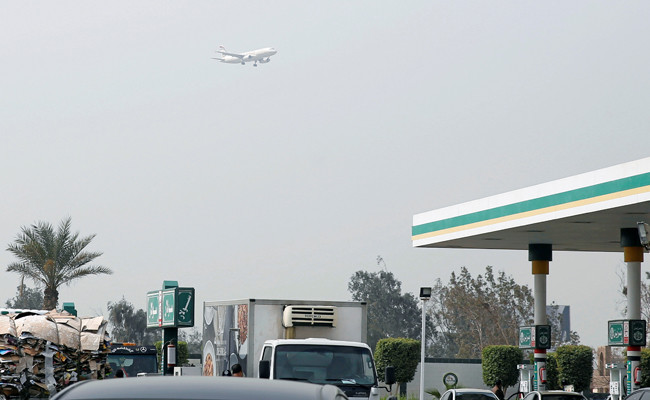
Air traffic between Saudi Arabia and Egypt grew by 22 percent in July and poised to register higher levels in the next few months, local media said quoting an expert.
In remarks to Al-Eqtisadiah daily, CEO of Egypt Air Hasan Aziz ascribed air traffic grew because of the influx of thousands of Egyptians to Makkah to perform Umrah. Saudi nationals choosing Egypt as their favorite tourist destination also contributed to the increase.
Egypt has been reportedly witnessing a growing movement of Saudi investors since the victory of Abdulfattah El-Sisi of the presidential elections and a visit made by Custodian of the Two Holy Mosques King Abdullah bin Abdulaziz.
In this context, some 20 Saudi firms plan to invest SR1.57 billion (3 billion Egyptian pounds) in agro projects in areas ranging 100,000 — 200,000 feddans, the paper said.
According to the CEO of Egypt Air, private aviation companies in the two countries, such as “the Nile”, “Nasma” and “Flynas” began to operate direct flights between Jeddah and Cairo which were earlier denied to do so between major airports.
They are operating 15 flights per month whereas Egypt Air alone has 15 flights per month between Cairo and Jeddah, he said.
He expected that air traffic between Egypt and other Arab countries will register a growth rate of 150 percent compared to figures in pre-June era, based on a number of developmental indicators, notably restoration of stability and strong come-back of foreign investments in Egypt.
“The (growing) number of flights between Egypt and Saudi Arabia represents a quantum leap and will be a good news for the liberation of airlines between Egypt and other countries in the next period, in a manner that will also activate airlines, on the one hand, and increase inter-trade between these countries, on the other hand,” he was quoted as saying.

Saudi-Egypt air traffic grows 22% in July
RLC Global Forum highlights role of Saudi youth in retail digital shift
RIYADH: Saudi Arabia’s young and highly digital population is reshaping how the Kingdom’s retail sector adopts new technologies and artificial intelligence, advancing faster than many global competitors, industry leaders told Arab News.
Speaking on the sidelines of the RLC Global Forum in Riyadh, executives told Arab News that the intersection of a youthful population and strong investment in AI is driving a shift in the industry’s priorities.
From understanding consumer behavior to leveraging the Kingdom’s growing status as a global AI leader, Saudi Arabia is becoming as a unique destination for the retail sector to thrive, learn, and evolve in the digital sphere.
Abdullah Al-Tamimi, CEO of commercial real estate company Hamat Holding, told Arab News that the firm is keen to analyze and understand consumer behavior, with a particular focus on the younger generation as a key part of that insight.
“Actually, it’s a big part of our day-to-day operation,” he said, adding that the company invests heavily in understanding customer needs and behavior and works to correct any missteps.
Al-Tamimi emphasized paying close attention to small details, noting that younger consumers are especially sensitive to the overall experience and “deserve that we work around the clock in order to improve it.”
He added that this focus “can be a competitive advantage for Saudi Arabia as well.”
Al-Tamimi said that as the younger generation grows accustomed to new technology shaping retail customer experiences, Hamat Holding is leveraging AI to enhance them further.
“We started a couple of initiatives improving digitalization,” he said, adding that the company sees digital tools as a way to enhance its work by automating day-to-day operations and allowing teams to focus on bigger-picture and more complex tasks.
While the firm has expanded its use of technology, he stressed it has not replaced human workers, emphasizing the continued importance of human capital for creativity and interaction. “AI is a big part of our strategy,” Al-Tamimi added.
Amit Keswani Manghnani, chief omnichannel and AI officer at luxury goods retailer and distributor Chalhoub Group, told Arab News that bridging a younger customer base with continuous digital development is key to advancing the Kingdom’s retail strategies.
On Saudi Arabia’s demographics, he said: “We look at 2030 as really building products which serve especially the younger population, which is growing and very digitally savvy.”
Manghnani underscored the unique characteristics of the Kingdom’s retail market as a tool for developing effective products and customer experiences.
“So it’s very digitally savvy, much more than in other markets,” he said, noting that e-commerce penetration is rising not only through online purchases but also via digital catalogs that drive in-store visits.
Manghnani said investment is focused on making products more digitally accessible and easier to use, while strengthening customer service to meet the expectations of what he described as a demanding but welcome consumer base. “Service excellence, digital — all these things together are how we are tapping into the younger population, which again is extremely savvy.”
Manghnani reinforced Al-Tamimi’s point that the Kingdom holds a competitive advantage, citing the speed at which its retail and technology industries are aligning.
“As a market, we’re tending to see the adoption of digital,” he said, referring to AI, data and other forms of digital interaction, adding that these tools are increasingly being combined.
He noted that this market is moving “much quicker than the other markets.”
The two-day RLC Global Forum brought together more than 2,000 global leaders, policymakers, and innovators from over 40 countries over the two-day event to define the next chapter of growth across retail, consumer, and lifestyle industries.