Global agencies to study Saudi satellite

Updated 17 March 2014
Follow

Global agencies to study Saudi satellite

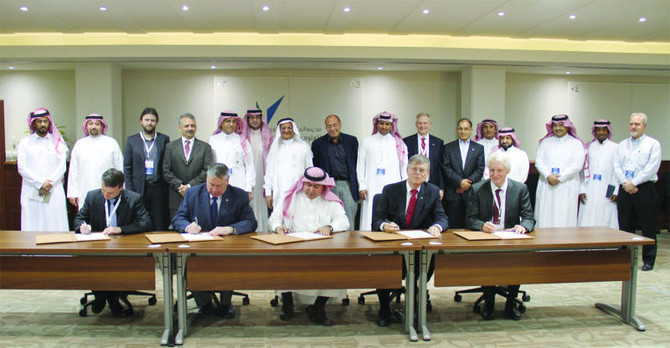
The King Abdulaziz City for Science and Technology (KACST) has signed an agreement with four global space agencies to conduct scientific experiments on Saudi SAT-4 satellite.
The accord was signed by Prince Turki bin Saud, KACST vice president for Research Institutes, with officials from NASA, the German Space Agency, Stanford University in the US and the Zarm (Drop-Tower Bremen) Center of Applied Space Technology and Microgravity.
The agreement was signed on the sidelines of the recently concluded workshop entitled “Search variation in the space of time and place,” which was organized by KACST in collaboration with the signing organizations.
“Saudi SAT-4 is to be launched during the summer,” said Badr Alsuwaidan of the National Satellite Program at KACST. “The satellite will be utilized for remote sensing and telecommunications.”
Saudi Arabia has launched 12 satellites so far. Two of them were sent up in 2000 and operated until September 2003, after which the SaudiSat was launched, which is still operational and serves communication facilities.
“Two Saudi satellites were successfully launched in 2004 and 2005, followed by six satellites in 2006 and 2007 that are still working around the clock and that have been sending detailed photos,” said Alsuwaidan.
“These satellites focus on outer space research, which benefits many public and private agencies.”
“Saudi Arabia has been making large strides in space science. Its programs cover applied satellite technology and services,” Prince Turki said.
KACST maintains close ties with NASA, Stanford University and space scientist Charles Everette in developing space technology.
There are currently five agreements with the US, India and Russia that have been approved by the Saudi Council of Ministers.
“Prince Sultan bin Salman’s space trip 27 years ago has, in fact, been the inspiration for Saudis to achieve greater accomplishments in the field of space science,” an official from KACST said.
He said that NASA has signed 4,000 agreements with 140 countries and that 36 scientists in 15 countries have participated in its space trips.
NASA, he said, has been monitoring and capturing images of climate change taking place around the world, including countries in the Gulf and the Middle East.


Ramadan brings local communities together to engage in volunteering activities

Updated 8 sec ago
Follow

Ramadan brings local communities together to engage in volunteering activities

  • For the Jeddah Volunteer group, local volunteers head out to lower-income neighborhoods to distribute meals
  • Supervisor Ahmed Al-Hamdan told Arab News that the iftar project is among the group’s most significant Ramadan initiatives

JEDDAH: Since the start of Ramadan, charities, mosques, restaurants, generous individuals and young volunteers across Saudi Arabia are coming together to make a tangible difference to the lives of those in need.

Volunteering activities usually peak in the weeks preceding Ramadan, with several initiatives taking place across the country.

“Every Ramadan, we are proud to see citizens and residents step up as volunteers across the Kingdom of Saudi Arabia, in Riyadh, Jeddah, Damam, Tabuk, Hail, Najran, Qassim and the rest of cities, embodying the spirit of giving and solidarity during this holy month. The people’s dedication and compassion have been a true reflection of Saudi Arabia’s values,” Sheikh Mansour Al-Shareef, imam of Al-Tawheed Mosque in Jeddah, told Arab News.

Al-Shareef underscored the spiritual essence of volunteerism, saying: “Volunteerism in Ramadan is not only about helping the needy but also about showing unity within communities.”

He noted the remarkable rise in community engagement in recent years. “Volunteering is on the rise with individuals from all walks of life contributing their time and resources to foster social solidarity, particularly during Ramadan.”

For the Jeddah Volunteer group, local volunteers head out to lower-income neighborhoods to distribute meals.

Supervisor Ahmed Al-Hamdan told Arab News that the iftar project is among the group’s most significant Ramadan initiatives.

He noted that the program aims to strengthen social solidarity and ease the burden on needy families, adding that every day during Ramadan, more than 100 volunteers arrive at the various iftar sites by the afternoon Asr prayer.

They work together to prepare special meals which include water, dates and rice, and later they distribute meals by hand. For many, the reward of helping those in need is what drives them to participate in volunteer campaigns.

It is becoming an act of duty for volunteer Noura Abdulaziz, who has been involved in such initiatives for the last two years.

She said: “I dedicate myself to this cause because it is the month of giving and it is our duty to give a hand in this special month. I really enjoy every minute of it.”

She pointed out that she sacrificed her time spent with her family to hand out meals to those who are in need.

“The number of iftars I have with my family is minimal, but they have no complaints as they understand the greater purpose,” she said.

Under the slogan “Ramadan Kareem,” fulfilling its annual commitment to community service, Kayani Event Management launched its annual “Iftar for the Fasting” campaign in the heart of Al-Balad district (historic Jeddah) for the fifth consecutive year, creating a scene of social solidarity within the ancient city.

The aim was to deliver Iftar meals to needy families and charitable organizations in the area, reinforcing the spirit of compassion embodied by the holy month.

Rana Bajouda, CEO of Kayani, told Arab News: “Our continuation for the fifth year is a confirmation of our commitment to our neighbors and our people in Jeddah, and our belief that giving is the true engine of success for any organization.”

From individual acts to organized government efforts, the General Directorate of Education in the Makkah Region launched a broad community initiative to provide Iftar meals for fasting visitors to the Holy Mosque, aiming to distribute 5,000 meals daily throughout the holy month of Ramadan.

Behind this initiative stands a team of 500 volunteers from the education sector, who work side by side, in a scene of faith that embodies the spirit of cohesion and clearly reflects the leading community role of the education sector in serving those who visit the Grand Mosque.