FORT MYERS, United States: Alligator and frog have long been on the menu in Florida, but a new delicacy has slithered its way onto dinner plates in the US state.
A pizzeria now offers Burmese python meat on what it calls the “Everglades Pizza” — named for Florida’s vast national park, where the snakes are being hunted to protect the nature preserve.
“It was just to create talk about the shop and being creative and this thing literally just went viral,” says Evan Daniell, the owner of Evan’s Neighborhood Pizza in the Gulf Coast city of Fort Myers.
“People talk about it all the time and whether it’s negative or positive, it really doesn’t matter because the fact is: we can make it and it’s delicious.”
So, the big question: what does it taste like? “It’s good but a little chewy,” says Mike, a tourist taking the python plunge from Minnesota.
“It tastes like chicken but chewier,” his wife Becky adds.
Daniell admits that python meat “can be gamier.” The chef tenderizes the slabs of snake meat by marinating them for several hours. They are then sliced thinly into what he calls “snake slivers.”
Before laying it onto the pizza, making sure “each slice has a piece of python,” Daniell pre-cooks the snake in the oven for a few minutes.
“There is some pink into the snake, and as it turns white, it will be done,” he explains.
Despite its steep price tag of $45, the “Everglades” pizza certainly has its fans.
Daniell’s pal Mike Gookin says he came up with the idea of using the snake meat to spice up pizzas after seeing a news report on the python problem in the Everglades.
The pizza also features alligator sausage and frog legs. Both are native to southern Florida. The pythons are definitely not, but they are everywhere.
“There could be thousands or tens of thousands of Burmese pythons in the wild here,” explains Roberto Torres, a field officer with The Nature Conservancy.
The snakes can measure up to 20 feet long and they are believed to have made the Everglades their home after being released by their owners.
“They get them as pets and when they get too big, they release them here,” Torres says, his feet deep in the mud of the wetlands near the suburbs of Miami where pythons have been spotted regularly.
Burmese pythons have no known predator in Florida, so they sit atop the food chain in their new home. As a result, environmental experts like Torres fear their presence could end up threatening biodiversity in the Everglades.
“It’s a perfect habitat for the snake — it’s wet, there is plenty of food. (...) They’ll eat anything they can catch — birds, fish, mammals, cats, dogs,” Torres says.
To raise awareness about the python invasion, chefs in Miami have held several events with python on the menu along with other non-native species.
But current food safety regulations do not allow the invasive snakes captured in Florida to be slaughtered and processed regularly to be sold in restaurants.
As a result, Daniell’s python meat is not local.
“I buy it frozen from a wholesaler who imports farmed python from Vietnam,” the restaurateur explains.


Ready for python pizza? Florida diners get a taste

Ready for python pizza? Florida diners get a taste
Chef serves up a taste of Spain at Ithra Cultural Days in Saudi Arabia
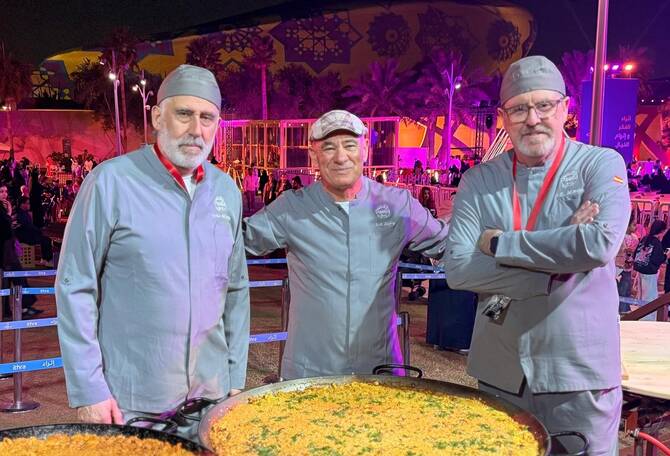
DHAHRAN: Among the attractions of the Ithra Cultural Days: Spain at the King Abdulaziz Center for World Culture (Ithra), visitors can try a tantalizing selection of Spanish foods — none more renowned than its famous paella.
Arab News spoke with chef Jose Zafra at the event, which runs until Jan. 31, who flew in from Spain to offer a taste of his homeland to the people of Saudi Arabia.
A “master rice cook, paella researcher and promoter,” according to his business card, his logo is even designed around the recognizable cooking pan and the phrase “Pasion por la paella,” or “Passion for paella.”
“That's why the pan is round because people get around and eat all together — to share culture and passion and life,” Zafra told Arab News as foodies lined up behind him, eager to try a plateful.

“It’s not just a food. It’s a link, a connection. Paella is the symbol of unity and sharing. And people now are going to try it — authentic Spanish paella in Saudi Arabia.”
The word “paella” comes from the Latin “patella,” meaning pan.
In Spanish, it refers both to the rice dish itself and the pan in which it is cooked.
Paella was introduced to Spain during Moorish rule. It originated in Valencia, on the country’s eastern coast, as a rural peasant dish that was cooked by farm workers over open fires using local ingredients. Over time, the dish’s popularity spread and other versions evolved, for example featuring seafood and meat.
It is different to Saudi Arabia’s kabsa, a communal dish which similarly uses rice and meat. Kabsa is cooked in a deep pot to ensure the rice stays soft and aromatic from the meaty broth, whereas paella uses a wide, shallow pan to fully absorb flavors evenly, often creating a prized crispy layer at the bottom.
Visitors to Ithra’s Culture Days can enjoy the flavors of Spain made with a sprinkling of local love — true to the origins of the dish.
Find the scoops of Spanish joy near the food truck area and try chicken paella, seafood paella —or both! You will see the signs offering a plate, at SR35 ($9) for chicken and SR40 for seafood, or let your nose lead you there.
Zafra concluded: “The chicken is from here, the seafood is from here — and the passion, well, that is from Spain.”


