MANILA: A Philippine government directive for female Muslim teachers to take off their face veils in class is not mandatory nor meant to curtail religious rights, the education minister said on Thursday.
Education Secretary Armin Luistro issued guidelines last week on wearing the “niqab” in schools, intended mainly for the southern Philippines, where most of the country’s Muslim minority live.
“I want to make it clear that the Department of Education order was not meant to impinge on the religious rights of Muslim teachers,” Luistro told AFP.
He emphasized the directive was worded as a “request.” There was initial confusion because the guidelines were entitled an “order.”
Many Filipino Muslim women traditionally wear the “hijab” veil which covers their hair and ears, neck and chest. But some of them additionally wear the “niqab” which covers the nose, cheeks, mouth and chin, leaving only their eyes exposed.
The guidelines for Muslim teachers refer only to “the veil that covers the entire face.” The Education Ministry said it employed 1,635 Muslim teachers to teach 166,000 students for its Arabic language and Islamic Education program, though it did not provide the total number of women in the list.
The program is in place in 849 schools across the Catholic-majority country, with most located in the Muslim regions of the south.


Manila says Muslim veil directive only a request

Manila says Muslim veil directive only a request
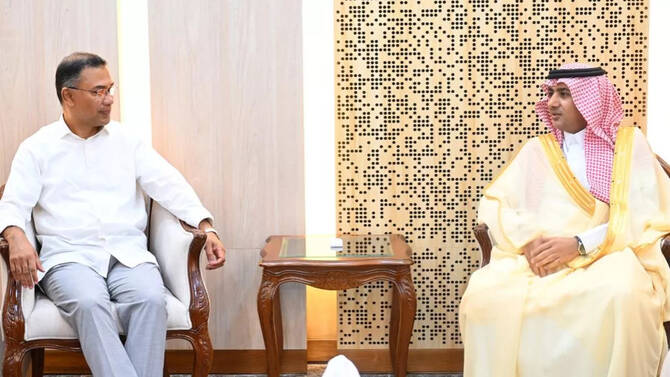
Saudi ambassador becomes first foreign envoy to meet Bangladesh’s new PM
- Tarique Rahman took oath as PM last week after landslide election win
- Ambassador Abdullah bin Abiyah also meets Bangladesh’s new FM
Dhaka: Saudi Arabia’s ambassador to Dhaka became on Sunday the first foreign envoy to meet Bangladesh’s new Prime Minister Tarique Rahman since he assumed the country’s top office.
Rahman’s Bangladesh Nationalist Party made a landslide win in the Feb. 12 election, securing an absolute majority with 209 seats in the 300-seat parliament.
The son of former Prime Minister Khaleda Zia and former President and BNP founder Ziaur Rahman, he was sworn in as the prime minister last week.
The Saudi government congratulated Rahman on the day he took the oath of office, and the Kingdom’s Ambassador Abdullah bin Abiyah was received by the premier in the Bangladesh Secretariat, where he also met Bangladesh’s new foreign minister.
“Among the ambassadors stationed in Dhaka, this is the first ambassadorial visit with Prime Minister Tarique Rahman since he assumed office,” Saleh Shibli, the prime minister’s press secretary, told Arab News.
“The ambassador conveyed greetings and best wishes to Bangladesh’s prime minister from the king and crown prince of Saudi Arabia … They discussed bilateral matters and ways to strengthen the ties among Muslim countries.”
Rahman’s administration succeeded an interim government that oversaw preparations for the next election following the 2024 student-led uprising, which toppled former leader Sheikh Hasina and ended her Awami League party’s 15-year rule.
New Cabinet members were sworn in during the same ceremony as the prime minister last week.
Foreign Minister Khalilur Rahman is a former UN official who served as Bangladesh’s national security adviser during the interim government’s term.
He received Saudi Arabia’s ambassador after the envoy’s meeting with the prime minister.
“The foreign minister expressed appreciation for the Saudi leadership’s role in promoting peace and stability in the Middle East and across the Muslim Ummah. He also conveyed gratitude for hosting a large number of Bangladeshi workers in the Kingdom and underscored the significant potential for expanding cooperation across trade, investment, energy, and other priority sectors, leveraging the geostrategic positions of both countries,” the ministry said in a statement.
“The Saudi ambassador expressed his support to the present government and his intention to work with the government to enhance the current bilateral relationship to a comprehensive relationship.”
Around 3.5 million Bangladeshis live and work in Saudi Arabia. They have been joining the Saudi labor market since 1976, when work migration to the Kingdom was established during the rule of the new prime minister’s father.
Bangladeshis are the largest expat group in the Kingdom and the largest Bangladeshi community outside Bangladesh and send home more than $5 billion in remittances every year.


