The US sailor had been back from war for just over a year when friends invited him to watch an unusually emotional training exercise for troops preparing to deploy.
The drill happened not on a military base but at a film studio, where Marine and Navy medics role-played wartime rescue missions with actors who had, in real-life, lost limbs in motorcycle or car accidents or to ailments such as cancer.
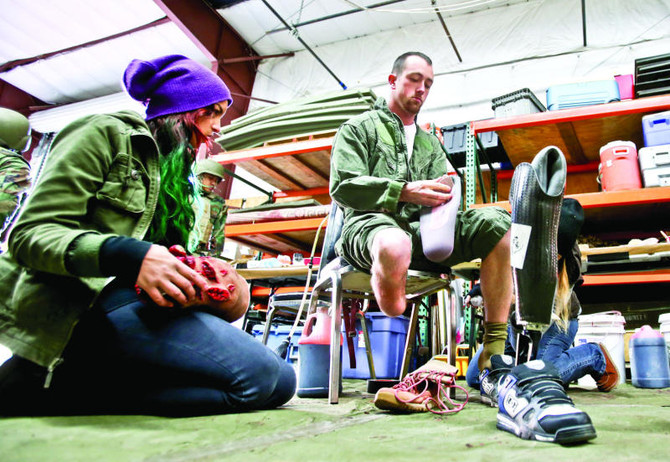
Those on hand weren’t sure how Joel Booth would react. The 24-year-old had been attached to a Marine battalion in Afghanistan as a naval combat medic — until he stepped on an explosive and doctors, two years ago, amputated his right leg below the knee. Since returning home he’d had to learn to adapt while also coping with the post-traumatic stress.
But Booth was transfixed as fake bombs exploded and medics practiced the type of rescue missions he’d once been on, saving the amputee actors — as he, in the end, had to be saved.
Then the young veteran did something unexpected: He asked for an audition.
Perhaps, he thought, this injury that had forever altered his life could help save someone else’s. What he didn’t know was how much reliving the horrors of war would help him, too.
“In society, amputees are seen by people on a large scale as having a disability, being weaker. But ... even someone who doesn’t have a hand can still operate a weapon to be able to defend themselves,” he said.
“It’s the same thing for me. I’m not afraid of it just because something bad happened. For people who haven’t been in combat, it’s hard to understand.”
Producer Stu Segall, best known for the TV police show “Silk Stalkings,” started Strategic Operations in 2002 shortly after the launch of the Iraq war to offer the military what it calls “hyper-realistic” training by using movie-making special effects and actors.
The group has since trained hundreds of thousands of troops in recreated scenes from Iraq, Afghanistan, Somalia and other hotspots. The creators strive to make the re-enactments as jarring as possible so troops experience war first in a controlled environment, and learn not to be rattled by it.
Marine 2nd Lt. Duane Blank, a commander who has gone through similar training, said amputee actors add a degree of realism that no one else can.
“The visual effect is invaluable because it’s something you don’t encounter every day,” said Blank, an Iraq war veteran. “There is no way to recreate that aspect of real combat, seeing a brother hurt in that sort of way.”
Since the inception of Strategic Operations, the group’s founders had made a concerted effort not to use veterans who lost limbs in combat.
“We felt it was one of those things: Why would you ask somebody who has gone through this experience to relive it? And we had plenty of amputee actors,” said executive vice president Kit Lavell.
Lavell flew 243 missions in Vietnam as a naval aviator. He knows how hearing screams and explosions — even on a studio lot in San Diego — can quickly bring back the stress of battle for even the most hardened soldiers.
But Booth convinced Lavell to let him join the group.
“He was so well-prepared as a corpsman,” Lavell said. “We felt: He’s the perfect one to do this.”
Booth first joined the Navy, at the age of 21, because he wanted to see combat and help save lives. The job of corpsman was perfect for him; as field medics in charge of providing emergency care to battleground troops, corpsmen often are caught in the thick of the action.
Almost a year after enlisting, he was deployed with the Marines to the Taleban stronghold of Sangin, Afghanistan. On July 21, 2011, while out on patrol, he and a Marine volunteered to return to base to get supplies. As they were walking, an explosion catapulted Booth onto his back.
He calmly told the Marine to check behind them for more improvised explosive devices. Then he looked down at his leg. There was no blood but the pain was excruciating and Booth couldn’t stand up. His ankle bones had been crushed.
Two days later he was back in the US, where he underwent surgery after surgery. But Booth didn’t want to be a patient. Frustrated with each failed operation and a growing infection, he pushed his doctors to amputate.
As a medic, Booth knew what his life would be like without a limb, and he wasn’t afraid. He had seen fellow service members adapt relatively quickly to using a prosthetic. He figured he could return quickly to an active lifestyle, doing the things he enjoyed, like riding motorcycles.
Booth learned his tenacity from his dad, a Black Hawk helicopter pilot in the Gulf War who taught his son to remember when faced with a challenge: “It could be worse. Just get through it and get on with it.”
On Nov. 29, 2011, doctors amputated Booth’s lower right leg. He was fitted with his prosthesis, and began therapy three times a week to learn how to walk again.
But Booth soon noticed his injuries went beyond the physical. During the day, he felt on edge. At night, he had nightmares or insomnia. He started seeing a psychiatrist, who diagnosed him with post-traumatic stress disorder and prescribed medication.
He wondered what he would do with his life when some Navy instructors who were training young medics invited him to the film studio.
A year ago in April, Booth started work with Strategic Operations. He has now performed with the group a dozen times, and he isn’t bothered by the gore and gunfire. Rather, said Booth, the exercises have helped him deal with his post-traumatic stress.
“When we’re at the point where the explosions and the gunfire is going off, I’m in a whole different mindset. I’m yelling and screaming and waiting for the corpsmen to come help me. So I’m not really worried about that (PTSD) anymore,” said Booth, who has since stopped taking his PTSD medication. “It’s more so about the guys coming to get me and really helping them.”
Mental health professionals said they are not surprised Booth has found solace in his role-playing.


![]()
![]()
Amputee veteran helps train US troops
Amputee veteran helps train US troops
Latest updates




© 2026 SAUDI RESEARCH & PUBLISHING COMPANY, All Rights Reserved And subject to Terms of Use Agreement.