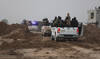
YANGON: Myanmar’s president said yesterday he wanted peace talks with all ethnic rebel groups in the country, but government troops again attacked rebel positions in Kachin State in the northeast despite his order to cease fire, rebels and a local source said.
President Thein Sein had issued the cease-fire order on Friday to troops in the La Ja Yang area of Kachin State near the border with China, where fighting has been fiercest.
It was due to take effect on Saturday morning, but Col. James Lum Dau, Thai-based spokesman for the Kachin Independence Army (KIA), told Reuters the army had continued to attack over the weekend, both in La Ja Yang and elsewhere in the state.
Thein Sein denied that the army, known as the Tamadaw, aimed to capture Laiza, where the KIA and its political arm, the Kachin Independence Organization (KIO), have their headquarters.
“Now the Tamadaw members are an arm’s length from the KIA/KIO headquarters in Laiza but I have ordered them not to occupy Laiza,” he said at a meeting with non-governmental groups in Yangon, the commercial capital.
“In order to gain sustainable peace all over the country, there is no other way but to hold talks at the negotiating table as soon as possible,” he added. A 17-year cease-fire with the KIA broke down in June 2011 and fighting has been particularly intense in recent weeks.
Twenty months of fighting has displaced tens of thousands of people and, for some analysts, raised doubts about the sincerity of all the political and economic reforms pursued by Thein Sein in Myanmar, also known as Burma. On Saturday, addressing a development forum attended by donor countries and international aid organizations, Thein Sein had invited the Kachin rebels to a “political dialogue” with the government and ethnic rebel groups from other states. No date was given.
Ten other major rebel groups have already agreed cease-fires.
The KIA’s Lum Dau said an offensive in La Ja Yang from about 8 a.m. on Sunday morning (0130 GMT) had involved artillery and infantry.
A local source in Kachin, who did not want to be identified, confirmed the army attacks on Sunday, including one on a rebel position about five miles (eight km) from Laiza.
Fighter jets had flown over the area but had not attacked, the source said. New York-based Human Rights Watch last week accused the army of indiscriminately shelling Laiza.
Loud explosions were also heard by residents of the town of Mai Ja Yang who felt the vibrations, the source said.
Lum Dau said the KIA had sent the president a reply saying it would not attend talks until there was more evidence of goodwill on the government side, involving a cease-fire in the whole state, or at least a big reduction in fighting.
“We already agreed to a cease-fire in 1994 and look at where we are now ... We didn’t break any agreement,” he said, expressing KIA mistrust of central government that has persisted even after Thein Sein took office in 2011 at the head of a quasi-civilian government after half a century of military rule.
The KIO said in a statement that “the government should reduce offensive operations all over Kachin State instead of suspending operations in La Ja Yang region.” Further clarification of its demands was not immediately available.
Lum Dau said the government was simply buying time and would use any cease-fire to prepare another assault on rebel positions.
He argued that it had only agreed to the partial cease-fire in response to diplomatic pressure from the United States and others, including China, which called for a halt to fighting on Jan. 15 after a shell landed on its side of the border.
There was no immediate response from the government to the accusations of continued attacks in La Ja Yang but it said rebels were responsible for violence elsewhere in Kachin.
Presidential spokesman Ye Htut said rebels attacked Kamine police station in the Phakant area early on Saturday, killing two policemen, wounding five and setting the building on fire.
He also blamed rebels for setting off mines that wounded about 20 people in cars on the road from Bamaw to Lwejei on Saturday.