Holding on to home is becoming more difficult by the day for Ruqaya Hasan, one month after Israeli settlers surrounded her house and two other Palestinian homes on a hilltop in Qusra in the occupied West Bank.
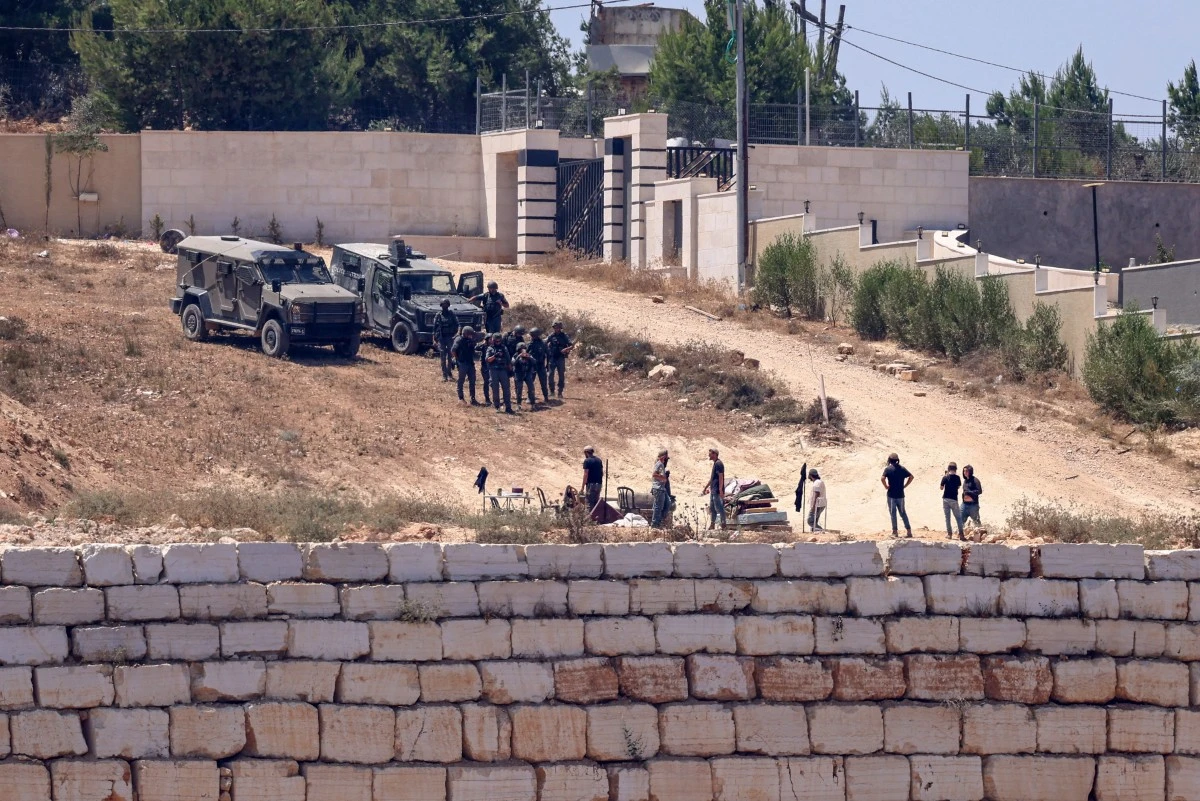
The settlers’ tent that once stood in the yard, blocking the only road to the homes, is now gone. In its place is an Israeli military post with soldiers stationed around the clock and an iron gate installed by the army, effectively cutting off the three families from the rest of their village.
Obtaining food, medicine and other essential supplies and receiving visits from relatives require prior coordination with the Israeli military in a process that residents and the mayor said can take days, sometimes up to a week.
Hasan is among 15 residents trapped despite an Israeli military operation ostensibly aimed at ending the settler siege.
The toll is evident in her daughters, Kinda, 4, and Hour, 2. As children across the occupied West Bank returned to classrooms on Sunday for the new academic year, the two girls remained at home.
“We are alone here. We cannot go anywhere and no one can come to visit us. We cannot even visit the two other houses nearby,” Hasan, who lives with her husband, Yousef, and two daughters, told Arab News.
The siege began after months of increasing settler attacks on Qusra village, southeast of Nablus, that Palestinians say are aimed at forcing them from their land.
On Aug. 9, dozens of settlers erected a tent outside three houses belonging to the Ridi and Hasan families on Ras Al-Ain Mountain, blocking the only road to the hilltop and cutting off electricity and water.
Under mounting US pressure after it emerged that one of the besieged homes belonged to Loui Ridi, a Palestinian American, the Israeli military launched an operation days later to remove the settlers. But they repeatedly returned.
“My daughters are severely distressed. They ask me several times a day why they cannot see their cousins and grandparents, or why they cannot go to school,” Hasan said.
“It is difficult to answer their questions and explain that the army is blocking us and that it is dangerous outside because the settlers are in the area.”
Last week, Hasan said, her daughters’ aunts were turned away by the Israeli army at the gate while trying to visit the family for the first time in a month.
Life in Qusra until the beginning of this year was relatively peaceful, despite a surge in settler violence alongside rapid state-driven settlement expansion in the wider West Bank amid the Israeli military assault on Gaza in retaliation for the Hamas-led attacks of Oct. 7, 2023.
However, on Jan. 21, Jewish settlers established the Tel Talpiyot outpost on Jabal Ein Ena in neighbouring Talfit village. The spot lies among Palestinian villages deep inside Area B — territory where the Palestinian Authority has civil responsibility under the 1995 Oslo II Accord and where there had previously been no settler presence.
In the month after the outpost was established, B’Tselem, a prominent Israeli rights group, documented 10 attacks against Palestinian residents of Talfit, Qusra and Jalud villages, including an assault on human rights activists who were accompanying a family driven out of their home by the violence.
Hasan said settler intimidation around Ras Al-Ain intensified over the following months, culminating in the siege after repeated attempts to pressure the families into leaving their homes failed.
“We constantly felt unsafe,” she told Arab News. “We would only leave to run errands, and when we did, we left secretly and took turns with our neighbors watching each other’s houses.”
She added: “When the settlers saw us, they continued their intimidation, occasionally cutting off our water and electricity.”
The events in Qusra are unfolding at a time of record levels of settler violence across the West Bank.
According to the UN Office for the Coordination of Humanitarian Affairs (OCHA), some 1,540 attacks caused Palestinian casualties or property damage this year alone — more than six attacks per day.
Settlers regularly clash with Palestinian residents using stones and clubs, burn homes and mosques, steal livestock, seize agricultural land and water resources, and vandalize cars.
By late August, 79 Palestinians, including 19 children, had been killed and about 1,870 injured by Israeli forces or settlers in the West Bank since the beginning of 2026, according to OCHA.
In just two weeks in August, the agency documented 80 settler attacks resulting in casualties or property damage.
OCHA noted that the monthly average of these attacks is now higher than in any other year on record.
According to the UN, the group of settlers responsible for the Qusra siege previously surrounded a Palestinian home in the neighbouring village of Jalud for more than two weeks, eventually forcing the family to flee.
The Israeli military said its presence was intended to protect the Palestinian families and prevent settlers from approaching their homes.
Hasan, however, said she struggles to reconcile that explanation with what she sees outside.
“They tell us they are here to protect our houses from the settlers, but what we see is that they are isolating us, while the violent settlers run free,” Hasan told Arab News.
The Israeli military had initially asked the three families to leave their homes during the Aug. 13 operation, but they refused.
“We said we would not leave, even if it meant sleeping under a tree,” Hasan told Arab News.
Instead, the families were temporarily confined to one house. Hasan’s own home was taken over by Israeli troops and used as a military post for about 10 days.
When her family was eventually allowed to return, she said they found belongings damaged or missing and kitchen appliances broken.
“Many things were stolen, and even my children’s toys had been thrown away,” she said.
Abdul Azim Wadi, Qusra’s mayor, called the constant presence of the army in Ras Al-Ain a “serious escalation” and accused the soldiers of besieging the houses alongside the settlers.
He said he feared that the pattern seen in Ras Al-Ain — settlers establishing a presence, followed by a permanent or semi-permanent military footprint and restrictions on Palestinians — could spread to other villages in the absence of accountability and firm international action.
“Israeli military operations were carried out across the West Bank, particularly in Jenin and Tulkarem refugee camps, under the pretext of combating resistance and outlaws,” Wadi told Arab News.
“Qusra, however, had never been the site of any armed confrontations or protests that Israel has cited to justify operations elsewhere.”
The pressure on Qusra comes as rights groups warn that settler outposts are pushing beyond Area C, which remains under full Israeli civil and security control, and into areas where Palestinian communities had previously faced little or no direct settler presence.
According to the Israeli human rights organization Peace Now, 26 Israeli outposts have been established in Area B, where Qusra is located, over the past two and a half years.
Around 700,000 Israeli settlers today live in the occupied West Bank and East Jerusalem across roughly 300 settlements and outposts. All settlements are regarded as illegal under international law.
Wadi warned that “the state-backed settler violence” and the expansion of military control, settlements and outposts would exacerbate displacement of Palestinian communities.
“If Area B comes under Israeli control, people will start leaving for the big cities,” Wadi told Arab News. “And if the restrictions continue, they will eventually leave their land and go abroad because they are being fought in the most basic aspect of life: living in their own homes.”
According to B’Tselem, settler violence has completely displaced 66 Palestinian communities and partially displaced 18 others, uprooting more than 4,900 people, including 2,343 children, in the past three years alone.
Military operations that began in January 2025 in Jenin, Tulkarem and Nur Shams refugee camps have displaced another 32,000 Palestinian refugees from their West Bank homes, according to OCHA.
The siege of Qusra has drawn domestic and international condemnation, including from US Ambassador to Israel Mike Huckabee, a longtime supporter of Israeli settlements, who reiterated his description of violent settlers as “Israeli terrorists” during a visit on Sept. 5 to Turmus Ayya, where he met Palestinian Americans affected by settler violence.
Ed Miliband, Britain’s foreign secretary, vowed a tough response to “appalling” violence by Israeli settlers against Palestinians.
Palestinians and rights groups have accused Israel of emboldening settlers to act with impunity, under the protection of Israeli forces, with no fear of accountability.
Footage showing some of the first Israeli soldiers deployed to Ras Al-Ain praying alongside the settlers sparked widespread backlash. While the military later vowed disciplinary action, Israeli media reported that one of the reservists was dismissed without further disciplinary action taken against him.
Footage recorded by one of the besieged residents also showed settlers on quad bikes back at the site shaking hands and chatting with Israeli forces.
Benjamin Netanyahu, the Israeli prime minister, broke his silence on Aug. 29 when a fourth house 400 meters away from the besieged hilltop was attacked by settlers with stones. Denouncing the “criminal acts of violence,” he said such actions harmed law-abiding settlers, interfered with the military’s missions and damaged Israel’s international standing.
According to a recent Reuters report, under US pressure to curb attacks on Palestinians, Netanyahu has ordered illegal West Bank settler outposts dismantled. Israeli media reported that about 100 outposts, technically considered illegal under the country’s law, could be targeted.
The reports said it was not immediately clear when the operation would begin and previous crackdowns have been poorly enforced.
Yair Dvir, a spokesperson for B’Tselem, said what was happening in Qusra could not be separated from Israeli policy across the West Bank aimed at “advancing the ethnic cleansing of the West Bank and extending Israeli control over the entire area.”
“The state funds and arms the settlers; the Israeli military protects them and, in many cases, takes part in the attacks itself,” Dvir told Arab News.
“State authorities, the military, and settler militias are different arms — some more official than others — working toward the same goal.”
The lack of accountability, combined with military and political backing, enables settlers to continue and expand their attacks into more densely populated Palestinian areas where Israeli settlers previously had no presence, according to Dvir.
For Hasan, the question of whether to leave has become a daily dilemma.
“Sometimes I think of taking my daughters and leaving because there is no reason they should handle all of this stress,” Hasan told Arab News.
“But then I think: This is my home and my land. How could I leave?”
For now, she tries to keep her daughters occupied inside the house. UNICEF has sent toys, but their mother says they barely touch them.
“They are distressed and distracted all day,” she said.
The Palestinian Education Ministry marked the beginning of the academic year in Qusra this week in solidarity with the girls cut off from their town, the mayor said.
Hasan does not know when they will be able to leave freely again, or how long her family can withstand the isolation.
But one month after settlers first arrived outside her home, she insists they are not ready to give it up.
“We won’t leave our homes and we will hold on for as long as we can,” she said. “And hopefully with time, things will get better, and my kids and I will be free again.”
‘We are alone here’: Palestinian families fear displacement as Qusra siege completes one month