- International Atomic Energy Agency chief Rafael Grossi calls for revival of 2025 Cairo Agreement between agency and Tehran, says Arab and regional mediation key to inspectors’ return
- Tehran has prevented inspectors from accessing nuclear sites bombed by Israel and the US for more than a year
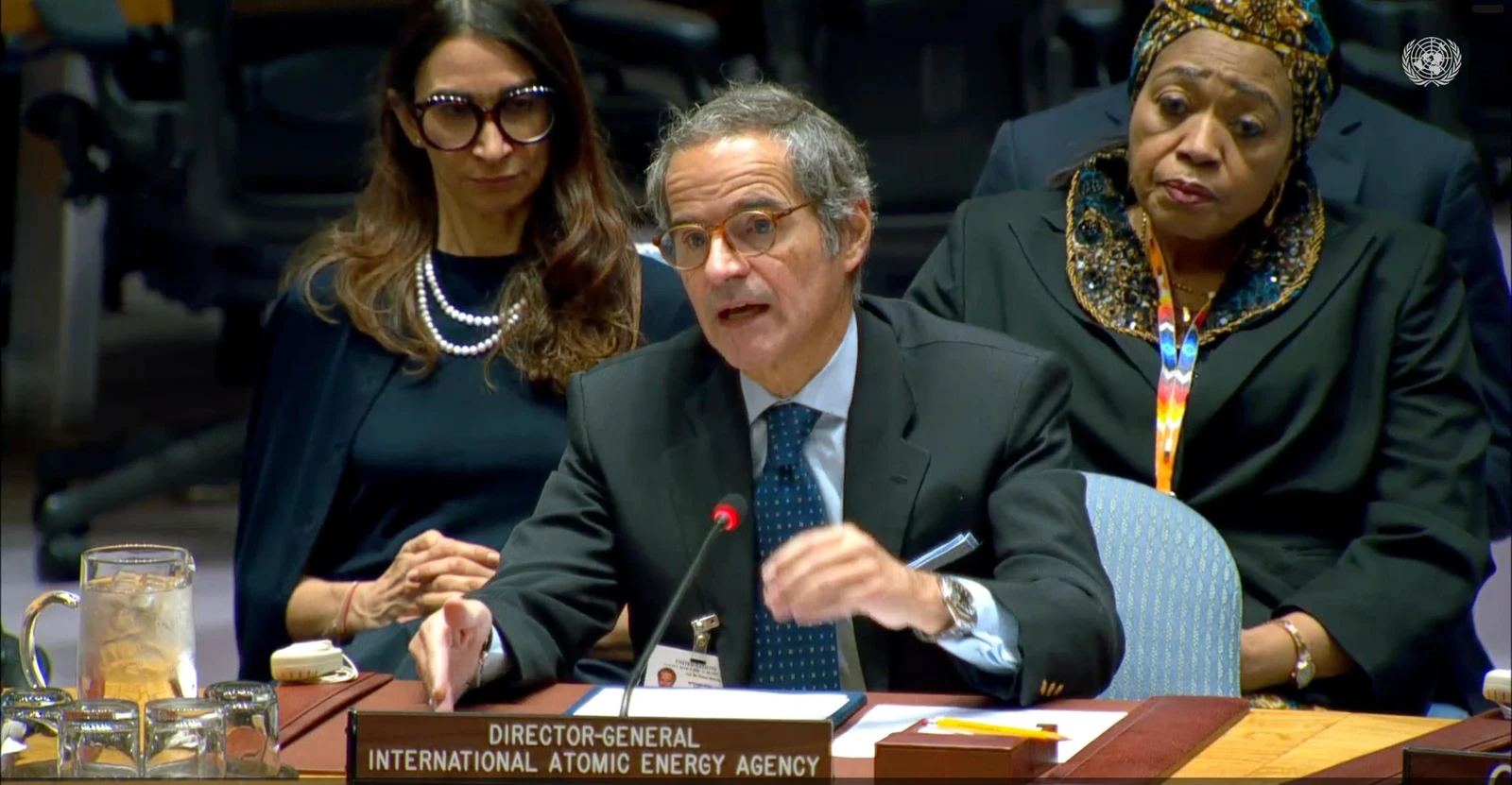
NEW YORK CITY: The head of the UN’s nuclear watchdog told the Security Council on Tuesday that his inspectors still cannot confirm that Iran has not diverted nuclear material, including 440 kg of highly enriched uranium that remains unaccounted for, more than a year after US and Israeli military strikes on Iranian nuclear sites forced inspectors to leave the country.
Rafael Grossi, director general of the International Atomic Energy Agency, said: “As of today, the IAEA has not been able to verify that there has been no diversion of nuclear material” that is required to be safeguarded under Tehran’s Comprehensive Safeguards Agreement with the agency. “This can, and must, be rectified,” he added.
The briefing was Grossi’s first to the 15-member Security Council since his agency’s board of governors formally reported Tehran to it last month. It was the first time in 20 years that Iran had been reported for breaching its nonproliferation obligations. The resolution to do so passed on Sept. 9 with 23 votes in favor, three against and eight abstentions. Tehran rejected the decision as political in nature and unlawful.
Grossi said the outstanding issues with Iran regarding nuclear safeguards have remained unresolved for more than five years. Verification work halted when IAEA inspectors were withdrawn from the country for their safety after the US and Israeli military attacks on Iranian nuclear sites began in June 2025. They have been ready to return “for many months now,” he added.
Grossi highlighted the key role of regional mediation efforts with Iran, and told the council that Oman, Pakistan, Qatar and Egypt had “undertaken important efforts” to re-engage Tehran and reach an acceptable arrangement.
He pointed in particular to the “Cairo Agreement” he signed with the Iranian foreign minister, Abbas Araghchi, on Sept. 9, 2025, under the auspices of the Egyptian president, Abdel Fattah El-Sisi, and with the assistance of the country’s foreign minister, Badr Abdelatty.
Grossi described the accord as a practical way to address Iran’s security concerns after the airstrikes in 2025 while allowing for the necessary verifications, and said revisiting it could help to resolve the status of facilities hit by the attacks.
Those sites include the Fordow Fuel Enrichment Plant, the pilot and main enrichment plants at Natanz, several facilities at the Esfahan complex, and the Khondab heavy water research reactor.
“Legal obligations in this regard cannot be unilaterally suspended under any circumstances,” Grossi said. “This is a basic principle of international law.”
The Bushehr nuclear power plant remains the sole exception to the general lack of progress, he said. Inspectors are currently working there, and Iran’s atomic energy authority has cooperated on the delivery of safeguards equipment ahead of the transfer of spent fuel to a new dry-storage facility, which is expected to take place early next year.
Grossi also referenced the Isfahan Fuel Enrichment Plant, which Iran declared to the IAEA just before the military strikes in June 2025. Tehran agreed at the time to grant access to inspectors, he said, but the attacks prevented the visit from taking place and Iran has rejected repeated requests for access since then.
Remote monitoring efforts by the agency had not identified any signs of activity to suggest that attempts were being made to repair or rebuild nuclear facilities hit by military strikes in 2025 or this year, Grossi said.
“However, nothing replaces access to the facilities to verify the actual situation,” he added.
Grossi said his agency had held “thorough” talks with US negotiating and technical teams, and the preparatory technical groundwork for a diplomatic deal securing the return of inspectors to Iran was in place.
Any path forward for Iran regarding its nuclear program, he stressed, must include IAEA verification, “without which, no solution is verifiable and, as a consequence, sustainable.”
Grossi urged Tehran to consider “gradual, technical, incremental steps” that could restore normal safeguards and help build confidence leading to a wider agreement, while signaling that his agency remained open to Tehran’s legitimate safety and security concerns.
“Only diplomacy, underpinned by IAEA verification, can prevent nuclear proliferation in the long-term, in Iran and around the world,” he said.