Pirouettes and plenty of pink at Gaza’s ballet school

Updated 01 December 2015
Follow

Pirouettes and plenty of pink at Gaza’s ballet school

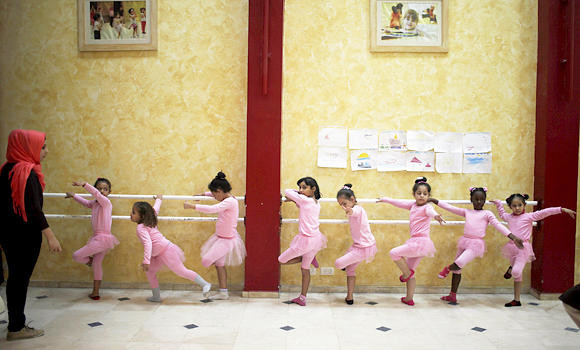
GAZA: The group of girls, ponytailed and dressed in pink, stretched their arms out to the sides and pivoted onto their toes, trying desperately to hold still. Eagle-eyed, the instructor surveyed Gaza’s latest crop of would-be ballerinas.
Fifty girls aged five to eight are now enrolled in the ballet school at the Al-Qattan Center for Children in Gaza, making it one of the most popular classes the arts institute runs, under the watchful eye of a Ukrainian teacher.
Amid the chaos and destruction that has shattered Gaza so often over the past five years, with repeated wars between Israel and Hamas, the school is a haven of calm and order, one many parents are eager for their children to enjoy.
“The ballet project was a dream for many families,” said Heyam Al-Hayek, the head of Qattan’s cultural activities. “They had been asking for ballet courses but we couldn’t find trainers. It was difficult to bring an instructor from abroad.”
The dream began to take shape when they found Tamara, a Ukrainian married to a Palestinian and living in Gaza, who had studied dance and was qualified to teach. She asked not to give her family name.
They started a pilot program in the summer, not sure how many parents would sign up given that Gaza is a conservative society and ballet is hardly a common pastime. Before they knew it, 50 children, all girls, were registered. There is now a waiting list that runs into the hundreds.
In the tiled hall, 14 pupils lined up in unison along the wall, one hand clutching a long metal barre. As Tamara showed them the steps, they copied precisely, angling their feet, bending their knees, one arm outstretched, chins held high.
Some of the children have lived through four wars in their short lifetimes, with Gaza on edge since Hamas seized full control of the enclave in 2007.


Drone attack on Sudan market kills 28: rights group

Updated 6 min 59 sec ago
Follow

Drone attack on Sudan market kills 28: rights group

  • Several drones struck the Al-Safiya area market outside the North Kordofan town of Sodari,

KHARTOUM: A drone attack on a crowded market in central Sudan killed 28 people, a rights group reported Monday, as the army and its paramilitary rivals traded aerial strikes in their battle for territory.
The attack occurred in a paramilitary-controlled area in the far north of Sudan’s Kordofan region, currently the fiercest frontline in the three-year-old war between the army and the Rapid Support Forces (RSF).
According to the Emergency Lawyers, a group monitoring atrocities in the conflict, several drones hit the Al-Safiya market outside the town of Sodari in North Kordofan on Sunday.
“The attack occurred when the market was bustling with civilians, including women, children and the elderly,” the group said, adding that the toll was preliminary.
It gave no indication of who carried out the strike.
Sodari, a remote town where desert trade routes cross, is around 230 kilometers (132 miles) northwest of El-Obeid, the state capital of North Kordofan, which the RSF has been trying to encircle for months.
The Kordofan region has seen a surge in deadly drone attacks as both sides fight over the country’s vital east-west axis, which links the western RSF-held region of Darfur, through El-Obeid, to the army-controlled capital Khartoum and the rest of Sudan.
Across vast stretches of territory, attacks by both sides — many on remote towns and villages — have killed up to dozens of civilians at a time.
Last Wednesday, two children were killed and a dozen wounded in one strike on a school, while another severely damaged a United Nations warehouse storing famine relief supplies.
After consolidating their hold on Darfur last year, the RSF has pushed east through oil- and gold-rich Kordofan, in an attempt to seize Sudan’s central corridor.
Since April 2023, the war between the army and the RSF has killed tens of thousands of people and displaced around 11 million, creating the world’s largest hunger and displacement crises.
It has also effectively split the country in two, with the army holding the center, north and east while the RSF controls the west and, with their allies, parts of the south.