BEIRUT: Islamic State group fighters advanced to the gates of ancient Palmyra Thursday, raising fears the Syrian world heritage site could face destruction of the kind the radicals have already wreaked in Iraq.
As it overran nearby villages, IS executed 26 civilians — 10 of whom were beheaded — for “collaborating with the regime,” the Syrian Observatory for Human Rights said.
Syria’s head of antiquities issued an urgent appeal for international action to save Palmyra, saying extremist militants were less than two kilometers from the remains of one of the most important cultural centers of the ancient world.
The world “must mobilize before, not after, the destruction of the artefacts” at the site, Mamoun Abdulkarim said in a telephone call.
“IS has not entered the city yet, and we hope these barbarians will never enter,” he said. “But if IS enters Palmyra, it will be destroyed and it will be an international catastrophe,” Abdulkarim added.
UNESCO describes Palmyra as a heritage site of “outstanding universal value.” The ancient city stood on a caravan route at the crossroads of several civilizations and its 1st and 2nd century temples and colonnaded streets mark a unique blend of Graeco-Roman and Persian influences.
Observatory head Rami Abdel Rahman said the city was “under threat” as fierce fighting and shelling continued on its eastern edges amid a regime counter-offensive.
The radicals’ advance on the well-preserved remains came as an international conference was under way in Cairo to address destruction already wreaked by IS on the ancient sites of Nimrud and Hatra in Iraq.
Abdulkarim said Syria’s antiquities officials would try to ensure the safety of artefacts found in Palmyra’s archaeological digs over the years and now housed in an adjacent museum.


![]()
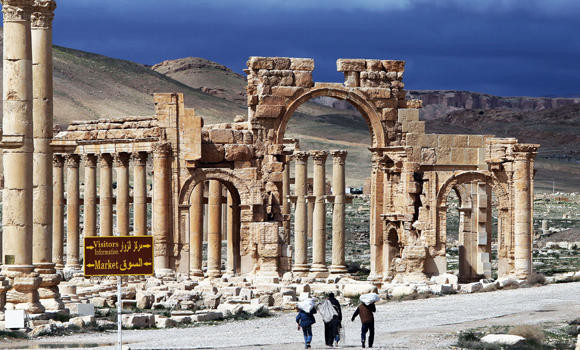
Ancient city of Palmyra might meet Nimrud fate
Ancient city of Palmyra might meet Nimrud fate
Latest updates





© 2026 SAUDI RESEARCH & PUBLISHING COMPANY, All Rights Reserved And subject to Terms of Use Agreement.