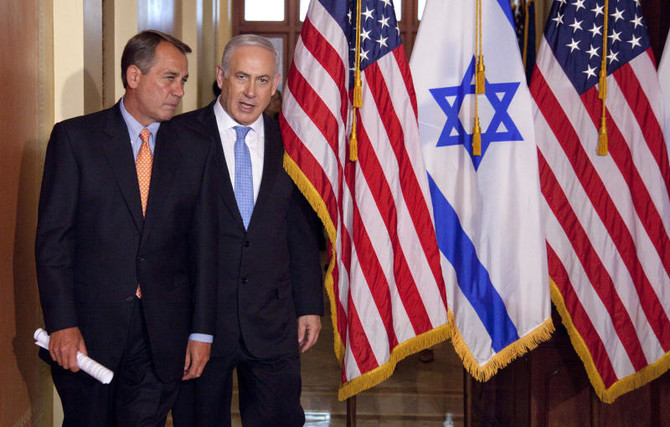
WASHINGTON: In a sometimes heated meeting with Israel’s ambassador to the US, several House Democrats expressed anger Wednesday over Prime Minister Benjamin Netanyahu’s acceptance of a Republican invitation to address Congress next month.
Some of the seven lawmakers — all of whom are Jewish and strong supporters of Israel — urged the prime minister to postpone the speech or hold it somewhere other than Congress, participants said. They told Ambassador Ron Dermer that Netanyahu was unwise to accept a Republican invitation that bypassed President Barack Obama, and to schedule the speech only two weeks before Netanyahu seeks another term in Israel’s elections.
The meeting’s purpose was “to try to defuse the optics” of the planned speech to Congress, and to return to substantive issues involving the two nations, said Rep. Steve Israel, a Democrat who hosted the gathering in his House office. Some attendees suggested a different time or venue for a Netanyahu speech, Israel told reporters, but “we have a while to go before we have to address whether or not he’s coming.”
Netanyahu’s March 3 speech would focus largely on Iran — and its nuclear program — amid delicate negotiations involving the United States, other Western powers and Tehran. Netanyahu’s acceptance of Republican House Speaker John Boehner’s invitation has infuriated the White House and many congressional Democrats.
Rep. Israel said the problem began when Boehner “decided that Israel would be a political football and he’d spike it in the end zone.”
Dermer asked for the Wednesday meeting in hopes of defusing some of the tension, lawmakers said.
Several Jewish House Democrats had met last week during the party’s retreat in Philadelphia to discuss what to do about the speech.
“I organized the meeting with Ambassador Dermer, and I invited key congressional Democratic supporters of Israel to attend,” Israel said in a statement. “There were a wide range of views that were discussed, but one thing we all agreed on emphatically is that Israel should never be used as a political football.”
Last Friday, House Democratic leader Nancy Pelosi was asked if Netanyahu would be well-advised to speak out in favor of heavier sanctions on Iran somewhere other than a joint meeting of Congress. She noted that the Israeli leader often appears on Sunday talk shows in the US.
Netanyahu has been an outspoken critic of the international efforts to negotiate a deal with Iran, which does not recognize the Jewish state, and which supports anti-Israeli militants like Lebanon’s Hezbollah and Palestinian Hamas.
He is sensitive, though, to Israel’s important relationship with the United States.
Last week, Netanyahu called Pelosi, Sen. Harry Reid, the Senate Democratic leader, and Sen. Chuck Schumer, the third-ranking Democrat in the Senate, in hopes of blunting their opposition to the invitation.
The issue has split many US Jewish organizations and communities, with some liberal groups criticizing the planned speech and others cheering it.
March 3 is 21 days before the US and its international partners are supposed to have reached a framework agreement with Iran — one that would provide an outline for a more comprehensive deal set to be finalized by the end of June.
The US and its allies want to prevent Iran from having the capability to develop a nuclear weapon. Iran denies any interest in nuclear weapons and says its program is for peaceful uses such as nuclear power and medical technology.


US Democrats give Israeli envoy earful over Netanyahu speech
US Democrats give Israeli envoy earful over Netanyahu speech

Israel police to deploy around Al-Aqsa for Ramadan, Palestinians report curbs
- The Al-Aqsa compound is a central symbol of Palestinian identity and also a frequent flashpoint
JERUSALEM: Israeli police said Monday that they would deploy in force around the Al?Aqsa Mosque during the Muslim holy month of Ramadan, which begins this week, as Palestinian officials accused Israel of imposing restrictions at the compound.
Over the course of the month of fasting and prayer, hundreds of thousands of Palestinians traditionally attend prayers at Al?Aqsa — Islam’s third-holiest site, located in east Jerusalem, which Israel captured in 1967 and later annexed.
Arad Braverman, a senior Jerusalem police officer, said forces would be deployed “day and night” across the compound, known to Jews as the Temple Mount, and in the surrounding area.
He said thousands of police would also be on duty for Friday prayers, which draw the largest crowds of Muslim worshippers.
Braverman said police had recommended issuing 10,000 permits for Palestinians from the occupied West Bank, who require special permission to enter Jerusalem.
He did not say whether age limits would apply, adding that the final number of people would be decided by the government.
The Palestinian Jerusalem Governorate said in a separate statement it had been informed that permits would again be restricted to men over 55 and women over 50, mirroring last year’s criteria.
It said Israeli authorities had blocked the Islamic Waqf — the Jordanian?run body administering the site — from carrying out routine preparations, including installing shade structures and setting up temporary medical clinics.
A Waqf source confirmed the restrictions and said 33 of its employees had been barred from entering the compound in the week before Ramadan.
The Al-Aqsa compound is a central symbol of Palestinian identity and also a frequent flashpoint.
Under long?standing arrangements, Jews may visit the compound — which they revere as the site of their second temple, destroyed by the Romans in 70 AD — but they are not permitted to pray there.
Israel says it is committed to maintaining this status quo, though Palestinians fear it is being eroded.
Braverman reiterated Monday that no changes were planned.
In recent years, a growing number of Jewish ultranationalists have challenged the prayer ban, including far?right politician Itamar Ben?Gvir, who prayed at the site while serving as national security minister in 2024 and 2025.