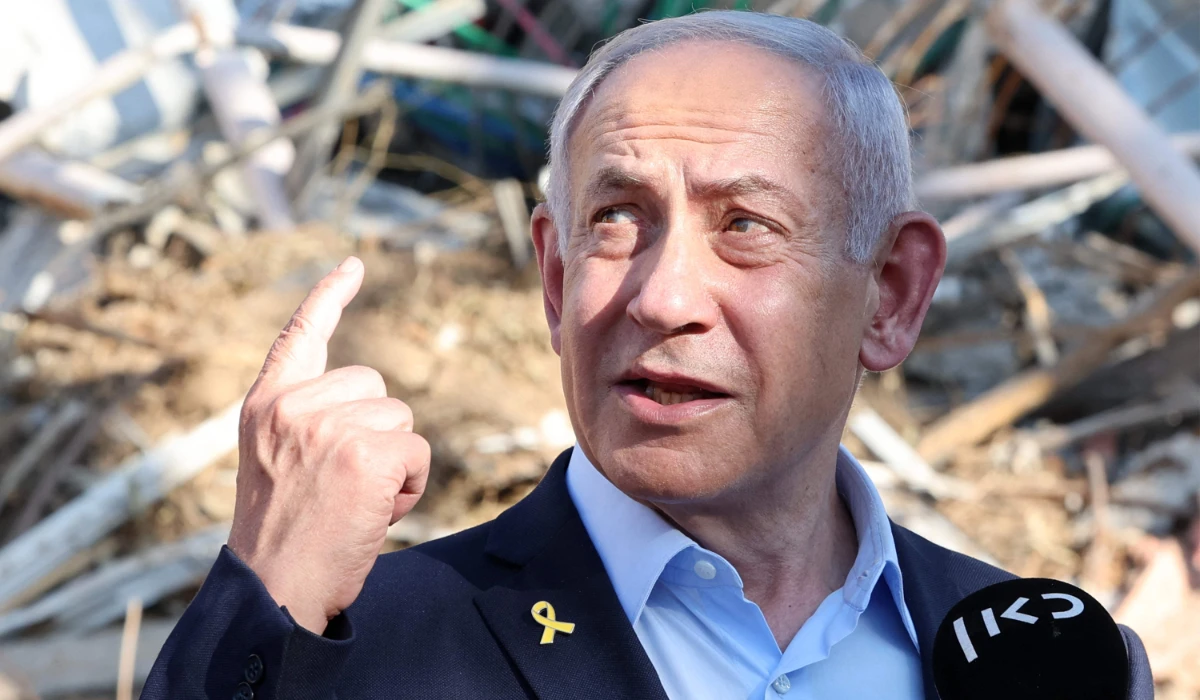
JERUSALEM: Prime Minister Benjamin Netanyahu warned on Monday of heavy reprisals on Israel’s enemies if they attacked, as he lauded the recent demolition of a Hezbollah tunnel network in southern Lebanon.
Netanyahu said Israel’s destruction of Hezbollah positions at the Beaufort and Ali Al-Taher ridges was a “massive victory” and vowed to “continue to destroy terrorist infrastructure.”
“I say to our enemies: If you haven’t learned the lesson by now, and you choose to attack us again, you will suffer even heavier blows. There is still work to complete,” Netanyahu added, according to a video published by his office.
On Thursday, Israel blew up what it described as a vast network of tunnels under the Ali Al-Taher ridge where Hezbollah kept a command center, living quarters and stocks of weapons with which to strike northern Israel and invading Israeli troops.
A huge fireball was seen in the area, with the US Geological Survey recording a tremor equivalent to a 4.1 magnitude earthquake.
The blast came a week after Israeli troops said they had seized the strategic highlands as they solidified control of a “security zone” in southern Lebanon.
Israel said the tunnel network was built over two decades with the help of Hezbollah’s patron Iran, whose clerical government has also backed Hamas in the Gaza Strip.
Israel and the United States attacked Iran in late February, sparking the Middle East war.
Hezbollah dragged Lebanon into the wider conflict when it fired rockets at Israel in solidarity with Iran.
Israel has struck south Lebanon during the war and its forces continue to occupy what it calls a “security zone” there.
The Ali Al-Taher ridge lies on the edge of Israel’s security zone just a few kilometers from the UNESCO-listed Beaufort castle, another strategic site that Israel captured in recent months.
Israel and Lebanon signed a US-sponsored framework agreement in late June that involves the disarmament of Hezbollah, a gradual withdrawal of Israeli forces from Lebanon’s south and the deployment of the Lebanese army to the region, starting in test areas known as “pilot zones.”