- Collapsing oil shipments, restricted trade deepen pressure on Tehran as households face rising prices and a weaker rial
- Analysts divided on whether reported reopening proposal reflects pressure or effort to preserve Iran’s bargaining position
After months of using the Strait of Hormuz to exert pressure on global trade, Iran is facing mounting economic costs of its own — raising questions about whether its reported offer to reopen the waterway reflects a growing need for relief or an effort to buy time.
A senior Iranian official told Reuters news agency on Tuesday that Tehran could reopen the strait within seven days if the US eased military pressure and lifted its blockade of Iranian ports. The proposal had been conveyed through mediators, the official said.
However, Iran’s semiofficial Fars news agency carried a denial of the reported seven-day offer, and Tehran has disputed suggestions that it has abandoned its earlier conditions. The competing accounts leave the scope of any proposal uncertain.
Some experts nevertheless see Iran’s emphasis on lifting the port blockade as evidence that economic pressure is influencing its calculations. Others caution that renewed diplomacy does not necessarily indicate a willingness to make significant concessions.
Iran’s gross domestic product contracted 10.1 percent year on year between March 21 and June 20, according to Statistical Center of Iran figures cited in published reports. Oil and gas output fell 26.4 percent over the same period. Later shipping data points to a further squeeze on its ability to earn foreign currency.
“The blockade has significantly impacted Iranian trade and imports, with its raw materials proving very difficult to reroute at such short notice,” Mehran Haghirian, executive director of research and programs at the Bourse & Bazaar Foundation, told Arab News.
“It is the same issue that the GCC states are facing. It is difficult to find alternatives in a few weeks and months when the hope is that everything will return to normal, particularly when you begin to consider costs that would be involved in this.”
Victoria Coates, a former deputy national security adviser to President Donald Trump for the Middle East and North Africa, described the blockade as “by far Trump’s most devastating tool,” saying it was restricting access to critical imports.
Reuters reported earlier this month that President Masoud Pezeshkian had put the decline in total trade at 25 percent to 35 percent. The same report cited official figures showing average inflation over 12 months at 69.9 percent, while the rial had weakened beyond 2.2 million to the dollar.
Coates pointed to Iran’s economic contraction and currency losses, adding that “inflation is climbing still higher, and the pressure on the banking system remains acute.”
Gregory Brew, a senior analyst on Iran and energy at Eurasia Group, warned that the loss of oil revenue could “create a tremendous crisis” in Iran’s external finances — a balance-of-payments emergency in which the country struggles to meet its foreign payment obligations.
Oil remains a crucial source of foreign currency despite years of sanctions. According to Vortexa and Kpler estimates reported by Reuters, Iran loaded about 220,000 to 255,000 barrels per day of crude oil and condensate in August, down from about 2 million barrels per day in March.
Those figures measure cargo loaded rather than shipments delivered to overseas buyers. Even so, the decline illustrates the constraints on a major source of export earnings.
Reduced access to foreign currency makes it harder to pay for imports and support the rial, adding to the pressure on prices. Reuters reported that prices for food, beverages and tobacco were rising at almost twice the overall 12-month average inflation rate.
Brew stressed, however, that a balance-of-payments crisis was not a foregone conclusion, noting Iran’s record of adapting to economic shocks and finding ways around restrictions.
Ksenia Kirkham, a senior lecturer in economic warfare at King’s College London, questioned whether the blockade would produce a decisive change in policy.
Iran “has lived under sanctions for more than 40 years,” she said, arguing that the current restrictions were not fundamentally different from conventional sanctions in their political effects.
“Humanitarian consequences have done little to alter US policy aimed at constraining Iran’s economic development, even during the pandemic when civilians struggled to obtain certain products and medical supplies because of stringent sanctions,” Kirkham told Arab News.
She said Iran had long balanced domestic welfare needs against geopolitical pressure.
“Any analysis of sanctions should begin by asking: what was the objective? If it was to inflict economic hardship on the population and increase anti-American sentiment, it succeeded.”
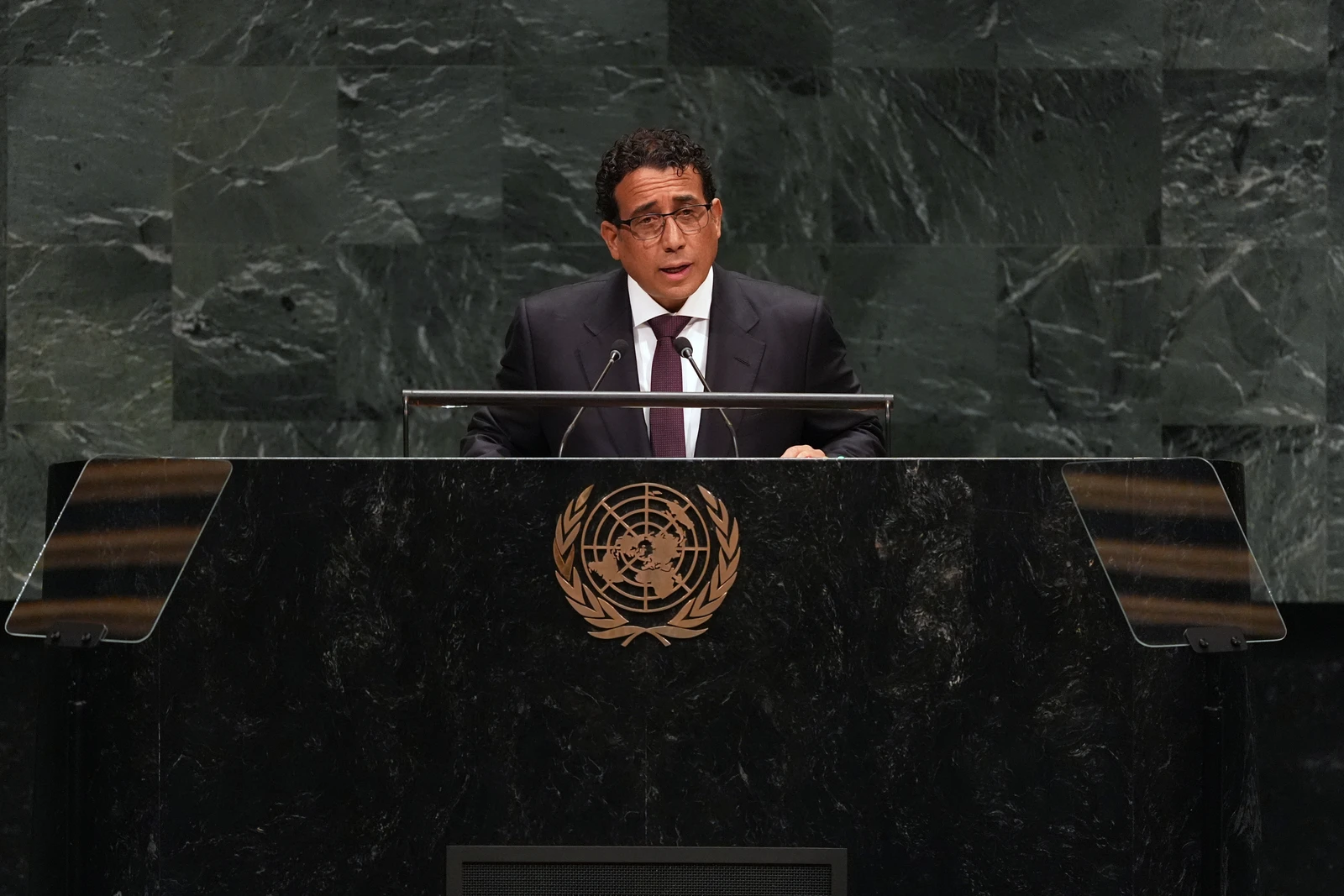
Tehran’s public position remained defiant on Wednesday. Addressing the UN General Assembly, Pezeshkian described Iranians as “victims of terrorism,” a day after Trump threatened to “annihilate the Islamic Republic.”
Addressing Hormuz, Pezeshkian said: “We cannot let some have free access and gain their interest from a waterway, while at the same time using it to impose their aggressions on us, to impose insecurity on us, to forbid us access to our own waterway.”
Iranian state media reported on Tuesday that Tehran’s conditions included the immediate lifting of the naval blockade, the release of frozen Iranian assets and an end to fighting across fronts involving its regional allies. The announcement did not establish that Iran had dropped other demands.
Kirkham suggested the reported offer could be an attempt to manage escalation and reduce the risk of a wider conflict, adding that “it looks like Iran wants to maintain its bargaining position, rather than acting in direct response to economic coercion.”
Mark Pfeifle, a Republican strategist and former White House deputy national security adviser, offered a different assessment. He described Tehran’s approach as a bluff to mask its economic difficulties.
Pfeifle viewed reports that Iran had dropped demands for reparations and reconstruction funding as a “concrete sign” that US pressure was working. That interpretation depends on a change in Iran’s position that Tehran has disputed.
Haghirian acknowledged that Iran had become an “expert” at navigating sanctions and restrictions on trade with neighboring countries and other partners. But its capacity to adapt was not unlimited.
“The pressure is particularly difficult because the cost is ultimately being passed on to a population whose purchasing power has already been severely eroded and with that the Iranian economy’s ability to purchase anything has significantly diminished,” he said.
Mohammad Bagher Ghalibaf, speaker of the Iranian Parliament, acknowledged those vulnerabilities in August, warning that military strength alone could not sustain the country if people went hungry and the economy lacked financial circulation, growth and domestic production.
One analyst told Arab News that access to frozen Iranian assets remained “the key talking point since discussions first began.”
Such funds are held abroad under a range of restrictions, rather than necessarily being held by Washington itself. Their release could help Iran finance imports and relieve some domestic pressure, although the benefit would depend on the amount released and the conditions governing its use.
After reports of the Hormuz proposal emerged, Neil Wilson of Saxo Markets said in comments carried by The Guardian that “pressured by its exports grinding to a halt, the economic toll is being felt in Tehran,” adding that Iran appeared to be “pinning hopes on this offer ending the stalemate.”
Haghirian also pointed to a factor beyond the “immediate economic bite”: the opportunity for dialogue, “particularly with everyone gathered in New York for the UN General Assembly.”
Kirkham similarly highlighted the importance of diplomacy.
The 2015 Joint Comprehensive Plan of Action — negotiated between Iran and six world powers, including the US — “remains one of the few examples cited as evidence that economic pressure secured meaningful concessions from Iran,” she said. But she challenged the view that coercion alone explained the agreement.
“Sanctions alone do not explain the agreement,” she said. “While the prospect of sanctions relief was an important part of the bargain, the decisive factor was the restoration of dialogue, a degree of mutual trust, and a belief in a credible and lasting settlement.
“It was the prospect of normalization, rather than coercion alone, that made compromise possible. Today, the situation is very difficult, as mutual trust has collapsed.”