- Event co-chaired by Kingdom, Norway, EU in coordination with France on sidelines of UN General Assembly
- Norwegian FM: Situation on the ground ‘deteriorating faster than our collective response’
NEW YORK: Every delay in implementing the two-state solution carries a mounting human cost, the Saudi foreign minister warned on Thursday, challenging world powers to say how many more lives would be lost before Palestinian statehood becomes a reality.
Prince Faisal bin Farhan opened a high-level ministerial meeting of the Global Alliance for the Implementation of the Two-State Solution on the sidelines of the 81st UN General Assembly.
He said the foundations of a lasting settlement are being eroded daily through displacement, expulsion, and the deliberate weakening of Palestinian institutions.
“Every delay has a price,” he added. “How much pain, how many shocks will the Palestinians and the Israelis endure until we reach this vision? How much more instability should our region endure?”
The meeting was co-chaired by Saudi Arabia, Norway and the EU in coordination with France. It came as senior officials acknowledged a widening gulf between unprecedented diplomatic support for Palestinian statehood and a worsening situation in Gaza and the West Bank.
Prince Faisal said the Arab Peace Initiative, put forward by Saudi Arabia, still offers a viable foundation of “land for peace, two states, security for both states and common prosperity.”
He added that the vision rests on international resolutions and law, and has been reinforced by US President Donald Trump’s plan to end the Gaza conflict.
“We shouldn’t wait for another 25 years to look back to a foundation that proved to be viable,” Prince Faisal said, warning that Gaza “shouldn’t come out of this crisis politically separated or geographically separated from the West Bank, including East Jerusalem.”
He said Saudi Arabia would reject “temporary arrangements that are presented as definitive solutions,” as well as settlements dictated by “passing geopolitical considerations.”
Prince Faisal offered a hopeful vision for the region, saying: “I see our children getting over their trauma. I see generations that share the same future.”
He described Jerusalem as a place that could become “a symbol for our common humanity.” Riyadh’s goal, he said, is “one Palestine, two states, a region of peace.”
That means a sovereign, viable and contiguous Palestinian state living alongside Israel on the 1967 borders with East Jerusalem as its capital, in a region where Muslims, Christians and Jews live together with their religious rights respected.
Saudi Arabia will keep working “with the US and our partners in the (global) alliance” to achieve it, he said.
Norwegian Foreign Minister Espen Barth Eide said the situation on the ground is “deteriorating faster than our collective response.”
Conditions in Gaza and the West Bank are “bleaker than ever,” even though international political support “has never been as high,” he added.
“We know exactly what the goal is. We don’t need to discuss the goal. We need to discuss implementation.”
He urged partners to act now to stop the preconditions for Palestinian statehood from disappearing altogether, saying more than 90 countries are now working systematically within the alliance.
He defended Norway’s recognition of Palestine last year as a break with decades of waiting on bilateral talks under the Oslo peace process.
Eide pointed to Norway’s ban on trade with illegal Israeli settlements, adopted with other countries, as a way of differentiating between Israel and occupied territory in line with recent rulings of the International Court of Justice.
He announced increased budget support for the Palestinian Authority and urged others to follow, saying: “In order to reform something, it also has to stay alive.”
He called for a more inclusive regional security framework, saying security “can’t be built for some while excluding others.”
EU foreign policy chief Kaja Kallas said the meeting showed that “the weight of the world is behind building a better future for Palestinian people.”
Kallas welcomed the PA’s reform efforts and its preparations for legislative elections, saying: “These have to take place.”
She added, however, that the alliance’s ambitions are “increasingly at odds with the hard realities on the ground.”
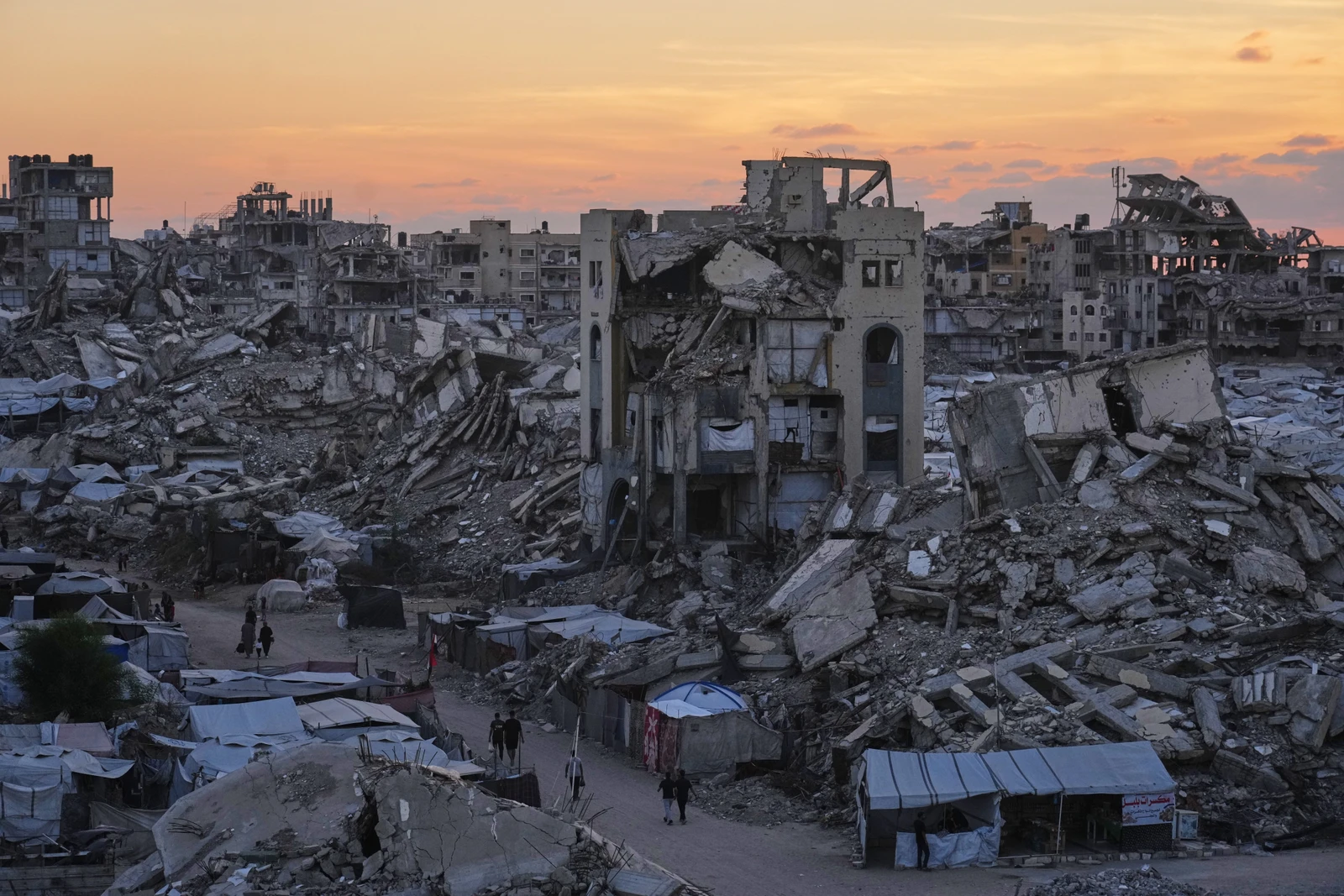
In Gaza, she said, Israeli strikes continue and humanitarian needs remain acute, while violence and settlement expansion in the West Bank threaten the viability of a Palestinian state.
“Our task today isn’t to reaffirm our support for the goal of this group, but to close the gap between commitments and actions and realities on the ground, and to move from preserving to realizing,” she added.
Kallas highlighted the EU’s Team Gaza early-recovery initiative and pilot projects on water and waste.
Nickolay Mladenov, the Board of Peace’s high representative for Gaza, presented the first recovery and reconstruction package drawn up with the National Committee for the Administration of Gaza.
It comprises 66 projects over six months at a cost of about $2.45 billion, covering water, sanitation, electricity, health, education, shelter and rubble removal. He said the package is dependent on security conditions rather than a calendar.
“Where weapons are decommissioned and security is established, reconstruction will follow, and it will follow quickly,” he said, stressing that this is “not a device for withholding assistance.”
He said Palestinians will be “the administrators, the owners and the designers” of the effort, not beneficiaries of “yet another international project conducted over their heads.”
Mladenov acknowledged that humanitarian access remains well short of what international law demands, the decommissioning of Hamas’ weapons has not begun, and Palestinians are still being killed in Gaza.
“A plan without a horizon is just administration. A horizon without a plan is just rhetoric,” he said, urging alliance members to channel their efforts rather than pursue parallel tracks.
The parties, he warned, “read international divisions far more attentively than they read our communiques.”
He added: “If we rebuild Gaza while the prospect of Palestinian self-determination is emptied of its content, we won’t have built peace. We’ll have built a more comfortable confinement.” Palestinian statehood “isn’t a reward” for good behavior but “the objective,” he said.
Prince Faisal launched the alliance during a ministerial meeting on the sidelines of the 79th UNGA in September 2024.