- Houthis fire 2 ballistic missiles and several drones at airport, government officials say; missiles hit close to tarmac minutes before a flight was due to land
- Attack on airport comes as fighting between government forces and Houthis intensifies in areas close to Bab Al-Mandab Strait and around the outskirts of Taiz
AL-MUKALLA: Iran-backed Houthis in Yemen on Wednesday fired missiles and drones at Aden International Airport, in the southern city that is the seat of the country’s internationally recognized government, as fighting raged across several fronts in western Yemen.
The attack, the first on the airport in years, came as the UN’s migration agency said the number of people displaced since the latest round of violence began in August had surpassed 200,000.
The Ministry of Transport in Aden said the Houthis fired two ballistic missiles and several drones at the airport, with the missiles hitting close to the tarmac just minutes before a Yemenia Airways flight was due to land.
The ministry strongly condemned the attack, which it said could have endangered dozens of passengers aboard incoming flights, as well as airport staff and travelers in the terminal awaiting the departure of a flight to Jeddah.
Yemeni government officials diverted Yemenia flights from Cairo bound for Aden to Jeddah, and two aircraft were moved from the airport to a safer location amid fears they might be targeted as Houthi drones hovered over the city, the ministry said.
“It is a blatant attack on a vital civilian facility that ought to be a safe space for travelers and staff, not a scene of fear and intimidation,” the ministry said.
Government officials also condemned the attack and called for civilian facilities to be kept out of the conflict so they could continue to serve people across the country, including those in Houthi-controlled areas.
Mustafa Noaman, Yemen’s vice minister of foreign affairs and expatriates, accused the Houthis of using their weapons to target one of the country’s few remaining departure points for students, people in need of medical care and other travelers.
“The Houthi militias do not hesitate to use their diabolical arsenal of missiles and drones to destroy everything Yemenis have built and struggled for over decades,” he said.
The attack on the airport came as fighting between Yemeni government forces and the Houthis intensified in areas close to Bab Al-Mandab Strait, on the outskirts of Taiz city, and in contested districts west of Taiz.
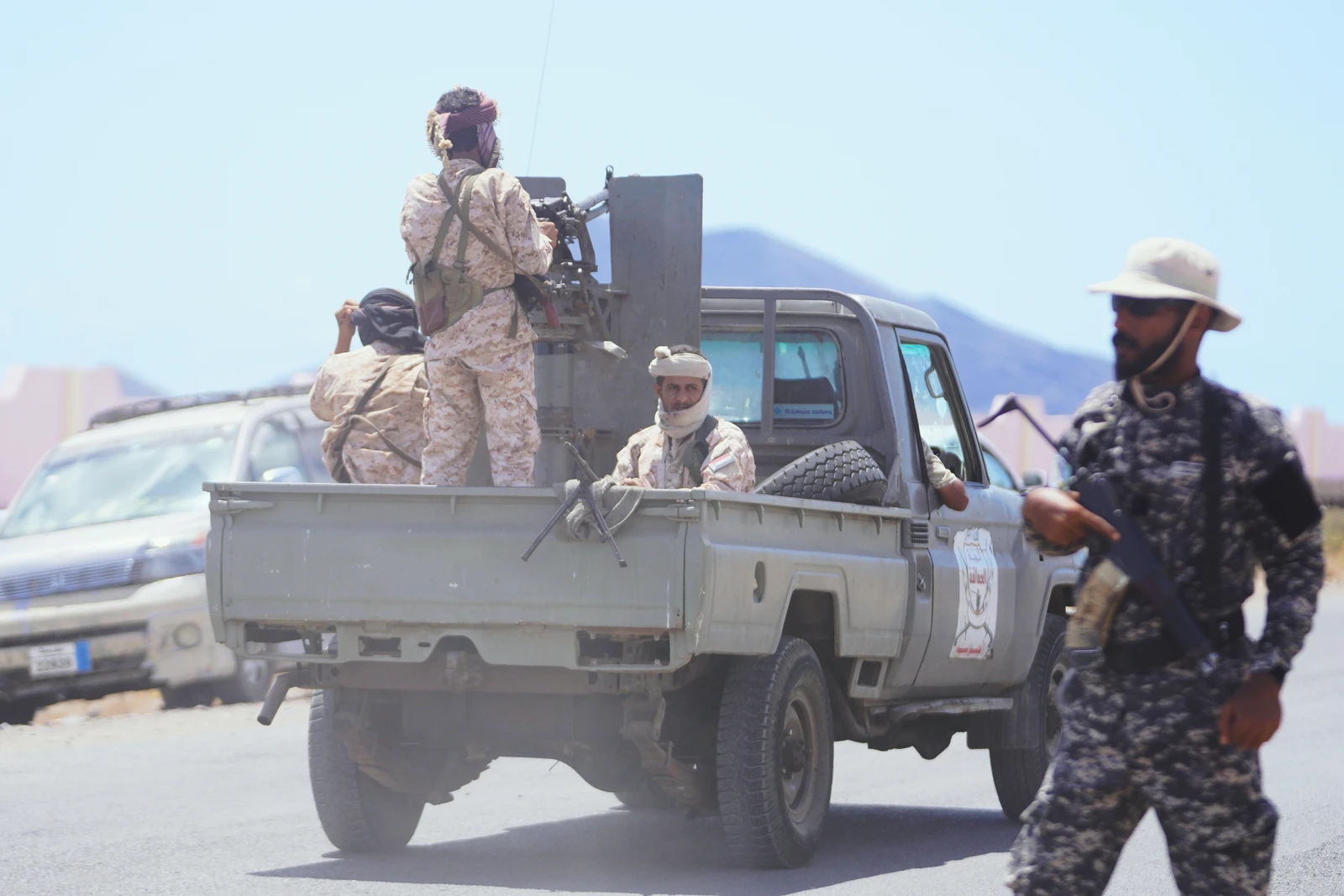
The Giants Brigades, a pro-government militia, said forces stationed at Thubab airfield on the Red Sea coast, near Bab Al-Mandab, had repelled a Houthi assault, forcing the attackers to retreat and abandon two military vehicles.
Since the launch by the government on Monday of a large-scale “Dawn of Yemen” counteroffensive against the Houthis, the Giants Brigades have secured the main road that links Thubab district, the closest part of the mainland to Bab Al-Mandab, with Mokha, marking the first major military gain for government forces after months of setbacks along the country’s western coast.
Repeated Houthi attempts to reopen the road, seize Thubab airfield or break the siege on their forces there have failed amid heavy air support from the Coalition to Restore Legitimacy in Yemen.
Meanwhile, the Nation’s Shield Forces, a military reserve unit under the command of Rashad Al-Alimi, the head of Yemen's Presidential Leadership Council, announced on Tuesday the launch of an operation targeting the Houthis in Al-Wazi’iyah district, west of Taiz, as part of the wider “Dawn of Yemen” campaign.
The forces later said they had seized what they described as the highest mountain peak in Jabal Habashi, west of Taiz, as well as a chain of elevated positions overlooking Al-Mansoura in Al-Wazi’iyah.
Yemeni army officers said the aim of the operation was to capture a large chain of mountains overlooking the Red Sea coast. Expelling the Houthis from their positions there, they said, would allow government troops to advance along the coast toward Mokha.
Elsewhere in Taiz, the Yemeni army said on Wednesday that fighting had intensified across several fronts, including the southern countryside, Jabal Habashi district in the west, and positions on the outskirts of Taiz city.
The last remaining road linking Taiz with government-held areas was recently blocked by fighting, effectively leaving the city under siege by the Houthis. Residents said the prices of essential goods and fuel had started to rise because of the blockade, and thousands of displaced persons were increasingly in desperate need of humanitarian assistance.
“The displaced people’s most urgent needs are food, water and cooking gas,” an aid worker, who asked not to be named, told Arab News. “They are no longer concerned about shelter; they just want something to eat, even if they have to sleep in the open.”
With fighting intensifying and explosions rocking the city, residents and displaced people feared they would become trapped or be forced to flee again if the Houthi forces advanced.
“The displaced people have already fled war zones and they are afraid of being targeted by the Houthis if they approach,” the aid worker said.
The UN’s International Organization for Migration said on Wednesday that the number of persons displaced since the start of the latest escalation had risen to 201,217, up from about 145,000 at the end of September and 76,000 in mid-September.
Taiz is the governorate worst affected by the latest fighting, accounting for 57 percent of the total number of displaced persons, the agency said.
“People are running for their lives and finding nowhere safe to go,” the organization’s director general, Amy Pope, said in a statement.