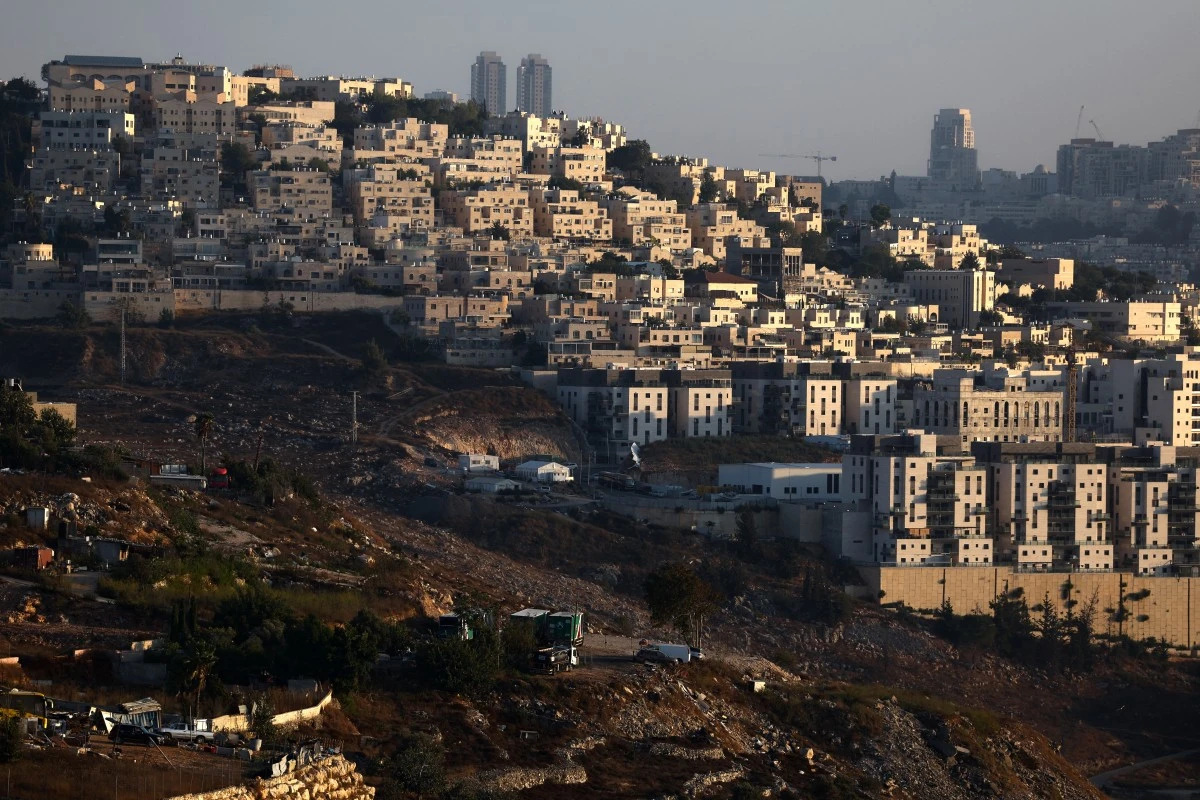
- Fifth company has withdrawn from controversial Jerusalem plan amid concerns over displacement
- Nir Barkat, former Jerusalem mayor, says project would help visitors ‘understand who is truly the landlord of the city’
LONDON: Five foreign firms have abandoned plans to build a cable car from West Jerusalem to East Jerusalem that could see dozens of Palestinian families lose their land and property rights, The Guardian has reported.
Despite the withdrawal of a fifth company, local authorities have said the project is proceeding as planned, after it appeared to have stalled for four years until late September.
That month, the Jerusalem Development Authority issued a notice of intent to award a contract without a public tender to ROPES, an engineering consultancy specializing in cable car production, based in Italy’s South Tyrol.
But Stephan Obexer, the firm’s CEO, told The Guardian that ROPES had declined the contract because of another obligation in India.
The cable car route through the holy city was approved by the Israeli government in 2019 and upheld by the High Court in 2022.
With a planned distance of 1.4 km, the project would connect West Jerusalem to a planned 16,000 sq. meter tourist facility promoted by Elad, an Israeli settler organization that plans to exert control over Palestinian areas of East Jerusalem.
Israel’s occupation of the Palestinian territories began in 1967.
Jerusalem’s Old City and the rest of the eastern half of the city were annexed in 1980 but are considered occupied under international law.
The Jerusalem Development Authority recently expedited plans for the long-delayed cable car project through sections of East Jerusalem, according to Emek Shaveh, an Israeli nongovernmental organization.
Nir Barkat, the city’s former mayor, described the project as a way for visitors to “understand who is truly the landlord of the city.”
Emek Shaveh said recently: ‘‘This project threatens the Palestinian communities and the timeless landscape of Jerusalem’s historic core. It is clear that the project’s central motivation is to consolidate the settlers’ hold in those areas as part of an effort to displace Palestinians from the Historic Basin and reshape Jerusalem’s cultural landscape.’’
At least four firms based outside Israel — three in France and one in Switzerland — have expressed interest in the cable car proposal, but several subsequently withdrew over political concerns, according to Haaretz.
The French government in 2015 called on one domestic company to avoid taking part in the project.
Less than a year ago, another French firm, CNA, withdrew, as did Switzerland’s Histec Engineering more recently.
In response to The Guardian, ROPES did not clarify whether legal concerns over the project’s location in East Jerusalem had influenced its decision.
A spokesperson for the JDA told Haaretz: “Following the High Court of Justice’s dismissal of petitions against the project about a year-and-a-half ago, the cable car continues to proceed according to plan and in accordance with the timetables set.
“Steps to promote the project are subject to the mandatory tenders law, and the tender is expected to be ready for publication in the coming months once its formulation is completed.”
The proposal has sparked outrage and protests among groups campaigning to protect Israeli heritage, Palestinian rights and the environment.
Alon Arad, an archaeologist and executive director of Emek Shaveh, said: “The cable car stands in complete contradiction to the historic principle that no large buildings or infrastructure should be built around the Old City.
“It is particularly troubling that the Israel Nature and Parks Authority, the body responsible for upholding this principle, is cooperating with the project.
“To understand the political context, one must look at the route. It begins in West Jerusalem and ends at a compound run by the far-right settler organization Elad Foundation, which stands to benefit from a project costing the state around half-a-billion shekels ($161 million). Elad is notorious for using state resources to advance its political agenda in East Jerusalem, taking over Palestinian properties, evicting families and settling Jewish residents in their place.”
About 54 Palestinian homes are threatened by the cable car project through the Wadi Hilweh neighborhood in Silwan, rights groups have warned.
Families there are already facing the expropriation of either their land or air rights.
Israeli authorities have issued 17 expropriation notices covering about 2.15 acres of land along the proposed route, where pylons will be installed to support the cable car system.
Sari Kronish, an architect and director of the East Jerusalem department at Israeli planning rights group Bimkom, said that Palestinian families along the route could have cable cars passing “as close as 4 meters” above their rooftops.
“Expropriations of land and homes for support pillars have already been set in motion, leaving residents in a constant state of uncertainty,” she added.
Settler activities are ramping up across the West Bank and East Jerusalem, where armed groups are increasingly stealing Palestinian properties.
Israeli authorities have also stepped up demolitions of homes belonging to Palestinians, citing lack of building permits.
Israeli settlers this month attacked Palestinian villages, burning cars and trees, and injured a Washington Post photographer amid the annual olive harvest.
A group of European diplomats, a French mayor and Palestinian olive pickers were also attacked by settlers in another high-profile incident.