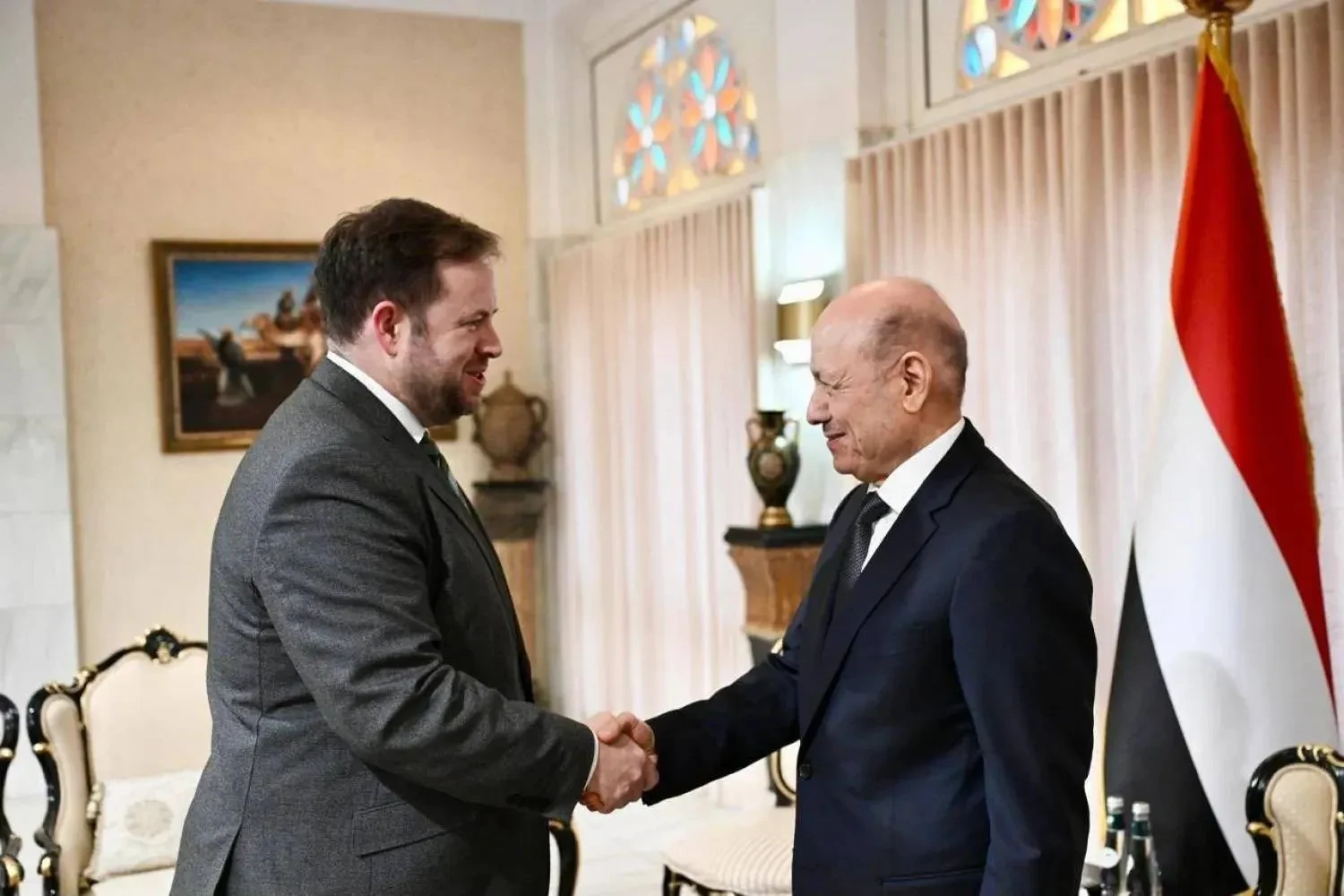
LONDON: British Minister of State for the Middle East Stephen Doughty stressed that the sanctions imposed by his country on Tuesday against the Houthi group are a "very significant step" in confronting the group's escalation of attacks inside Yemen and against neighboring countries.
He expressed confidence in the effectiveness of the new measures, without disclosing whether London is considering designating the Houthis as a terrorist organization.
In remarks to Asharq Al-Awsat, Doughty revealed close cooperation between Britain and the Yemeni Coast Guard to intercept illicit arms shipments to the Houthis as part of efforts to safeguard international navigation.
He also condemned Houthi attacks against Saudi Arabia, confirming that Britain is providing defensive military support to Riyadh, including air defense, aerial refueling, and Typhoon fighter jet support.
The minister described the Iranian threats facing the United Kingdom as "wide-ranging," calling on Tehran to halt its destabilizing activities inside and outside the region.
Broad sanctions package
The British government announced on Tuesday sanctions on the Houthi group, including an asset freeze, as well as sanctions targeting four of its officials over their involvement in serious human rights violations, comprising asset freezes and travel bans to the United Kingdom.
The British Foreign Office said the decision stemmed from the Houthis' escalation of fighting inside Yemen, their targeting of civilian infrastructure in Saudi Arabia, and their disruption of international shipping in the Red Sea and the Bab al-Mandeb Strait, which has disrupted global supply chains and added to cost-of-living pressures in the United Kingdom.
Amid the Houthis' continued escalation of attacks despite previous punitive measures, Doughty stressed that what sets the new package apart is that it targets the group in its entirety.
This is an important announcement that comes in response to the reckless escalation and aggression carried out by the Houthis, not only inside Yemen and against the Yemeni people, but also against neighboring countries in the region, including Saudi Arabia, he said.
This is completely unacceptable. There is immense humanitarian harm inside Yemen, hundreds of thousands of people are fleeing their homes, and there are horrific reports of human rights abuses and atrocities being committed. That is why the UK acted, he stressed.
Doughty noted that the sanctions also targeted four senior Houthi officials implicated in human rights violations and implementing these policies, adding that the new measures as a "very important step forward" and a direct response to the Houthis' actions.
Asked whether the British government is considering blacklisting the Houthi group and designating it as a terrorist organization, following the lead of the US, he replied that listing the Houthi group in its entirety on the sanctions list represents a very significant step.
It takes effect immediately, and it will have the impact London is seeking to achieve, he stated.
He likewise did not specify whether Britain intends to take additional measures to target the military and financial support Iran provides to the Houthis.
He noted that the number of British sanctions imposed on Iran now runs into the hundreds, and that London enacted a series of measures on September 8 against Iran and its proxy groups, including Lebanon's Hezbollah.
Red Sea maritime security
Within the framework of British efforts to protect international navigation in the Red Sea and the Bab al-Mandeb Strait, Doughty confirmed that his country is cooperating closely with the Yemeni Coast Guard to intercept illicit weapons supplies to the Houthis.
The Houthi actions against freedom of navigation and their threats to shipping are completely unacceptable. Maritime security and freedom of navigation must be respected, he said, pointing to a series of measures to bolster maritime security in the region.
These efforts are not limited to cooperation with Yemeni authorities. Doughty noted that London is working with a range of regional partners, while underlining the need to work toward ending the conflict in Yemen.
Ultimately, diplomatic pathways to de-escalate, ensuring freedom of navigation, but also, fundamentally, ending the conflict in Yemen are needed. This conflict is having devastating effects on hundreds of thousands of Yemenis and is destabilizing the region, he said.
He stressed that attacks targeting civilians and infrastructure in neighboring countries, such as the strikes that hit Saudi airports, are "completely unacceptable."
Military support for Saudi Arabia
Doughty condemned the Houthi attacks on Saudi Arabia, stressing that the UK has been supporting the Kingdom for weeks through a range of measures, including air defense, aerial refueling, as well as support with Typhoon aircraft.
This is extremely important as part of the defensive role the UK is playing to support its close partner and friend, the Kingdom of Saudi Arabia, he stressed, adding that his country will listen carefully to any further requests it may put forward.
The UK and Saudi Arabia are working very closely together, he remarked.
Recalling his recent visit to Riyadh, he said what the Kingdom was subjected to is "completely unacceptable," citing attacks on its airports, and the killing and injury of innocent civilians.
He demanded that the Houthis cease these actions immediately.
Prospects of renewed war with Iran
At a time when world capitals are monitoring indicators regarding a potential resumption of military confrontation between the United States and Iran in the coming months, Doughty stressed London's commitment to the diplomatic track, pointing to its close cooperation with regional partners and its support for talks mediated by Oman, as well as efforts by Qatar and others.
Doughty said London wants to reach a negotiated diplomatic solution that allows the reopening of the Strait of Hormuz, which is vital for the global economy, the British economy, and the economies of the region.
He underlined the importance of defending the principles of maritime security and freedom of navigation.
The minister, who assumed office four months ago, also affirmed the United Kingdom's readiness to defend its partners and interests. "When our partners and allies, as well as British interests, are threatened, we will of course defend our partners and our interests," he said.
Doughty reiterated his country's rejection of Iran acquiring a nuclear weapon.
Iran cannot be allowed to develop a nuclear weapon. It must stop its attacks on its neighbors and halt its destabilizing activities in the region and beyond, he urged.
He underscored the importance of diplomacy, and that has been conveyed directly to Tehran. The UK will continue to work with its regional partners to reach a diplomatic solution.
Iran's ‘wide-ranging’ threats
British concerns over Iran's activities are not confined to the Middle East. Following European Union accusations that Tehran was behind cyberattacks targeting cooling systems in several European countries days ago, Doughty described the threats Iran poses to the United Kingdom as "wide-ranging," stressing the need for them to stop.
He pointed to the varied nature of these threats, ranging from those targeting military bases and cyberattacks to the targeting of individuals and communities, recalling that the British government has previously spoken publicly about several of these issues.
Doughty expressed his country's full solidarity with France and other nations, condemning any attempts at cyber interference targeting the UK's partners and allies, and urging Iran to cease these activities immediately.
While declining to go into detail regarding British defensive capabilities, he underlined London's awareness of the hybrid threats it faces from various actors, whether Russia, Iran, or others.
"We will defend our infrastructure and our citizens," he said.