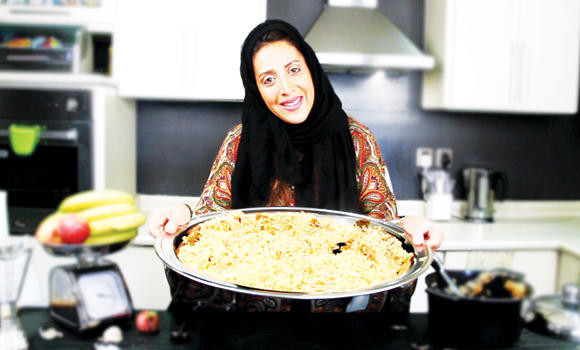
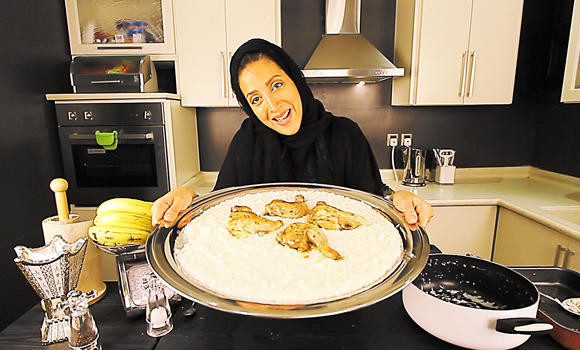
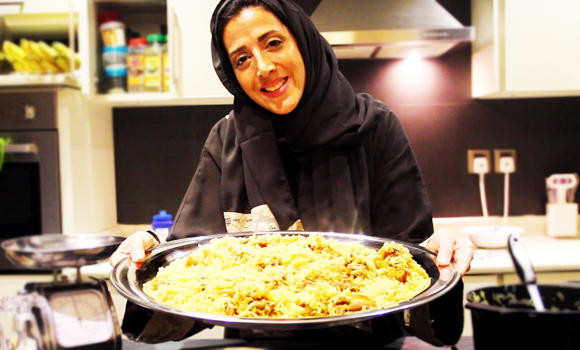
To most outsiders, Saudi food remains a mystery by and large, even in a time when there is no dearth of food bloggers and Buzzfeed videos showcasing recipes from far and wide places. Be it Korea’s Kimchi or Brazil’s Brigadeiros, if you are armed with a phone or a tablet, you are good to go to the kitchen. However, traditional Saudi food has evaded such spotlight for long. The closest you get online is a non-Saudi chef creating his or her own version of ‘Kabsa’ or ‘Sambusa’. Enter Eman Gazzaz, the only English-speaking Saudi blogger with a popular YouTube channel ‘Saudi Food with Eman’ where she dishes out some authentic Saudi recipes in easy to follow videos.
Eman has a great personality and her recipes are simple. She has been around since 2012, and her 17 videos so far have garnered around12,500 subscribers and a total of 948,336 views. From the traditional Saleeg to the Saudi sand cake, she’s got it all covered.
Arab News interviewed the chirpy food blogger to find out more about her food feats.
Who is Eman?
My full name is Eman Gazzaz and I am a 38-year-old Saudi woman currently living in Riyadh. I was born in Brazil, and have lived in around six different countries throughout my life. The countries I lived in were Brazil, Philippines, Ghana, Algeria, Morocco and Pakistan. I majored in Human Resource Development from Al-Akhawayn University in Morocco. I lived abroad all my life and came back to Saudi Arabia almost 10 years ago for the first time in my life.
How and when did you think of starting a YouTube channel?
I started my YouTube channel back in 2012 when a friend of mine, Alia, from Morocco visited Jeddah, and she happened to have a cooking channel. During her visit, Alia filmed three Saudi dishes with me (Saleeg, Sambusa, Shakshoka), and it was a hit when she uploaded them. Now some videos have over a million views. Before she traveled back home, she convinced me to start the same concept, where I introduce the Saudi culture to the world, since very little is known about it. I saw it as an opportunity to do something for my country and I grabbed it. Simply put, my channel aims to explain who Saudi women are, how they dress, what they really eat on a daily basis, and that they are are educated and intellectual. All this in the end, represents our culture.
What is the secret of your expertise in Saudi food?
I have always had love for the kitchen and wondered how to get the most balanced flavors. I enjoy and aspire to always find the perfect taste. Majority of my cooking before getting married in 2008 was focused on Asian, American and European cuisines. After I got married, I began missing home food, and started learning Saudi recipes from my parents, which they used to make at home all the time.
How was the response when you first started the channel? How is the feedback now?
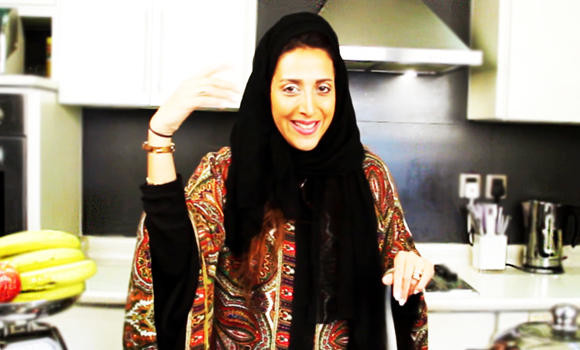
When I first started in 2012, there was a big response, and many people were amazed that a Saudi woman was showing her face on camera. Some questioned if I was even a Saudi. I focused on wearing our abaya as part of introducing the Saudi culture and I wore the Hijab in different ways to show that we have style. Now, many people love the idea that a Saudi female is teaching foreigners her culture through a YouTube channel.
How do you deal with negative comments?
My aim is much bigger than the negative comments I get. In the end, I know I am creating something that will positively change what people think about Saudis and how we are all beings with just different nationalities. I hope that through my channel I can change people’s perceptions, even if the change is minor. I feel satisfied to know that I have positively impacted people.
Is yours the only Saudi recipe channel in English language?
Yes. When I first started, I searched for the same concept, of a Saudi woman cooking Saudi food in English but I couldn’t find any. Today, there is still no other channel like mine.
Which is your favorite dish and why?
My favorite dish is Saleeg because it brings back lots of memories as a child and I love the flavor. It’s comfort food for me.
Are you a full-time YouTuber? If not, what do you do other than that?
No, I’m not. I do the channel as a side hobby. I work in a bank as an HR project manager.
How do you time your videos?
I try to make one video every week or two, depends on how busy I am.
What are your hobbies?
I love to paint, fix things, watch Food Network and learn new things.
Tell us something about your family.
I am married with three kids, Fahad (8 years), Faisal (6 years), and Warda (2 years). My family is like the Greek family, where all our weekly gatherings are centered around lots of food and laughter. My parents live in Jeddah, we originally come from Makkah. Two of my sisters and their families are in the food business as well. One of them started Kufta Gourmet (high-end burgers and barbecue) and the other one started Naqaniq (homemade hotdog). My dad is a unique man who loves to collect antique cars, collect old pocket watches, loves gardening, loves cooking, and adores his children and 26 nieces/nephews. My mom is a strong, genuine woman, loves to help the needy, thinks of others before herself, and anyone who meets her sees her as their own mother.
The trend of food vlogs dedicated to just one type of cuisine has long faded. Do you see yourself diversifying your recipes?
I will take it step by step, and see where this path takes me. My Saudi Food with Eman channel will always be there. However, since I do have a love for the kitchen, I might start other YouTube channels where I cook my own fusion dishes. However, I don’t want it to be another food channel, it should be unique. I’m just waiting for the next great idea.
Do you make money from YouTube views? If not, do you plan to go more aggressive on your channel to gain more viewers and expand on other social media?
I got into the other social media arena five months ago where I created my Facebook, Instagram and Twitter accounts. Only a few months ago, I monetized my YouTube channel, meaning I started getting paid for it. The reason for doing so is because my channel will be advertised next to other similar channels. This will help boost the engagement and subscribers. I didn’t do it for the money.
So if you’ve wanted to impress your friends and family with authentic local specialities, tune in to Saudi Food with Eman on YouTube and enjoy Eman’s easy step-by-step guides.
—
Email: [email protected]


Saudi YouTube chef finds recipe to success

Saudi YouTube chef finds recipe to success

Where We Are Going Today: Orient Restaurant
- The grilled seabass was simple but cleanly prepared, with a subtle saffron emulsion that didn’t overpower the fish
Orient Restaurant at Rixos Obhur Resort & Villas brings a new dining perspective to the city, drawing on Turkiye’s culinary heritage and the history of the Silk Road.
The concept is evident from the moment guests enter the restaurant, where traditional Turkish flavors are presented with a contemporary touch, and the ambiance reflects the region’s history of trade and cultural exchange.
The menu is broad, featuring cold starters such as haydari, strained yogurt with herbs, and babaganus, smoked aubergine with tahini and olive oil. These dishes are straightforward and well-prepared, with fresh flavors and a clear attention to balance.
For the hot starters, we tried items like halloumi with pomegranate molasses and fried calamari with garlic aioli, which felt original and consistent with the cold dishes in preparation. Some items, however, such as the spiced beef borek, can feel heavy if ordered in multiple quantities.
For the main courses, I tried a range of meats and seafood. The testi kebabi — a clay-pot lamb stew with apricot and thyme — was carefully cooked, with the lamb tender and well-flavored.
The grilled seabass was simple but cleanly prepared, with a subtle saffron emulsion that didn’t overpower the fish.
I also ordered the ali nazik and kuzu sis, both of which were nicely seasoned and had good texture, though the adana kebab was less flavorful than I expected and could have used more spice.
The side dishes were straightforward. We opted for the bulgur pilaf and butter rice to accompany the mains, though they didn’t particularly add anything to the meal.
After finishing the savory dishes, although we were full, we decided to try the desserts. We went with baklava, kunefe, and sutlac, all executed consistently, though they offered few surprises in flavor or presentation.
This is a good place to celebrate a special occasion with its fine-dining setting or simply spend some quality time, enjoying cocktails or traditional Turkish coffee.


