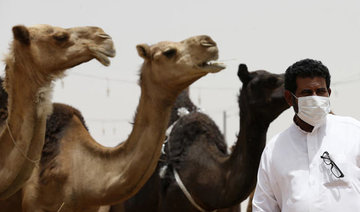
MADINAH: The Ministry of Health has reiterated that the ban on slaughtering camels during Haj would remain in place, with no exceptions, because of the danger posed by Middle East Respiratory Syndrome (MERS) coronavirus.
Faisal Al-Zahrani, spokesman of the ministry, said the ban covers the entire Kingdom during Eid Al-Adha. It also includes the Burmese community in Makkah, whose members traditionally sacrifice camels. They would now have to use lambs, he was quoted as saying by a local publication.
He said the Grand Mufti Sheikh Abdul Aziz Al-Asheikh had issued an edict instituting the ban to protect pilgrims. The fatwa states that people can use cows or sheep.
Abdulrahman Abdulkarim, an official at the Reconciliation Council at the Mount of Ohod in Madinah, said the Burmese community collects money to buy camels every year, with people sharing the meat of the animal.
He said that he has not received any official confirmation of the ban. However, several camel merchants have stopped buying camels and purchased sheep and cows because of the MERS virus, he said.
Camels have been identified as carriers of the MERS virus, which has infected 1,225 people in the kingdom since June 2012 when tit was first discovered by scientists.
Of the total, 521 victims have died, 633 have recovered and 71 are still under treatment, including 16 new cases in the past four days.
The Ministry of Agriculture earlier said that 3.3 percent, or 7,700 out of the 233,000 camels in the Kingdom, are infected with MERS virus.


Camel slaughter during Haj banned

Camel slaughter during Haj banned

Winter at Tantora Festival returns to AlUla, showcasing rich cultural heritage
- Festival now established as a premier annual event
AlUla: The Winter at Tantora Festival launched on Thursday in AlUla. It runs until Jan. 10 and presents a cultural season which celebrates the region’s rich civilizational, cultural, and historic legacy.
The festival’s program includes a wide array of cultural, artistic, and traditional activities, reported the Saudi Press Agency.
Attractions include Old Town Nights, Shorfat Tantora, When Shadow Tracks Us, and the Al-Manshiyah Carnival.
FASTFACT
In the past, AlUla’s inhabitants used this clock to measure time and coordinate their agricultural activities.
In addition, there are guided tours of street art through the Old Town, special events commemorating the Year of Handicrafts, culinary experiences, and artistic and musical performances.
The festival derives its name from the Tantora, an ancient sundial situated in the Old Town’s center. In the past, AlUla’s inhabitants used this clock to measure time and coordinate their agricultural activities. The modern festival honors this tradition by marking the onset of winter and the start of the planting season.
This year’s edition offers a range of experiences to celebrate heritage, genuine local culture, and traditional craftsmanship.
As part of AlUla Moments, the Winter at Tantora Festival supports efforts to boost cultural and tourist engagement while enhancing the visitor experience.
The initiative reflects Saudi Vision 2030’s commitment to advancing cultural tourism and promoting the Kingdom’s historic landmarks.
The festival has established itself as one of AlUla’s premier annual events, consistently attracting both domestic and international audiences.


