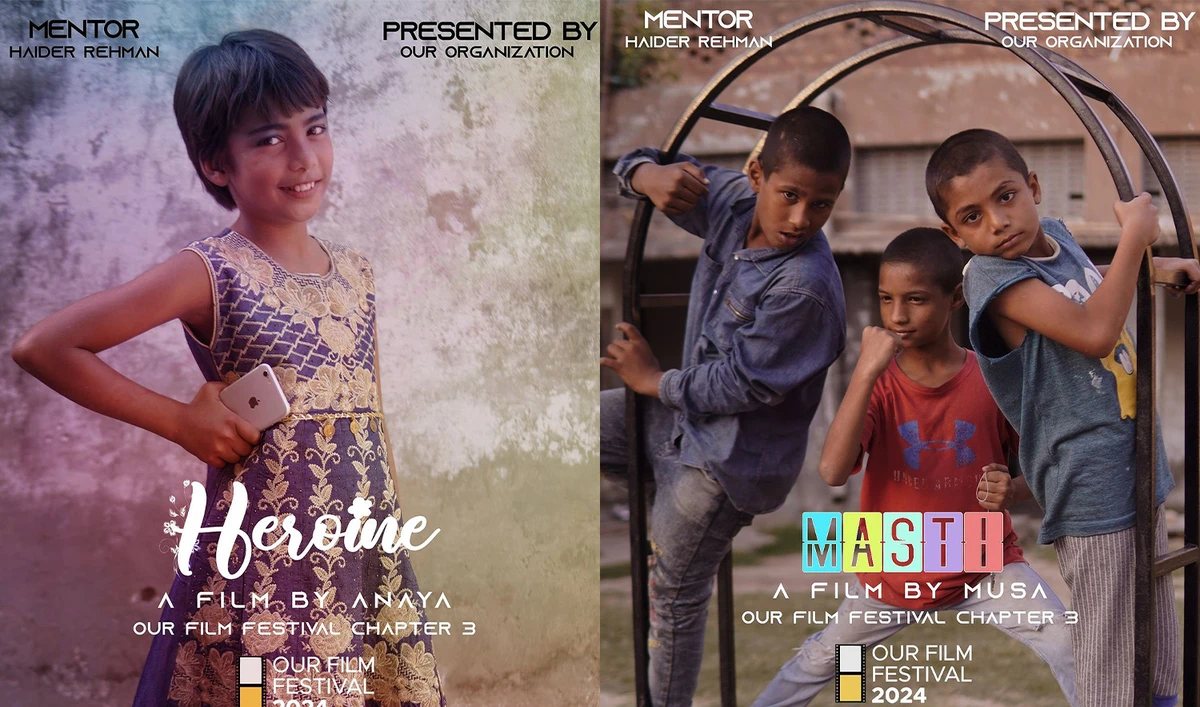
- NGO holds film festival in Lahore showcasing works of underprivileged children and orphans as actors and directors
- Short films centered around compelling themes of poverty, disability, minorities’ problems and future aspirations
LAHORE: Uzair Mohsin, the nine-year-old son of a street vendor, was ecstatic when the audience broke out in applause after his short film ended. The appreciation from the crowd was encouraging for Mohsin, whose compelling short film inspired viewers despite the limited financial resources at his disposal.
“Our Organization,” a Lahore-based non-governmental organization, hosted a film festival for underprivileged children on Saturday, Oct. 26. Short films featuring children from southern Lahore’s slum areas and orphanages, and children with disabilities, were screened. Many of these children could neither read nor write, but the festival empowered them enough to tell their stories as actors and directors.
“Our Film Festival,” whose third edition was held at Lahore’s HUFC Club in Valencia Town, is the brainchild of social worker and filmmaker Ribqa Raza Malik. The festival started in 2020 and relies on volunteers and donations to highlight the works of underprivileged children. Its short films were centered around riveting themes such as poverty, disability, conundrums minorities face in Pakistan, neighborhood bullying, losing a parent and future aspirations. The festival screened short films from children under three broad categories: impoverished children, orphans and children with disabilities. It is organized by volunteers, all of them Malik’s own present or past students from private universities where she teaches.
A resident of Lahore’s Satto Katla neighborhood, an unplanned peri-urban settlement that mostly comprises slums, Mohsin chose to create a short film about his visually impaired uncle.
“The film is called Geet [song]. It’s about my chachu [father’s younger brother], his name is Shamoon and he’s blind,” Mohsin told Arab News, “[He] likes to sing. I picked up the camera and shot him singing. This was the first time I picked up a camera and I really enjoyed it.”
Mohsin said Shamoon stopped singing after he lost his eyesight due to a degenerative condition, adding that the family could not afford his treatment. Mohsin, a Christian, said his uncle stopped singing at St. Mark’s Church as well.
“He used to play the Tabla really well,” Mohsin explained, referring to a hand drum popular in South Asia. “If he didn’t have that, he would start playing on kitchen utensils. If he couldn’t sleep at night he’d start playing a beat on metal machines [lying around].”
The short film also stars Mohsin’s older brother, who can be seen dancing in one scene.
Malik, who teaches filmmaking at private colleges, said she started the festival after finding it unfair that visual storytelling through films was accessible only to students enrolled in expensive educational institutions.
“A lot of [these kids] have never even left their homes, who have never held a pencil,” she told Arab News.
“We give them a camera.”
Malik said she wanted to give an opportunity to as many children from underprivileged backgrounds as possible to showcase their talents.
“Uzair is my little champion,” she said. “He’s seen a lot of hardship in his life but he takes to the camera really well, his handling was really good, you can see the love he has for his uncle.”
Haider Rehman, a 21-year-old volunteer studying film and TV at the University of Lahore where he also teaches, mentored six junior filmmakers for the festival.
Rehman said he mentored kids from orphanages, saying it was not easy to teach people not familiar with video production equipment. However, he said it was “unbelievable” how the children expressed themselves creatively.
“And it was so much fun working with them,” Rehman said. “Yes we lost a lot of sleep but the work that they’ve done, I’m really, really proud of them.”
Sara Babar, 14, made a film about her late father, who was a police officer. Her mother died when she was an infant.
“He passed away so I always had this in my mind that I should honor his legacy,” Babar told Arab News. “Before this I had never held a camera. I had seen them but never did any shooting. So this is my first experience.”
The film featured another orphan as an adult policeman who goes about his daily life, sometimes to comic relief when rounding up criminals.
Malik hoped the exercise would help the children heal from their traumas, in addition to teaching them new skills.
“Storytelling is often therapeutic, film is no different,” he said. “You can see that in the stories these children chose to tell.”
Buoyed by the response his film got, Mohsin thanked the volunteers for teaching him filmmaking skills. Despite his limited financial resources, Mohsin hoped he could continue to learn filmmaking via similar opportunities.
“I’ll keep working like this and someday I’ll be important too,” he said. “I’ll be the big man.”