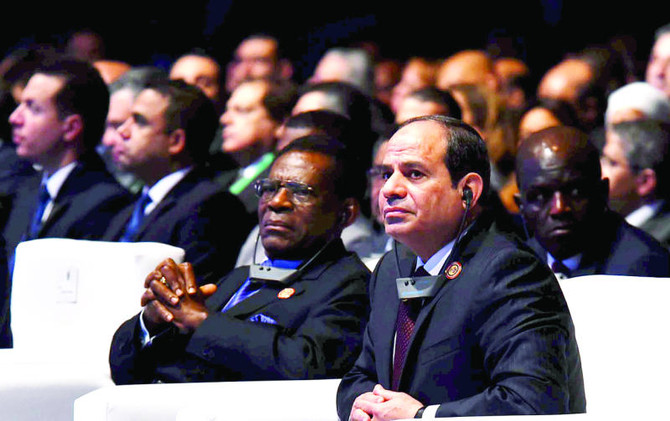
SHARM EL SHEIKH: African leaders and bankers turned out at an economic summit in Egypt, vowing to push for trade and investments on the continent despite growing security concerns in the region.
More than 1,200 delegates including some heads of state aim to sign business agreements during the next two days at the Red Sea resort of Sharm El-Sheikh, to attract private sector investments in Africa.
Organizers hope the “Africa 2016” conference can build on a 26-nation free trade pact signed last year to create a common market on half the continent.
Analysts say that despite the continent’s economic growth rate of more than four percent, Africa still accounts for about only two percent of global trade.
The forum was aimed at “pushing forward trade and investment in our continent to strengthen Africa’s place in the world economy,” Egyptian President Abdel Fattah El-Sisi said in his opening remarks at the conference.
“It not only aims to present investment opportunities that Africa offers to the international business community... but aims to pave the way for active decisions, communication and cooperation.”
Organizers are also seeking to turn the spotlight on Egypt as its economy remains sluggish after years of political turmoil following the ouster of longtime autocrat Hosni Mubarak in early 2011.
Heavily dependent on tourism, Egypt’s economy was dealt a body blow when a Russian airliner broke up mid-air on October 31, minutes after taking off from Sharm el-Sheikh.
All 224 people on board, mostly Russian tourists, were killed when the plane blew up over the Sinai Peninsula. The Daesh group said it brought down the jet with a bomb on board.
Egypt says it still has no evidence that a bomb downed the plane, although Moscow has acknowledged that a “terrorist attack” caused the disaster.
“Africa 2016 forum is expected to position Egypt as a gateway for foreign investments into African markets,” Omar Ben Yedder, member of the organizing committee, said.
Those attending the summit organized by Egypt and the African Union include the presidents of Sudan, Nigeria, Togo, and Gabon, and dozens of ministers and senior officials from Africa involved in trade and investment.
Nigerian President Muhammadu Buhari said that growing security concerns in Africa were absorbing huge resources.
“The new problem affecting investments is international terrorism... lot of resources that could be used for development are being diverted to address security issues,” Buhari said.
Nigeria, Africa’s largest economy, is fighting a brutal insurgency launched by Boko Haram since 2009.
Boko Haram, which seeks a hard-line state in northern Nigeria, has killed some 17,000 people and forced more than 2.6 million others to flee their homes since the start of the insurgency.
Bankers however say the continent remains a growth story.
“We plan to invest 12 billion dollars in the energy sector over the next five years... so that people in Africa can have universal access to electricity,” said Africa Development Bank President Akinwumi Adesina.
Africa still has 645 million people without access to electricity, he said, and the only way to address the issue is to widen private sector participation in the energy sector.
The economy is projected to grow at a rate of 4.4 percent this year and five percent in 2017 as against three percent growth expected in developed countries, he said.
“Africa is doing well despite the challenges it is facing,” Adesina said.

African leaders push for investments at summit
Dubai Financial Market reports $288.6m profit for 2025 - up 159%
RIYADH: Dubai Financial Market reported net profit before tax of 1.06 billion dirhams ($288.6 million) in 2025, up 159 percent from a year earlier.
The improved performance was driven by sustained confidence in Dubai’s capital markets and a year of heightened trading activity, with momentum continuing through the fourth quarter.
The results coincided with the exchange marking 25 years since its establishment in 2000, highlighting its evolution into a more globally connected and institutionally active marketplace, according to a report by the Emirates News Agency.
For the full year ending Dec. 31, total consolidated revenues rose to 1.28 billion dirhams, while earnings before interest, tax, depreciation and amortization reached 1.13 billion dirhams, translating into an EBITDA margin of 88 percent.
The results come as Dubai pushes ahead with its D33 agenda to double the emirate’s economy by 2033 and deepen its position as a global financial hub.
The UAE central bank has pointed to solid capital markets momentum and low sovereign risk indicators in 2025, underscoring the confidence backdrop for higher trading activity.
Helal Al-Marri, chairman of DFM, said: “DFM’s performance in 2025 reflects the continued strength of Dubai’s capital markets and the confidence of global investors in the emirate’s economic vision.
“As we mark 25 years since the establishment of DFM, the exchange continues to play a central role within Dubai’s financial ecosystem, supporting transparency, liquidity, and long-term market development in line with the Dubai Economic Agenda D33.”
Fourth-quarter net profit before tax increased to 124.4 million dirhams from 110.6 million dirhams in the same period of 2024, reflecting sustained trading momentum toward year-end.
Market performance remained strong throughout the year, with the DFM General Index rising 17.2 percent and total market capitalization reaching 992 billion dirhams.
Average daily traded value climbed to 692 million dirhams, while total traded value amounted to 174 billion dirhams, marking the highest liquidity levels in more than a decade.
The average daily number of trades rose 31 percent year on year, driven by increased institutional and cross-border activity.
Hamed Ali, CEO of DFM and Nasdaq Dubai, said: “In 2025, DFM continued to build on the progress of recent years, supported by steady trading activity, growing international participation, and ongoing enhancements to our market infrastructure.”
He added: “Our focus throughout the year remained on improving market accessibility, supporting a broad range of investment activity, and ensuring the market continues to operate efficiently for both issuers and investors. As we mark 25 years of DFM, we remain committed to developing the market in line with Dubai’s long-term capital markets ambitions.”
Investor participation broadened further during the year, with 97,394 new participants joining the market, of which 84 percent were foreign.
Foreign investors accounted for 51 percent of total trading value, while institutional investors represented 71 percent of trading activity.
The total investor base reached 1.25 million, reinforcing DFM’s position as a destination for regional and international capital.
Capital-raising activity also expanded DFM’s sectoral footprint.
The exchange hosted Dubai Residential REIT, the region’s first publicly traded residential leasing real estate investment trust, which attracted subscriptions 26 times over and total demand of 56 billion dirhams.
It also saw the secondary public offering of Emirates Integrated Telecommunications Co., alongside the initial public offering of ALEC Holdings, the UAE’s largest construction-sector listing to date, which generated subscriptions of 30 billion dirhams, representing an oversubscription of 21 times.
Innovation and market development remained a focus in 2025, with the launch of a centralized securities lending and borrowing framework and further enhancements to digital platforms, including AI-enabled features on iVestor.
DFM also strengthened its international engagement through global roadshows and partnerships, including a memorandum of understanding with the Taiwan Stock Exchange aimed at supporting cross-border listings and investor outreach.
Looking ahead, the exchange said it remains focused on enhancing liquidity, expanding product offerings, and deepening global connectivity, supported by a strong financial position and a diversified investor base.