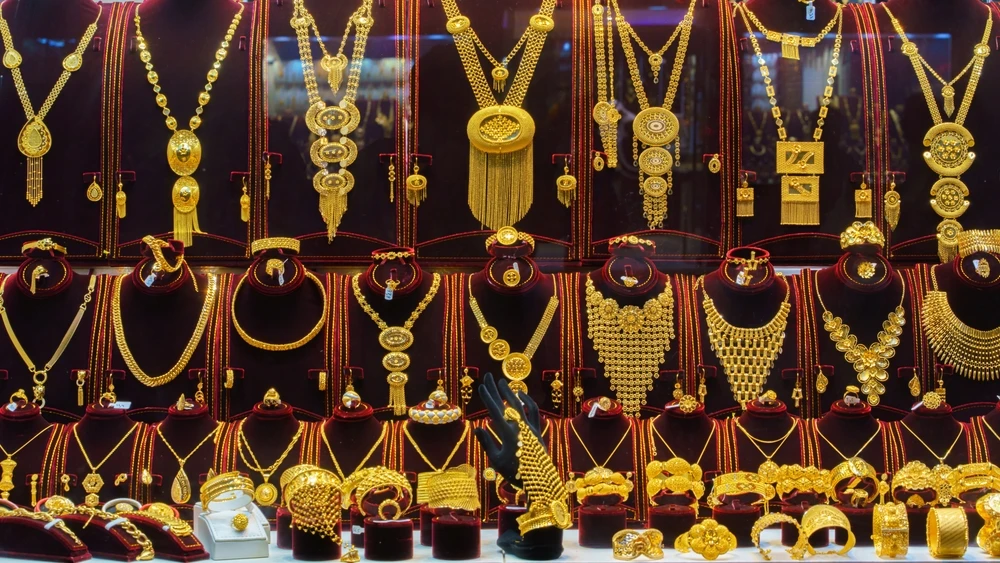
- High gold prices, economic uncertainty, and reduced disposable income have pressured consumers across the region, leading to steep declines in jewelry purchases.
- The UAE and Kuwait both experienced a 29% drop in jewelry demand, while other regional markets faced a 43% decline.
RIYADH: Saudi Arabia remained the Middle East’s largest gold jewelry market in the third quarter of 2026, even as regional demand fell sharply, according to the World Gold Council.
According to the organization's latest Gold Demand Trends report, jewellery purchases in Saudi Arabia fell 12 percent year on year to 8.2 tonnes in the third quarter, down from 9.3 tonnes in the same period of 2025.
Middle East demand slid 22 percent to 26.2 tonnes from 33.4 tonnes a year earlier.
The regional decline in demand across the sector comes amid a period of elevated prices and economic uncertainty, as higher purchasing costs weigh on consumers’ discretionary spending.
Although Saudi Arabia has not been immune to these pressures, its comparatively smaller annual decline has strengthened its position as the region’s largest jewellery market, highlighting the resilience of demand relative to neighbouring markets.
“High gold prices, pressure on household purchasing power and continuing geopolitical uncertainty, notable in anaemic tourist numbers, combined to constrain discretionary purchases across the region,” the report said.
Regional peers
The UAE recorded one of the region’s steepest declines, with jewellery demand falling 29 percent year on year to 4.5 tonnes, from 6.4 tonnes.
Kuwait saw a similar 29 percent drop, with demand reaching 1.7 tonnes, while other Middle East markets recorded a 43 percent decline to 2.5 tonnes.
Egypt’s demand fell 12 percent to 3.8 tonnes, in line with the Saudi rate but in a very different context, as reduced subsidies, persistent inflation and exceptionally high interest rates squeezed household finances.
Neighboring Turkiye, by comparison, proved relatively resilient, with demand slipping just 4 percent to 7 tonnes.
Cushioning effect
“The gap between those two figures is the story: Saudi Arabia declined by roughly half as much as the region overall,” Aseel Al-Aranki, head of financial market analysis at CG Invest, told Arab News.
She noted the Kingdom’s share of regional demand rose to about 31 percent from 28 percent, and that it accounted for only around 1 tonne of the roughly 7-tonne regional drop.
“The relative stability of the largest market therefore helped cushion the overall regional figure,” she said.
Quarterly trend
Al-Aranki highlighted Saudi demand fell 20 percent from 10.3 tonnes in the second quarter, after 12.7 tonnes in the first.
“The relative resilience is therefore a year-on-year story and does not indicate that the market is recovering,” she said.
Investment holds
Saudi bar and coin demand fell 9 percent to 4.1 tonnes amid profit-taking, as investors eyed September’s interest rate hike, the first since 2023. Regional investment demand fell 24 percent.
In July, Andrew Naylor, the council’s head of Middle East and public policy, told Arab News the Kingdom was poised to outperform regional peers, helped by a shift toward investment.
Global picture
Worldwide, jewelry consumption fell 17 percent to 313 tonnes, its weakest third quarter since records began in 2000 and the 13th straight quarterly decline. Value rose 2 percent to $43 billion as gold averaged $4,262 an ounce, up 23 percent.
Price-dependent outlook
The council expects global jewelry demand to fall again year on year in the fourth quarter, as elevated prices continue to weigh on volumes.
Al-Aranki said a meaningful recovery likely depends on prices easing or consumers fully adjusting.
“Until then, a pattern of smaller purchases and lower tonnage, even where spending holds up, is the most likely scenario,” she said.