With the advent of social media, changing socio-economic situations and modernization, the art scene has evolved and changed dramatically all over the Arabian Peninsula in the past few years. A large number of bold, young artists have emerged confidently all over the region.
Their art reflects modern ideas, themes and mediums. Artists now provoke discussions and debates through their work. Like any other art scene in the western world, gender issues, identity crisis, freedom, and space are all now part of the modern Arab art scene.
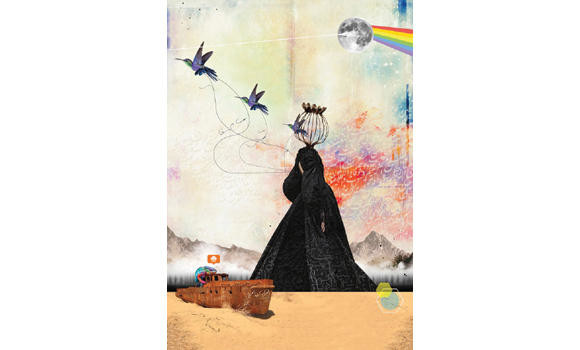
While some artists are still sticking to their old roots of calligraphy and sculpture, other modern Arab artists now use mixed mediums like ink work on paper and archival paper, Gouache technique, print on aluminum and even on wooden decks to create their masterpieces. But to showcase and display their talent and art, there is always a need for a platform where creative people can come, discuss and get encouragement.
Art enthusiasts living in Alkhobar and Dammam are familiar with the name ‘Desert Designs.’ Situated on the brink of Dhahran Street, it offers a huge variety of local antiques, handicrafts and handmade furniture. Established in 1990, it is also a place for local artisans and other talented people to display and sell their products. On their second floor, there is a coffee shop where you can sit and enjoy your latte or mocha in an exceptionally creative and artistic environment.
The owners of Desert Design in collaboration with Loud Art and Le Meridien hotels arranged an art exhibition on Thursday last week in their showroom.
Raneen Bukhari, the co-founder of Loud Art, said during the reception held at Le Meridien, Alkhobar on Wednesday: “We are extremely proud and grateful to announce that Loud Art is registered now as a separate entity after all the support we have received throughout the past three years and are absolutely delighted to have partnered with Le Meridien this year.”
Le Meridien’s General Manager Han De Windt said: “Le Meridien has created unique partnerships to provide guests with access to contemporary cultural centers around the world. Explore and inspire cultural experiences by presenting the Unlock Art pass found in our rooms.”
He said Le Meridien Alkhobar has chosen to sponsor Loud Art exhibition this year as it is one of the “most successful exhibitions in the region that supports and promotes new regional talents.”
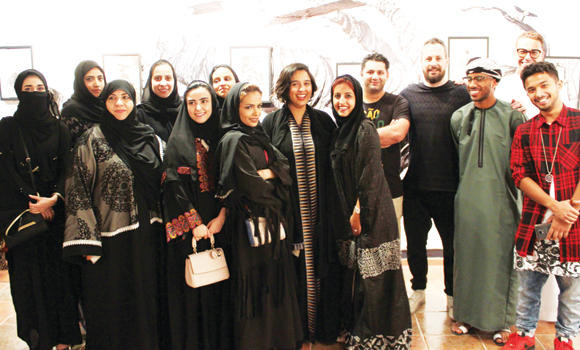
The idea behind such exhibitions is to promote local artists and to revive old techniques of art with new ideas. Reinterpreting Contemporary exhibition was attended by local Arab elites, media people, young university and college students and art collectors who would pay any price for a worthy piece.
On the second floor of Desert Designs’ showroom, the impact of visual art on architecture, photography, film and art was beautifully displayed. The ambience was bright with people mingling and discussing each painting or photograph with its creator who explained every piece in detail and the idea behind it.
Ali Chaa’ban, Yusef Al-Ahmed, Khaled Zahid and Iftikhar Ali were the main highlights.
Ali Iftikhar, a young Pakistani architect born and raised in Saudi Arabia, explained his technique of tilt photography. His photos of Madinah’s street markets and a Pakistani truck crossing a river stream caught the eye of everyone.
Hussain Ismail’s ink on paper technique prints of shopping mania and the traffic chaos in Saudi Arabia were something every Arab female and male could relate to.
Moath Alofi’s photographs of graffiti on walls attracted many.
Mohammad Laban’s depiction of Passion on stencil showed a man in white and a woman in black, the typical Arab culture staples.
Mohammad Awad’s Giclee print and pigment ink work explained how media propaganda has entered every home and mind.
Mohammad Al-Hemd showed the new Middle East through his ink jet print on wood of a shemagh. He highlighted its importance not only in the Arab world but also in the West. How it united the Arabs globally and became symbolic in the early 2000s is known to everyone.
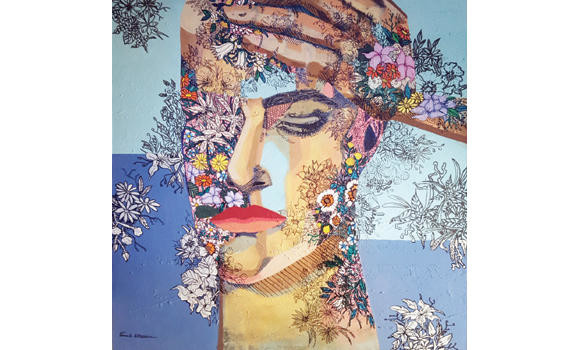
Najla Abdullah’s Distance was in bright acrylic on canvas. It reminded many of Mona Lisa.
Noorah Kareem’s Unpolished Portraits in mixed media done on sticky notes caught the eye of many young students.
Naïf Arab’s spray paint done on a guitar was modern and creative.
Yusuf Ahmad’s Palindrome printed on heavy weight archival paper was sublime.
Ramlaa Al-Halal’s print on aluminum called ‘The Godfather’ was based on the trend of playstation and other computer games, which have left the young generation glued to their screens and unaware of old local legends. She explained sadly that our new generation remembers all the names of western football players and celebrities but none of their own old legendary Arab football players and actors.
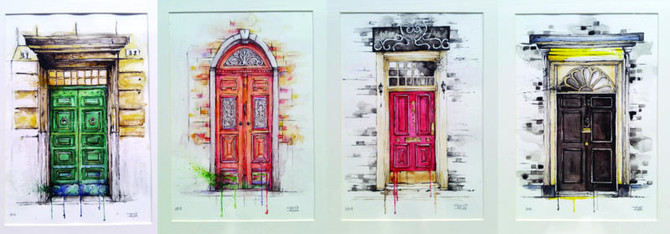
Khadija Kareem’s series on ‘Doors’ was brilliantly done in water colors. Her series of Andalucía patterns painted in vibrant water colors brought life to the wall they were displayed on.
Loud Art and Le Meridien’s efforts to bring many local talented artists under one roof are commendable. The event was well-organized.
According to Raneen, Loud Art intends to extend their annual art exhibitions to Jeddah and Riyadh in the coming months.
—
Email: [email protected]


Revisiting art in the Arab world


Revisiting art in the Arab world

Cairo book fair breaks visitor records
- Strong Saudi participation underscores KSA’s prominent role in Arab cultural landscape
- Egyptian writer Naguib Mahfouz, who was awarded the Nobel Prize in Literature in 1988, was selected as the fair’s featured personality
CAIRO: The 57th edition of the Cairo International Book Fair has attracted record public attendance, with the number of visits reaching nearly 6 million, up from a reported 5.5 million previously.
Egypt’s Minister of Culture Ahmed Fouad Hanou said: “This strong turnout reflects the public’s eagerness across all age groups to engage with the exhibition’s diverse cultural and intellectual offerings.”
Hanou said the event included “literary and intellectual activities, meetings with thinkers and creative figures, and thousands of titles spanning various fields of knowledge.”
The Egyptian writer Naguib Mahfouz, who was awarded the Nobel Prize in Literature in 1988, was selected as the fair’s featured personality, coinciding with the 20th anniversary of his death.
The exhibition’s official poster features a famous quote by Mahfouz: “Who stops reading for an hour falls centuries behind.”
A total of 1,457 publishing houses from 83 countries participated in the fair. Mahfouz’s novels occupied a special place, as Egypt’s Diwan Library showcased the author’s complete works, about 54 books.
“The pavilion of the Egyptian National Library and Archives witnessed exceptionally high attendance throughout the fair, showcasing a collection of rare and significant books.
Among the highlights was the book “Mosques of Egypt” in Arabic and English, Dr. Sherif Saleh, head of financial and administrative affairs at the Egyptian National Library and Archives, told Arab News.
The fair ended on Tuesday with a closing ceremony that featured a cultural performance titled “Here is Cairo.”
The event included the announcement of the winners of the fair’s awards, as well as the recipient of the Naguib Mahfouz Award for Arabic Fiction.
Organizers described this year’s edition as having a celebratory and cultural character, bringing together literature, art, and cinema.
Romania was the guest of honor this year, coinciding with the 120th anniversary of Egyptian-Romanian relations.
At the Saudi pavilion, visitors were welcomed with traditional coffee. It showcased diverse aspects of Saudi culture, offering a rich experience of the Kingdom’s heritage and creativity.
There was significant participation from Saudi Arabia at the event, highlighting the Kingdom’s prominent role in the Arab cultural arena.
Saudi Arabia’s participation aimed to showcase its literary and intellectual output, in alignment with the objectives of Vision 2030.
The Kingdom’s delegation was led by Saudi Arabia’s Ambassador to Egypt Saleh bin Eid Al-Hussaini. Also in attendance were Dr. Abdul Latif Abdulaziz Al-Wasel, CEO of the Literature, Publishing and Translation Commission, and Dr. Hilah Al-Khalaf, the commission’s director-general.
The King Abdulaziz Public Library placed the Encyclopedia of Saudi Arabia in a prominent position at the pavilion. The encyclopedia, consisting of 20 volumes, is organized according to the Kingdom’s culturally diverse regions.
Founded in 1980 by King Abdullah, the library was established to facilitate access to knowledge and preserve heritage collections. Over the years, it has grown into one of the Kingdom’s most important cultural institutions.
Internationally, the library has strengthened ties between Saudi Arabia and China, including the opening of a branch at Peking University and receiving the Crown Prince Mohammed bin Salman Award for Cultural Cooperation between the two nations.
Regionally, the library has played a pivotal role in the Arab world through the creation of the Unified Arabic Cataloging Project, one of the most important initiatives contributing to knowledge accessibility and alignment with global standards.