- Marco Rubio urges G20 to tackle geopolitical crises.
- European officials object to photo with Sergei Lavrov.
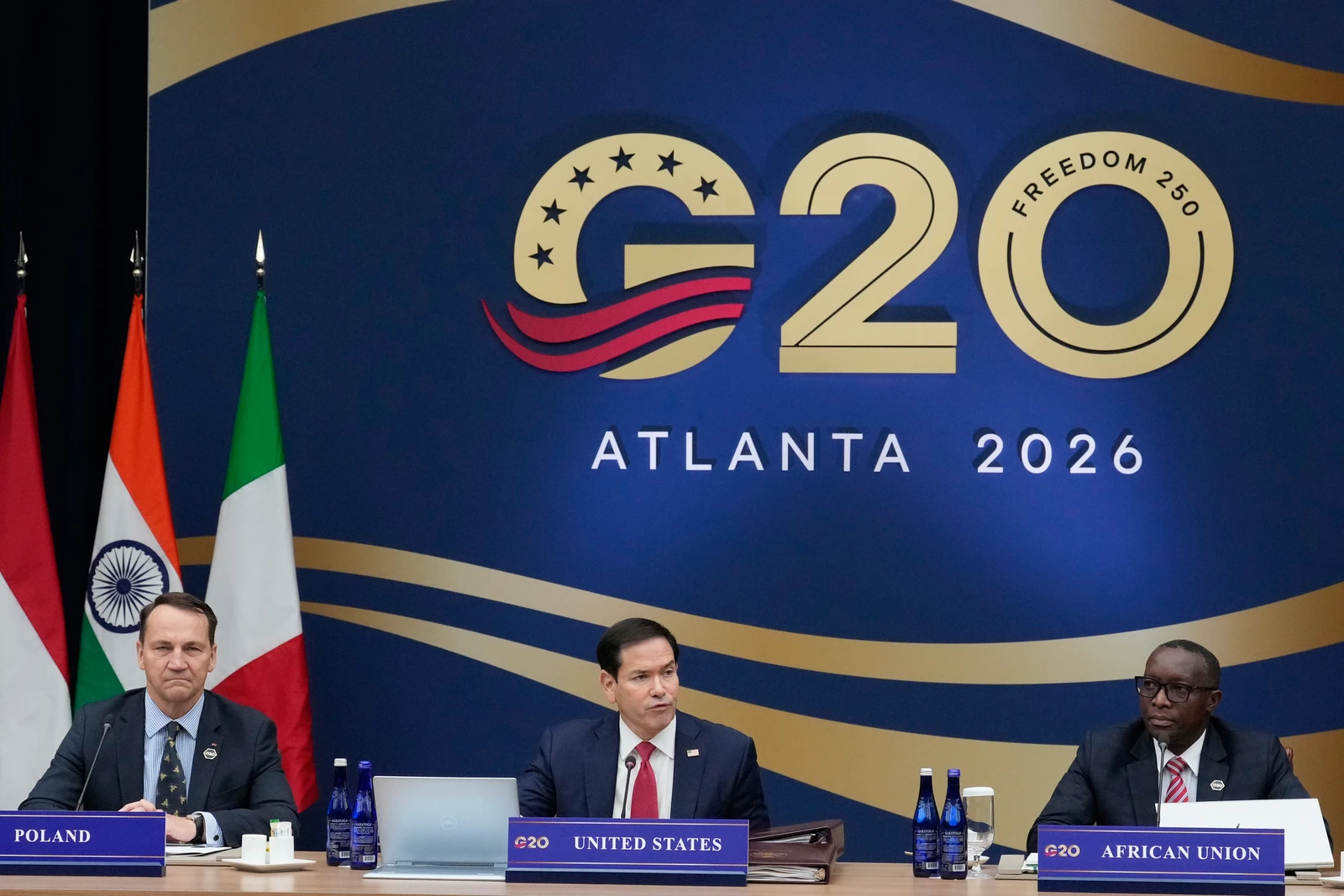
ATLANTA: US Secretary of State Marco Rubio on Friday told G20 counterparts including Russia’s Sergei Lavrov that the world faces a decisive moment to tackle geopolitical crises, as wars in Ukraine and on Iran deepen rifts between member countries.
Already, a traditional group photo planned for Friday morning was called off shortly before the two-day meeting started, as some European officials objected to appearing alongside Lavrov, a diplomatic source told AFP.
European leaders have opted not to appear in photos with Russian delegations in earlier G20 meetings this year too, as fighting continues after Russia’s 2022 invasion of Ukraine.
A US official said the photo was canceled due to the controversy and to avoid allowing “a ceremonial photo opportunity to become a diplomatic distraction.”
The foreign ministers’ gathering in Atlanta, Georgia, taking place just days before US midterm elections, also comes as global energy prices have rocketed since the US war on Iran.
It sets the stage for a December G20 leaders’ summit in Miami at President Donald Trump’s Doral resort.
But even as the United States seeks to focus on economic growth, trade imbalances and supply chain challenges — covering areas like energy and critical minerals — few breakthroughs are expected.
A diplomatic source said that instead of a final declaration, this week’s meeting will likely conclude with a chair summary drafted by the United States.
Rubio told an opening plenary Friday that the world faces a critical “moment of choosing” as it grapples with “interconnected economic and geopolitical crises.”
He urged the Group of 20 economies — which include China, India, Russia, Japan, Germany and France — to work together against threats like strains on global energy and food supply chains, and on freedom of navigation.
‘No normality’
Russia has been shunned by most of the West after its 2022 invasion, and Lavrov himself remains under international sanctions.
German Foreign Minister Johann Wadephul told German media ahead of the Atlanta meeting that “there is no normality with Russia.”
“We have to exchange our differences of opinion here at the table,” he said.
“But we must not send out any misleading visual signals,” he added on Europeans’ objections to a photo with Lavrov.
“Today, in this forum, I will once again call on Russia to finally accept Ukraine’s offer of a ceasefire, starting in the Black Sea,” said Wadephul.
Rubio’s encounter with Lavrov — whose presence adds an additional layer of tension — will be closely watched as Washington pursues diplomacy on Ukraine while seeking Moscow’s cooperation on reining in fuel prices, a key campaign issue in the midterms.
His US appearance comes ahead of fresh negotiations between Moscow, Kyiv and Washington in November.
Analysts say his presence is not surprising, however, as Washington has welcomed Russian officials to this year’s G20 events, while excluding member South Africa.
Trump has invited his Russian counterpart Vladimir Putin to Miami in December too and eased some sanctions on Moscow while touting a deal for Russia to sell diesel as prices soared, squeezing Americans.
Threat of escalation
Another issue key to the US agenda is freedom of navigation. A US State Department official flagged “shared resolve to confront urgent crises and keep critical sea lanes open to commerce without threats or tolls.”
Global energy prices have rocketed since US-Israel strikes on Iran from late February triggered Tehran’s blockage of the Strait of Hormuz.
The waterway is crucial to the global transit of oil, gas and fertilizers.
Alisha Chhangani of the Atlantic Council expects Washington will push for agreement on what “freedom of navigation” means within and beyond Hormuz.
But this could face objections from China, which dissented against wording on free navigation in Hormuz and worldwide at an earlier gathering of finance ministers.
China’s top diplomat Wang Yi did not travel to Atlanta, instead sending his deputy.
The possibility of further escalation in the Middle East is also mounting, with Trump signalling he could attack after Tuesday’s midterm elections.