WASHINGTON: If you thought Mitt Romney was the only presidential candidate whose problems were piling up in the final stretch of the 2012 election campaign, think again.
From Middle East upheaval to the troubled Afghan war effort to a more assertive Russia, President Barack Obama is facing pressures that threaten to chip away at a foreign policy record his aides hoped would be immune to Republican attack.
The White House is increasingly concerned but isn’t hitting the panic button, yet. Administration officials are heartened by Republican challenger Mitt Romney’s own recent foreign policy stumbles and doubt Obama’s critics will gain traction in a campaign focused mainly on the US economy.
As a result, when Obama speaks inside the cavernous UN General Assembly hall on Tuesday exactly six weeks before the US election, he will seek to reassure American voters as well as world leaders he is on top of the latest global challenges. But he won’t propose any new remedies or bold initiatives.
There will be close scrutiny of how far he goes in talking tough about Iran’s nuclear program — but even on that point, aides say privately he will not break new policy ground.
Obama’s final turn on the world stage before facing voters will be a reflection of where his priorities lie. Despite simmering global crises, he will skip traditional private meetings with foreign counterparts and squeeze his UN visit into just 24 hours so he can jump back on the campaign trail.
UN delegates shouldn’t take it personally.
“It’s just that they don’t vote,” said Joseph Cirincione, a foreign policy expert at the Ploughshares Fund, a global security foundation.
But Obama’s relatively low-key UN itinerary will also be a stark reminder that the heady optimism that greeted him when he took office promising to be a transformational statesman has cooled, giving way to geopolitical realities.
Aides insist foreign policy is still an election-year bright spot for Obama. The White House never tires of touting the killing of Osama Bin Laden and the ending of the war in Iraq. But his record appears to have dimmed a bit with a recent run of bad news.
Obama has found himself sharply at odds with Israeli Prime Minister Benjamin Netanyahu over how to curb Iran’s nuclear ambitions, a dispute that sent relations between the two close allies to a new low on the president’s watch.
An eruption of violent unrest against US diplomatic missions across the Muslim world has confronted Obama with his worst setback yet in his efforts to keep the Arab Spring from fueling a new wave of anti-Americanism — and has underscored that he has few good options to deal with it.
NATO’s cutback of joint operations with Afghan forces in response to a spate of deadly “insider” attacks has also raised questions about what will be left behind when, under Obama’s strategy, most US forces depart Afghanistan in 2014.
And Russian President Vladimir Putin’s decision last week to suspend a US aid mission to Moscow threatens what’s left of Obama’s “reset” in relations with Russia, which his aides had touted as a signature foreign policy accomplishment.
At the same time, the Obama administration has shown itself unwilling to intervene to end the bloody crisis in Syria, where President Bashar Assad has defied international calls to step aside and pressed on with efforts to crush an 18-month uprising.
Romney and his campaign aides have pounced on these developments, seeking to support their argument that Obama has weakened America’s global standing by failing to lead.
“It’s symptomatic of failed policy,” said Dan Senor, a Romney adviser who served as a spokesman in Baghdad under President George W. Bush. “Biography and force of personality are nice attributes but not substitutes for leadership.” Obama, whose lofty oratory and vision of multilateral diplomacy helped him win the Nobel Peace Prize after just 11 months in office, is widely credited with improving the tone of US foreign relations after what was perceived as a go-it-alone approach by his predecessor, Bush.
“It’s clear that the United States is in a stronger position than we were when he took office,” White House spokesman Tommy Vietor said in previewing the themes of Obama’s UN speech.
But while polls show Obama remains personally popular in many parts of the world, America’s image is again in decline, especially in the Middle East, the focus of intense personal outreach at the start of the president’s term.
Though it remains unclear how much of a liability the latest crisis will be for Obama at home, his approval rating on foreign policy dropped to 49 percent from 54 percent in August, according to a Wall Street Journal/NBC News poll after attacks on US missions in Egypt, Libya and other Muslim countries.
But Romney may have a hard time reaping political dividends.
A Pew Research Center poll found that while 45 percent of Americans approved of Obama’s handling of the crisis, only 26 percent backed Romney’s criticism of the president’s response. Romney was widely accused of opportunism in a national tragedy.
Obama, at the UN, will address the unrest in Muslim countries fueled by an anti-Islamic film his administration has denounced, and will repeat his message that the United States “will never retreat from the world,” Vietor said.
He will also reassert that Iran must not be allowed to acquire a nuclear weapon. But aides say privately that while he may sharpen his rhetoric, he will stop short of setting a specific “red line” for Tehran as Netanyahu has demanded.
At the same time, Obama will impart an implicit warning that a Romney presidency would pursue a more hawkish foreign policy.
Also unspoken will be the fact that Obama was caught flat-footed by the latest turmoil in Muslim countries.
Though the protests seemed to have subsided in most places for now and Libya even saw a backlash against militiamen, some conservative commentators have conjured up images of the Iran hostage crisis — which helped sink Jimmy Carter’s re-election — should the situation deteriorate.
“If there’s more of it, it drives home a sense that he doesn’t know what he’s doing,” said Elliot Abrams, former deputy national security adviser under Bush. “If there were a few more weeks of it, it would have a political impact.”


Obama foreign policy bright spot now looking dimmer

Obama foreign policy bright spot now looking dimmer
Bangladesh’s Yunus announces resignation, end of interim govt
- Yunus handed over power after congratulating the Bangladesh Nationalist Party and its leader Tarique Rahman
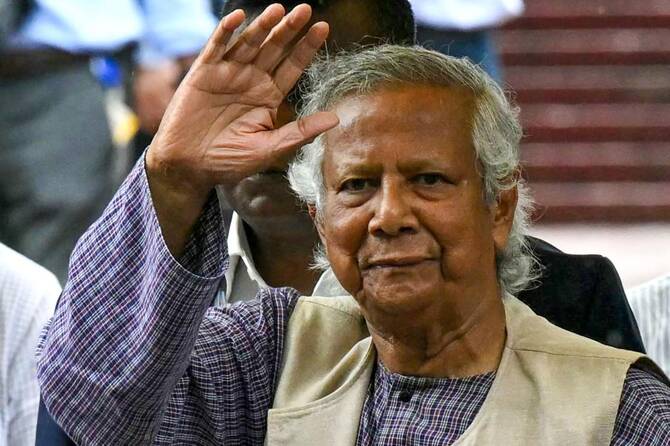
DHAKA: Bangladesh’s interim leader Muhammad Yunus stepped down on Monday in a farewell broadcast to the nation before handing over to an elected government.
“Today, the interim government is stepping down,” the 85-year-old Nobel Peace Prize winner said.
“But let the practice of democracy, freedom of speech, and fundamental rights that has begun not be halted.”
Yunus returned from self-imposed exile in August 2024, days after the iron-fisted government of Sheikh Hasina was overthrown by a student-led uprising and she fled by helicopter to India.
“That was the day of great liberation,” he said. “What a day of joy it was! Bangladeshis across the world shed tears of happiness. The youth of our country freed it from the grip of a demon.”
He has led Bangladesh as its “chief adviser” since, and now hands over power after congratulating the Bangladesh Nationalist Party (BNP) and its leader Tarique Rahman on a “landslide victory” in elections last week.
“The people, voters, political parties, and stakeholder institutions linked to the election have set a commendable example,” Yunus said.
“This election has set a benchmark for future elections.”
Rahman, 60, chief of the BNP and scion of one of the country’s most powerful political dynasties, will lead the South Asian nation of 170 million.
‘Rebuilt institutions’
Bangladeshi voters endorsed sweeping democratic reforms in a national referendum, a key pillar of Yunus’s post-uprising transition agenda, on the same day as the elections.
The lengthy document, known as the “July Charter” after the month when the uprising that toppled Hasina began, proposes term limits for prime ministers, the creation of an upper house of parliament, stronger presidential powers and greater judicial independence.
“We did not start from zero — we started from a deficit,” he said.
“Sweeping away the ruins, we rebuilt institutions and set the course for reforms.”
The referendum noted that approval would make the charter “binding on the parties that win” the election, obliging them to endorse it.
However, several parties raised questions before the vote, and the reforms will still require ratification by the new parliament.
The BNP alliance won 212 seats, compared with 77 for the Jamaat-e-Islami-led alliance, according to the Election Commission.
Jamaat chief Shafiqur Rahman conceded on Saturday, saying his party would “serve as a vigilant, principled, and peaceful opposition.”
Newly elected lawmakers are expected to be sworn in on Tuesday, after which Tarique Rahman is set to become Bangladesh’s next prime minister.
Police records show that political clashes during the campaign period killed five people and injured more than 600.
However, despite weeks of turbulence ahead of the polls, voting day passed without major unrest and the country has responded to the results with relative calm.